Study of Compounds – Nitric Acid · Question 48 of 49
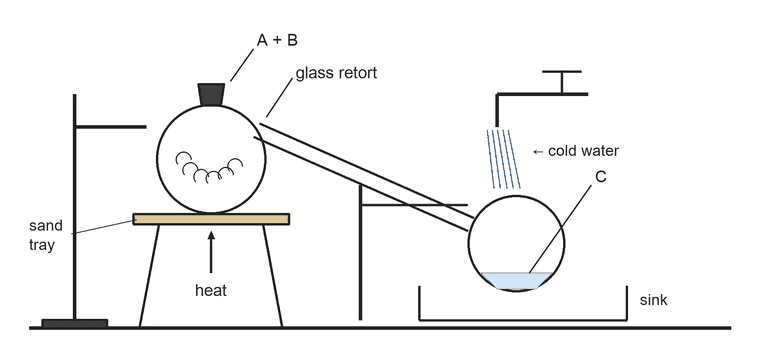
The figure given below illustrates the apparatus used in the laboratory preparation of nitric acid.
Question 485 marksEasy
The figure given below illustrates the apparatus used in the laboratory preparation of nitric acid.
(a) Name A (a liquid), B (a solid) and C (a liquid). (Do not give the formulae).
(b) Write an equation to show how nitric acid undergoes decomposition.
(c) Write the equation for the reaction in which copper is oxidized by concentrated nitric acid.
Solution:
Concept: In the laboratory, nitric acid is made by heating potassium nitrate (nitre) with concentrated sulphuric acid in an all-glass retort, below 200 °C. Concentrated sulphuric acid is non-volatile, so it displaces the volatile nitric acid, which distils over and is condensed in a cooled receiver.
Step 1 — (a) Name A, B and C.
The retort holds a liquid and a solid, and the receiver collects the product:
A = concentrated sulphuric acid (the liquid in the retort);
B = potassium nitrate (or sodium nitrate), the solid;
C = nitric acid, the liquid collected in the receiver.
KNO3+H2SO4below 200∘CKHSO4+HNO3
Step 2 — (b) Decomposition of nitric acid.
In light or on heating, nitric acid gives reddish-brown nitrogen dioxide, water and oxygen; the dissolved NO₂ makes the acid yellow:
4HNO3light or heat4NO2+2H2O+O2
Step 3 — (c) Copper oxidised by conc. nitric acid.
Copper is oxidised to copper nitrate and the acid is reduced to NO₂:
Cu+4HNO3→Cu(NO3)2+2H2O+2NO2↑
Watch out: The question asks for names, not formulae, in (a).
Therefore, (a) A is concentrated sulphuric acid, B is potassium nitrate and C is nitric acid; (b) 4HNO₃ → 4NO₂ + 2H₂O + O₂; (c) Cu + 4HNO₃ → Cu(NO₃)₂ + 2H₂O + 2NO₂.