Solution:
Concept: Nitric acid is an oxidising acid. Its nascent oxygen oxidises any hydrogen formed to water, so the acid is reduced to an oxide of nitrogen instead.
Step 1 — (a) How dilute nitric acid differs.
Other dilute acids react with active metals to liberate hydrogen. Dilute nitric acid does not liberate hydrogen: the nascent oxygen it forms oxidises the hydrogen to water, and the acid is reduced to oxides of nitrogen such as NO:
2HNO3→2NO+H2O+3[O]
It even reacts with copper, which other dilute acids do not attack.
Step 2 — (a) The exception.
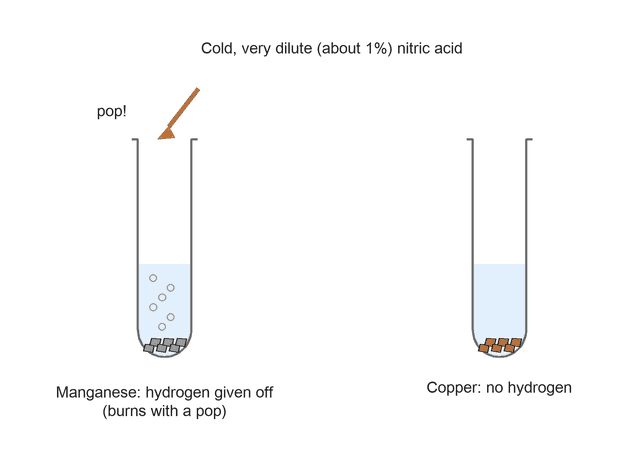
Only very dilute (about 1%) nitric acid gives hydrogen, and only with magnesium and manganese, because its oxidising action is then much weaker:
Mg+2HNO3→Mg(NO3)2+H2↑
Step 3 — (b) Copper with dilute and with concentrated acid.
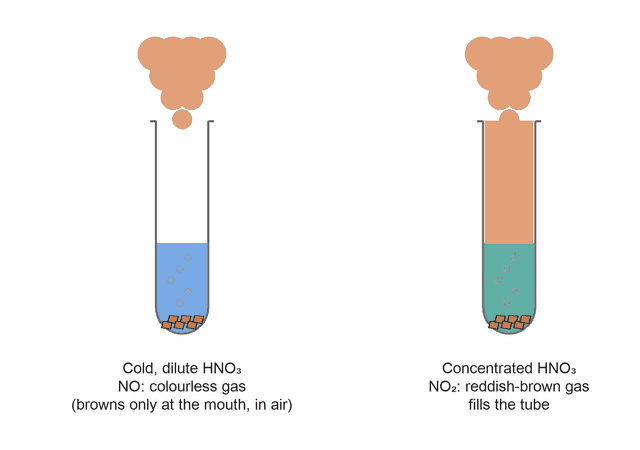
Dilute nitric acid gives colourless nitric oxide:
3Cu+8HNO3→3Cu(NO3)2+4H2O+2NO↑
Concentrated nitric acid gives reddish-brown nitrogen dioxide:
Cu+4HNO3→Cu(NO3)2+2H2O+2NO2↑
Therefore, (a) dilute nitric acid does not liberate hydrogen with metals (except very dilute acid with Mg and Mn) because it is an oxidising agent; (b) 3Cu + 8HNO₃ (dil.) → 3Cu(NO₃)₂ + 4H₂O + 2NO and Cu + 4HNO₃ (conc.) → Cu(NO₃)₂ + 2H₂O + 2NO₂.
