Study of Compounds – Nitric Acid · Question 46 of 49
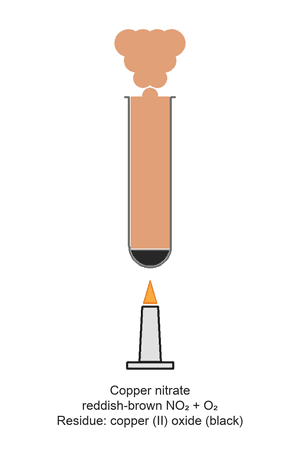
The action of heat on the blue crystalline solid X, gives a reddish brown gas Y, a gas which re-lights a glowing…
Question 465 marksMedium
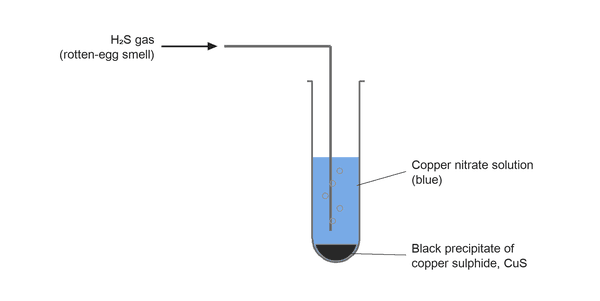
The action of heat on the blue crystalline solid X, gives a reddish brown gas Y, a gas which re-lights a glowing splint and leaves a black residue. When gas Z, which has a rotten egg smell, is passed through a solution of X, a black ppt. is formed.
(a) Identify X, Y and Z.
(b) Write equation for action of heat on X.
(c) Write equation between solution of X and gas Z.
Solution:
Concept: A blue crystalline solid that gives a reddish-brown gas and oxygen on heating and leaves a black residue (CuO) is copper nitrate. A gas with a rotten-egg smell is hydrogen sulphide, which gives a black precipitate of copper sulphide.
Step 1 — (a) Identify X, Y and Z.
Use each clue in turn:
X = copper (II) nitrate, Cu(NO₃)₂: blue crystals that leave black copper (II) oxide.
Y = nitrogen dioxide, NO₂: the reddish-brown gas (the gas that re-lights a glowing splint is oxygen).
Z = hydrogen sulphide, H₂S: the gas with a rotten-egg smell.
Step 2 — (b) Action of heat on X.
Copper nitrate decomposes into copper (II) oxide, nitrogen dioxide and oxygen:
2Cu(NO3)2Δ2CuO+4NO2+O2
Step 3 — (c) Solution of X with gas Z.
Hydrogen sulphide gives a black precipitate of copper sulphide with the copper nitrate solution:
Cu(NO3)2+H2S→CuS↓+2HNO3
Watch out: Y is the reddish-brown gas only; oxygen is the second gas, not Y.
Therefore, X is Cu(NO₃)₂, Y is NO₂ and Z is H₂S; 2Cu(NO₃)₂ → 2CuO + 4NO₂ + O₂; Cu(NO₃)₂ + H₂S → CuS + 2HNO₃.