Solution:
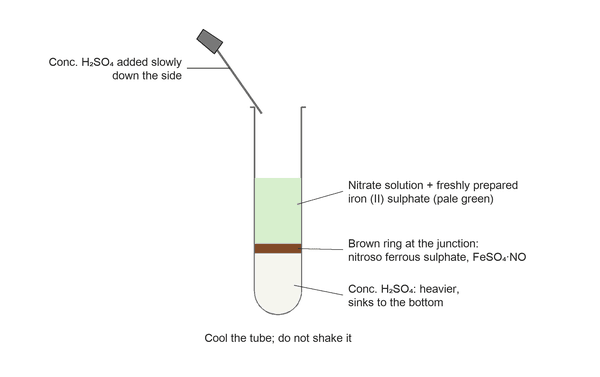
Concept: Each use of nitric acid depends on one of its properties. The brown ring test detects the nitrate ion. Freshly prepared iron (II) sulphate reduces the nitrate (as nitric acid) to nitric oxide, and then joins with the nitric oxide to form the brown compound nitroso ferrous sulphate, FeSO₄·NO, at the junction with the conc. sulphuric acid layer.
Step 1 — (a) Three uses and the property involved.
The table matches each use with the property it relies on:
| Use | Property involved |
|---|
| Etching designs on copper and brassware | It is a solvent for most metals |
| Purification of gold (removing Cu, Ag, Zn, Pb impurities) | It dissolves the impurity metals but not gold |
| Manufacture of fertilisers such as ammonium nitrate | Its acidic nature (it neutralises ammonia) |
Step 2 — (b) Set up the brown ring test.
Add freshly prepared saturated iron (II) sulphate solution to the nitrate solution (or dilute nitric acid). Then pour conc. sulphuric acid slowly down the side of the tube. Being heavier, it forms a separate layer at the bottom. Keep the tube cool.
Step 3 — (b) The reactions.
Iron (II) sulphate reduces the nitric acid to nitric oxide:
6FeSO4+3H2SO4+2HNO3→3Fe2(SO4)3+4H2O+2NO
The nitric oxide joins with more iron (II) sulphate to give the brown compound, which appears as a brown ring at the junction of the two layers:
FeSO4+NO→FeSO4⋅NO
Step 4 — (c) Why fresh ferrous sulphate.
On exposure to air, ferrous sulphate solution is oxidised to ferric sulphate. Ferric sulphate cannot reduce the nitrate to NO and does not form the brown ring, so the test would fail.
Watch out: Do not shake the tube: the brown compound forms only at the junction of the layers.
Therefore, (a) etching (solvent action), purifying gold (dissolves other metals) and making fertilisers (acidic nature); (b) a brown ring of FeSO₄·NO forms at the junction; (c) old FeSO₄ is oxidised to Fe₂(SO₄)₃, which does not give the test.
