Study of Compounds – Nitric Acid · Question 5 of 49
(a) Write a balanced chemical equation for the laboratory preparation of nitric acid.
Question 55 marksMedium
(a) Write a balanced chemical equation for the laboratory preparation of nitric acid.
(b) In the preparation of nitric acid from KNO3, concentrated hydrochloric acid is not used in place of concentrated sulphuric acid. Explain why ?
(c) Conc. nitric acid prepared in laboratory is yellow in colour. Why ? How is this colour removed ?
(d) Give reasons for the following :
In the laboratory preparation of nitric acid, the mixture of concentrated sulphuric acid and sodium nitrate should not be heated very strongly above 200°C.
Solution:
Concept: In the laboratory, nitric acid is made by heating potassium nitrate (nitre) with concentrated sulphuric acid in an all-glass retort, below 200 °C. Concentrated sulphuric acid is non-volatile, so it displaces the volatile nitric acid, which distils over and is condensed in a cooled receiver.
Step 1 — (a) Equation for the laboratory preparation.
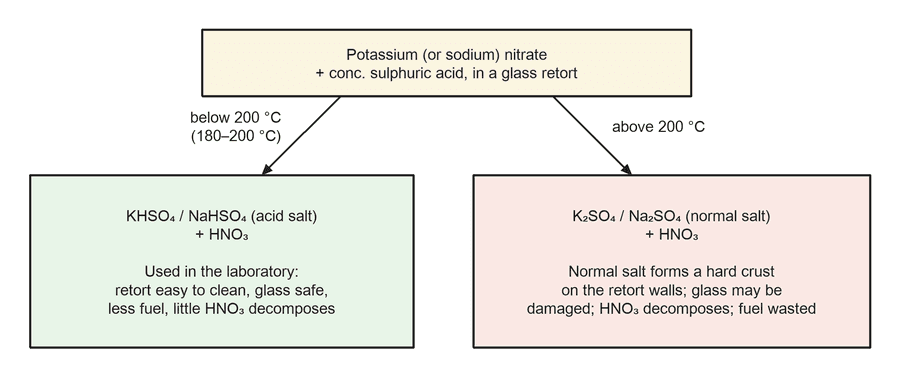
Equal weights of potassium nitrate and conc. sulphuric acid are heated gently (180–200 °C) in an all-glass retort. Potassium hydrogen sulphate and nitric acid form:
KNO3+H2SO4below 200∘CKHSO4+HNO3
Step 2 — (b) Why not conc. hydrochloric acid.
Hydrochloric acid is itself volatile. On heating, its vapours would distil over together with the nitric acid vapours, so the nitric acid collected would be impure. Conc. sulphuric acid is non-volatile, so only nitric acid distils over.
Step 3 — (c) Why the acid is yellow.
During the distillation, a portion of the nitric acid decomposes on heating. The reddish-brown nitrogen dioxide formed dissolves in the acid and makes it yellow:
4HNO3light or heat4NO2+2H2O+O2
Step 4 — (c) How the colour is removed.
The dissolved NO₂ is removed in either of two ways:
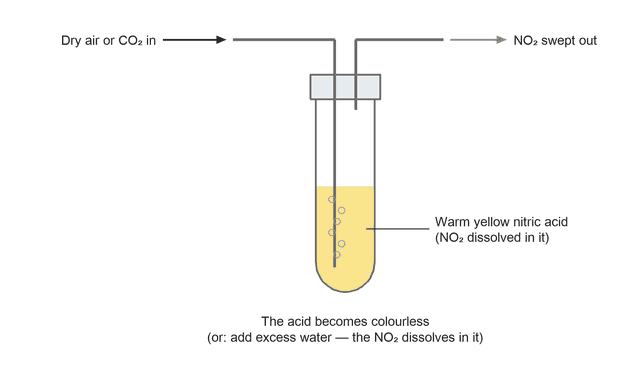
Bubble dry air or carbon dioxide through the warm yellow acid. The gas sweeps out the NO₂, and the acid becomes colourless.
Add excess water. The nitrogen dioxide dissolves in the water and turns back into nitric acid.
Step 5 — (d) Why not above 200 °C.
At a higher temperature the acid salt reacts further and the normal salt, sodium sulphate, forms:
2NaNO3+H2SO4above 200∘CNa2SO4+2HNO3
The sodium sulphate forms a hard crust that sticks to the walls of the retort and is difficult to remove.
The high temperature may damage the glass retort.
More of the nitric acid decomposes, and fuel is wasted.
Watch out: The reaction below 200 °C gives the acid salt (KHSO₄ or NaHSO₄), not the normal salt.
Therefore, (a) KNO₃ + H₂SO₄ → KHSO₄ + HNO₃ (below 200 °C); (b) HCl is volatile and would make the nitric acid impure; (c) dissolved NO₂ from decomposition makes it yellow, removed by bubbling dry air or CO₂ through the warm acid (or adding water); (d) above 200 °C a hard crust of Na₂SO₄ forms, the glass may crack, the acid decomposes and fuel is wasted.