
Question 141 markMCQEasy
The chemical used in the brown ring test is :
Confirming your payment
Sign up now and get 250 free tokens.
Study of Compounds – Nitric Acid · Question 14 of 49
The chemical used in the brown ring test is :
(A)
(B)
(C)
(D)
Answer: (B)
Concept: The brown ring test detects the nitrate ion. Freshly prepared iron (II) sulphate reduces the nitrate (as nitric acid) to nitric oxide, and then joins with the nitric oxide to form the brown compound nitroso ferrous sulphate, FeSO₄·NO, at the junction with the conc. sulphuric acid layer.
Step 1 — Reduce the nitrate.
Iron (II) sulphate, in the presence of conc. sulphuric acid, reduces the nitric acid to nitric oxide and is itself oxidised to iron (III) sulphate:
Step 2 — Form the brown ring.
More iron (II) sulphate joins with the nitric oxide to give the brown compound:
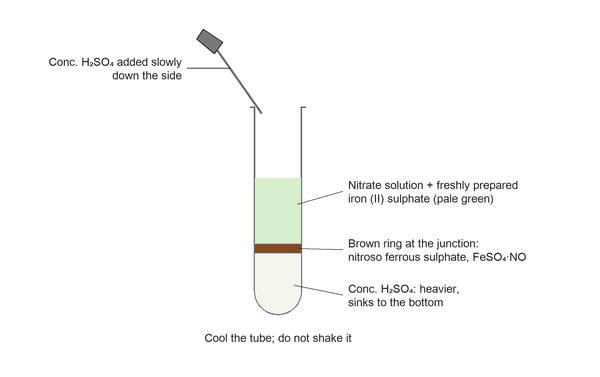
Watch out: The solution must be freshly prepared; old FeSO₄ solution is oxidised by air to Fe₂(SO₄)₃ and fails.
Why the other options are wrong:
Therefore, the chemical used in the brown ring test is FeSO₄, option (B).