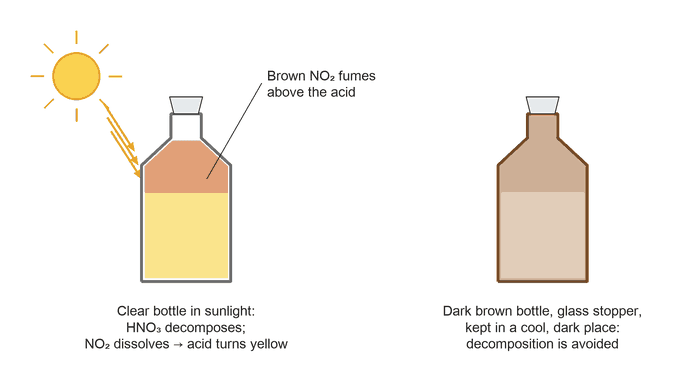
(d) Nitric acid remains colourless even when exposed to light.
(e) Magnesium reacts with nitric acid to liberate hydrogen gas.
Solution:
Concept: Each statement is wrong as printed. For each, write the corrected statement and give the reason.
Step 1 — (a) Oxidising, not reducing.
HNO3 is a strong oxidising agent. It readily gives nascent oxygen, which oxidises metals and non-metals:
2HNO3→2NO2+H2O+[O]
Step 2 — (b) Sodium nitrate gives no NO₂.
NaNO3 gives sodium nitrite and oxygen on heating. Sodium and potassium nitrates give only oxygen:
2NaNO3Δ2NaNO2+O2↑
Step 3 — (c) The constant boiling mixture is 68%.
Constant boiling nitric acid contains 68% nitric acid by weight, and it boils at about 121 °C.
Step 4 — (d) The acid turns yellow in light.
Nitric acid turns yellow when exposed to light. It decomposes, and the nitrogen dioxide formed dissolves in it:
4HNO3light or heat4NO2+2H2O+O2
Step 5 — (e) Hydrogen only with very dilute acid.
Magnesium liberates hydrogen only with very dilute (about 1%) nitric acid. At this dilution the oxidising action of the acid is so weak that the hydrogen is not oxidised to water:
Mg+2HNO3→Mg(NO3)2+H2↑
Watch out: In (e), ordinary dilute nitric acid does not give hydrogen even with magnesium.
Therefore, (a) HNO₃ is a strong oxidising agent; (b) NaNO₃ gives NaNO₂ and O₂ on heating; (c) constant boiling nitric acid contains 68% HNO₃; (d) nitric acid turns yellow in light; (e) magnesium liberates hydrogen only with very dilute (1%) nitric acid.