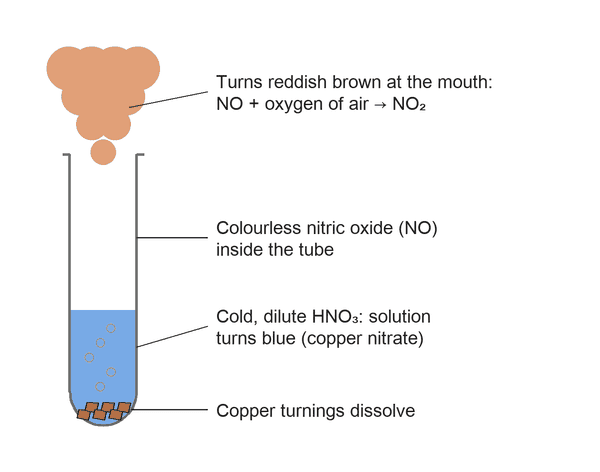
(i) Cold, dilute nitric acid reacts with copper to give ...............
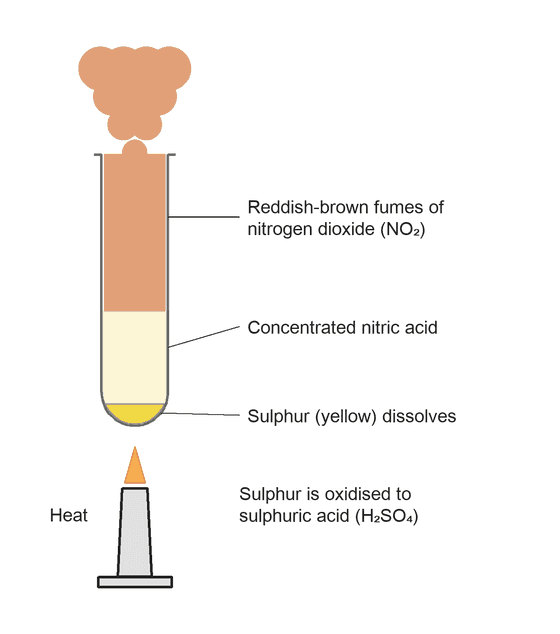
(ii) Hot, concentrated nitric acid reacts with sulphur to form ...............
Solution:
Concept: Nitric acid is an oxidising agent. With copper, cold, dilute acid is reduced to nitric oxide (NO), while concentrated acid is reduced to nitrogen dioxide (NO₂). With a non-metal such as sulphur, hot concentrated acid oxidises it to its highest oxyacid, sulphuric acid.
Step 1 — (i) Copper with cold, dilute nitric acid.
Cold, dilute nitric acid oxidises copper to copper nitrate and is reduced to nitric oxide, so the blank is nitric oxide.
3Cu+8HNO3(dil.)→3Cu(NO3)2+4H2O+2NO↑
Nitrogen dioxide does not fit here, because it is the gas given by concentrated nitric acid with copper.
Step 2 — (ii) Sulphur with hot, concentrated nitric acid.
Hot, concentrated nitric acid oxidises sulphur to sulphuric acid and is reduced to nitrogen dioxide, so the blank is sulphuric acid.
S+6HNO3(conc.)ΔH2SO4+2H2O+6NO2↑
Sulphur dioxide does not fit, because nitric acid is a strong enough oxidising agent to take sulphur past the +4 state of SO₂ to the +6 state of H₂SO₄.
Watch out: The gas from copper depends on the concentration of the acid (dilute → NO, concentrated → NO₂).
Therefore, (i) cold, dilute nitric acid reacts with copper to give nitric oxide; (ii) hot, concentrated nitric acid reacts with sulphur to form sulphuric acid.