
Opening your dashboard
Class 10 Chemistry Chapter 10 Study of Compounds – Nitric Acid: Previous Year Questions
29 questions on Chapter 10, each solved step by step. Class 10 Chemistry, ICSE 2026-27.
29 questions with solutions
1–5 marks · Mixed difficulty
- 11 mark
Question 1
Write balanced chemical equations for each of the following:
Action of hot and concentrated Nitric acid on copper.
Solve with AIWritten solution
Solution:
Concept: Copper lies below hydrogen in the activity series, so it cannot set hydrogen free from an acid. Concentrated nitric acid still attacks it, because the acid is a strong oxidising agent: it oxidises copper to copper nitrate and is itself reduced to nitrogen dioxide, NO₂, a reddish-brown gas.
Step 1 — Decide the products.
Hot, concentrated nitric acid oxidises copper to copper nitrate. The acid is reduced to nitrogen dioxide, and water is also formed.
Step 2 — Write the balanced equation.
One copper atom needs four molecules of the acid: two of them supply the nitrate ions of copper nitrate and two are reduced to nitrogen dioxide.
Step 3 — Check that the equation is balanced.
We count each kind of atom on both sides of the copper–nitric acid equation; every count must be the same on the left and the right.
Atom Left side Right side Cu 1 1 N 4 4 H 4 4 O 12 12 Step 4 — Note what is seen.
Reddish-brown fumes of nitrogen dioxide are given off, the copper dissolves and the solution turns greenish blue (copper nitrate).
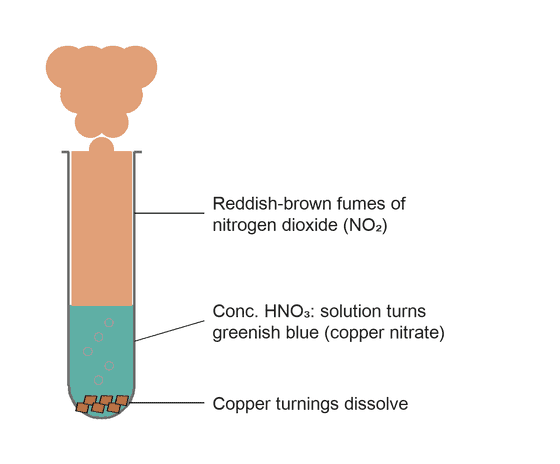
Watch out: Cold, dilute nitric acid gives NO with copper and concentrated acid gives NO₂; neither gives hydrogen, so never write H₂ as a product of copper and nitric acid.
Therefore, Cu + 4HNO₃ (conc.) → Cu(NO₃)₂ + 2H₂O + 2NO₂↑ (reddish-brown NO₂ is given off).
- 22 marks
Question 2
Fill in the blanks using the appropriate words given below:
(Sulphur dioxide, Nitrogen dioxide, Nitric oxide, Sulphuric acid)
(i) Cold, dilute nitric acid reacts with copper to give ...............
(ii) Hot, concentrated nitric acid reacts with sulphur to form ...............
Solve with AIWritten solution
Solution:
Concept: Nitric acid is an oxidising agent. With copper, cold, dilute acid is reduced to nitric oxide (NO), while concentrated acid is reduced to nitrogen dioxide (NO₂). With a non-metal such as sulphur, hot concentrated acid oxidises it to its highest oxyacid, sulphuric acid.
Step 1 — (i) Copper with cold, dilute nitric acid.
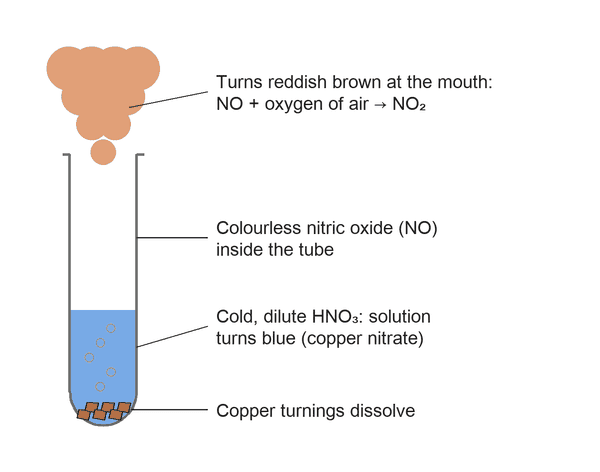
Cold, dilute nitric acid oxidises copper to copper nitrate and is reduced to nitric oxide, so the blank is nitric oxide.
Nitrogen dioxide does not fit here, because it is the gas given by concentrated nitric acid with copper.
Step 2 — (ii) Sulphur with hot, concentrated nitric acid.
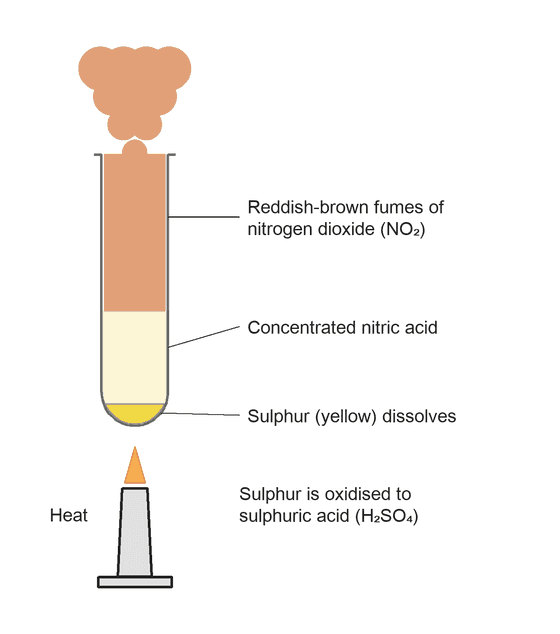
Hot, concentrated nitric acid oxidises sulphur to sulphuric acid and is reduced to nitrogen dioxide, so the blank is sulphuric acid.
Sulphur dioxide does not fit, because nitric acid is a strong enough oxidising agent to take sulphur past the +4 state of SO₂ to the +6 state of H₂SO₄.
Watch out: The gas from copper depends on the concentration of the acid (dilute → NO, concentrated → NO₂).
Therefore, (i) cold, dilute nitric acid reacts with copper to give nitric oxide; (ii) hot, concentrated nitric acid reacts with sulphur to form sulphuric acid.
- 31 mark
Question 3
Write a balanced chemical equation for each of the following:
Action of cold and dilute Nitric acid on Copper.
Solve with AIWritten solution
Solution:
Concept: Nitric acid is an oxidising acid, and the gas it gives with copper depends on its concentration. Cold, dilute nitric acid is reduced only as far as nitric oxide, NO (a colourless gas), while concentrated nitric acid is reduced to nitrogen dioxide, NO₂.
Step 1 — Decide the products.
Cold, dilute nitric acid oxidises copper to copper nitrate and is itself reduced to nitric oxide; water is also formed.
Step 2 — Write the balanced equation.
Three copper atoms react with eight molecules of the acid: six of them become the nitrate ions of three copper nitrate units and two are reduced to nitric oxide.
Step 3 — Check that the equation is balanced.
We count each kind of atom on both sides of the copper–dilute nitric acid equation; every count must be the same on the left and the right.
Atom Left side Right side Cu 3 3 N 8 8 H 8 8 O 24 24 Step 4 — Note what is seen.
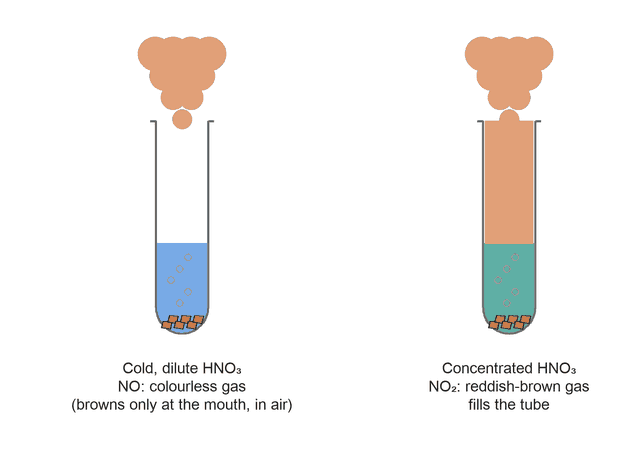
The copper dissolves, the solution turns blue, and a colourless gas (NO) is given off. At the mouth of the tube it meets the oxygen of the air and turns reddish brown (NO₂).
Watch out: Cold, dilute nitric acid gives NO with copper and concentrated acid gives NO₂; neither gives hydrogen, so never write H₂ as a product of copper and nitric acid.
Therefore, 3Cu + 8HNO₃ (dil.) → 3Cu(NO₃)₂ + 4H₂O + 2NO↑.
- 44 marks
Question 4
Give a balanced chemical equation for each of the following:
(i) Action of conc. Nitric acid on Sulphur.
(ii) Catalytic oxidation of Ammonia.
(iii) Laboratory preparation of Nitric acid.
(iv) Reaction of Ammonia with Nitric acid.
Solve with AIWritten solution
Solution:
Concept: Nitric acid shows three kinds of behaviour in this question: as an oxidising agent (with sulphur), in its manufacture (catalytic oxidation of ammonia) and laboratory preparation, and as an acid (neutralised by the base ammonia). Each equation is written with its conditions and checked atom by atom.
Step 1 — (i) Conc. nitric acid on sulphur.
Hot, concentrated nitric acid oxidises sulphur to sulphuric acid and is reduced to nitrogen dioxide.
Atom Left side Right side S 1 1 N 6 6 H 6 6 O 18 18 Step 2 — (ii) Catalytic oxidation of ammonia.
This is the first step of the Ostwald process. Dry ammonia mixed with dust-free air (1 : 10 by volume) is passed over a platinum gauze catalyst at about 800 °C. The reaction gives out heat, which keeps the catalyst hot.
Atom Left side Right side N 4 4 H 12 12 O 10 10 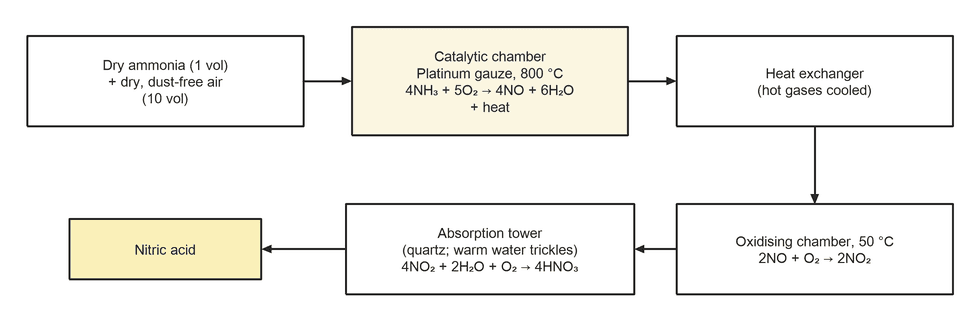
Step 3 — (iii) Laboratory preparation of nitric acid.
Potassium nitrate is heated gently with concentrated sulphuric acid in an all-glass retort, below 200 °C. The non-volatile sulphuric acid displaces the volatile nitric acid, whose vapours are condensed in a receiver cooled by water.
Atom Left side Right side K 1 1 S 1 1 N 1 1 H 2 2 O 7 7 
Step 4 — (iv) Ammonia with nitric acid.
Ammonia is a base, so nitric acid neutralises it and forms the salt ammonium nitrate (used as a fertiliser). No water is formed, because ammonia simply takes up the H⁺ ion of the acid.
Watch out: In (iii) the temperature is kept below 200 °C, so the product is the acid salt KHSO₄, not K₂SO₄.
Therefore, (i) S + 6HNO₃ → H₂SO₄ + 2H₂O + 6NO₂; (ii) 4NH₃ + 5O₂ → 4NO + 6H₂O (Pt, 800 °C); (iii) KNO₃ + H₂SO₄ → KHSO₄ + HNO₃ (below 200 °C); (iv) NH₃ + HNO₃ → NH₄NO₃.
- 51 mark
Question 5
Name the gas that is produced in each of the following cases:
Sulphur is oxidized by concentrated nitric acid.
Solve with AIWritten solution
Solution:
Concept: Hot, concentrated nitric acid oxidises the non-metal sulphur all the way to sulphuric acid (sulphur goes from oxidation state 0 to +6) and is itself reduced to reddish-brown nitrogen dioxide.
Step 1 — Find what the acid is reduced to.
Concentrated nitric acid gives nascent oxygen and is reduced to nitrogen dioxide; this nascent oxygen oxidises the sulphur.
Step 2 — Write the overall reaction.
Putting the oxidation of sulphur to sulphuric acid together with this reduction of the acid gives the overall equation, which shows the gas formed.
Step 3 — Name the gas.
The gas given off is nitrogen dioxide, seen as reddish-brown fumes. (The sulphur ends up in solution as sulphuric acid, so no sulphur dioxide escapes.)
Watch out: The sulphur is oxidised to sulphuric acid, not to sulphur dioxide; the only gas is NO₂.
Therefore, the gas produced is nitrogen dioxide (NO₂).
- 61 mark
Question 6
Name the gas that is produced in each of the following cases:
Action of cold and dilute nitric acid on copper.
Solve with AIWritten solution
Solution:
Concept: Nitric acid is an oxidising acid, and the gas it gives with copper depends on its concentration. Cold, dilute nitric acid is reduced only as far as nitric oxide, NO (a colourless gas), while concentrated nitric acid is reduced to nitrogen dioxide, NO₂.
Step 1 — Write the reaction.
Cold, dilute nitric acid oxidises copper to copper nitrate and is reduced to nitric oxide.
Step 2 — Name the gas.
The gas produced is nitric oxide (nitrogen monoxide), NO. It is colourless, but at the mouth of the tube it combines with the oxygen of the air and turns reddish brown.
Watch out: The brown colour at the mouth comes from NO₂ formed in the air; the gas the reaction produces is NO.
Therefore, the gas produced is nitric oxide (NO).
- 72 marks
Question 7
(i) What is the type of salt formed when the reactants are heated at a suitable temperature for the preparation of Nitric acid?
(ii) State why for the preparation of Nitric acid, the complete apparatus is made up of glass.
Solve with AIWritten solution
Solution:
Concept: Sulphuric acid has two replaceable hydrogen atoms. At the temperature used in the laboratory (below 200 °C) the metal of the nitrate replaces only one of them, so an acid salt is left in the retort. Nitric acid vapours are highly corrosive and attack rubber and cork.
Step 1 — (i) Find the salt formed.
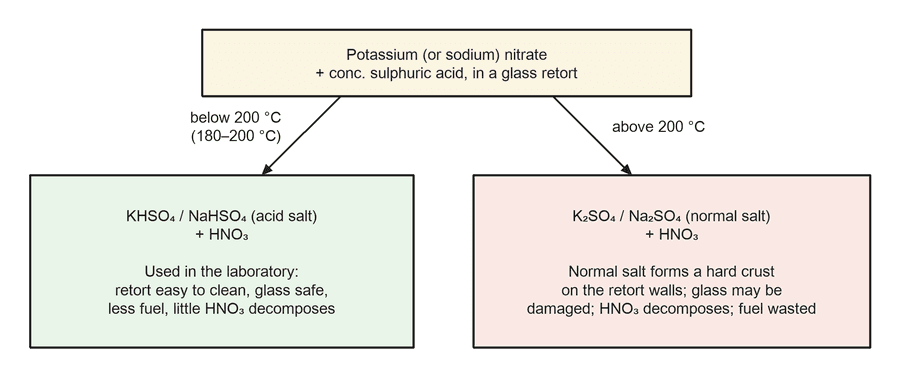
Heated gently with concentrated sulphuric acid below 200 °C, potassium nitrate gives nitric acid and potassium hydrogen sulphate (potassium bisulphate), KHSO₄.
KHSO₄ still contains a replaceable hydrogen atom, so it is an acid salt (with sodium nitrate the acid salt is NaHSO₄). Above 200 °C the normal salt K₂SO₄ would form, which is avoided.
Step 2 — (ii) Explain the all-glass apparatus.
Nitric acid vapours are highly corrosive: they attack rubber and cork, which would be eaten away and would also spoil the acid. Glass is not attacked, so the retort has a glass stopper and its neck fits straight into the receiver, with no cork or rubber joints.
Watch out: The question asks for the TYPE of salt: answer 'acid salt', and name KHSO₄ as the example.
Therefore, (i) an acid salt (KHSO₄, or NaHSO₄ from sodium nitrate) is formed; (ii) the apparatus is all glass because nitric acid vapours attack rubber and cork, but not glass.
- 81 mark
Question 8
State one observation for each of the following:
Concentrated nitric acid is reacted with sulphur.
Solve with AIWritten solution
Solution:
Concept: Hot, concentrated nitric acid oxidises the non-metal sulphur all the way to sulphuric acid (sulphur goes from oxidation state 0 to +6) and is itself reduced to reddish-brown nitrogen dioxide.
Step 1 — Write the reaction.
Concentrated nitric acid is warmed with sulphur; the sulphur is oxidised to sulphuric acid and the acid is reduced to nitrogen dioxide.
Step 2 — State what is seen.
Reddish-brown fumes of nitrogen dioxide are given off, and the yellow sulphur slowly dissolves as it is oxidised to sulphuric acid.
Watch out: Write what you SEE (reddish-brown fumes), not only the name of the gas.
Therefore, reddish-brown fumes of nitrogen dioxide are given off (and the yellow sulphur dissolves).
- 93 marks
Question 9
Complete the following equations:
(i)
(ii)
(iii)
Solve with AIWritten solution
Solution:
Concept: Concentrated nitric acid and hot concentrated sulphuric acid are oxidising acids: they oxidise non-metals (sulphur, carbon) and are themselves reduced, nitric acid to an oxide of nitrogen and sulphuric acid to sulphur dioxide. Dilute nitric acid with copper gives nitric oxide.
Step 1 — (i) Sulphur with concentrated nitric acid.
Sulphur is oxidised to sulphuric acid and the acid is reduced to nitrogen dioxide.
Atom Left side Right side S 1 1 N 6 6 H 6 6 O 18 18 Step 2 — (ii) Carbon with concentrated sulphuric acid.
Hot, concentrated sulphuric acid oxidises carbon to carbon dioxide and is reduced to sulphur dioxide; water is also formed.
Atom Left side Right side C 1 1 S 2 2 H 4 4 O 8 8 Step 3 — (iii) Copper with dilute nitric acid.
Copper is oxidised to copper nitrate and the dilute acid is reduced to nitric oxide.
Atom Left side Right side Cu 3 3 N 8 8 H 8 8 O 24 24 Watch out: In (ii) the acid is sulphuric acid, so its reduced product is SO₂ (not NO₂); in (iii) the acid is dilute, so the gas is NO (not NO₂).
Therefore, (i) S + 6HNO₃ → H₂SO₄ + 2H₂O + 6NO₂; (ii) C + 2H₂SO₄ → CO₂ + 2SO₂ + 2H₂O; (iii) 3Cu + 8HNO₃ → 3Cu(NO₃)₂ + 4H₂O + 2NO.
- 103 marks
Question 10
Identify the substances underlined :
(i) The catalyst used to oxidise ammonia.
(ii) The organic compound which when solidified, forms an ice like mass.
(iii) The dilute acid which is an oxidizing agent.
Solve with AIWritten solution
Solution:
Concept: Each clue points to one substance: the catalyst of the Ostwald process, the organic acid that freezes into an ice-like solid, and the one common dilute acid that acts as an oxidising agent instead of giving hydrogen with metals.
Step 1 — (i) The catalyst used to oxidise ammonia.
In the Ostwald process, ammonia is oxidised by air over platinum (platinum gauze) at about 800 °C.
Step 2 — (ii) The organic compound that forms an ice-like mass.
Pure (anhydrous) acetic acid, glacial acetic acid (ethanoic acid, CH₃COOH), freezes at about 17 °C (16.6 °C) into a colourless, ice-like crystalline mass; this is why it is called 'glacial'.
Step 3 — (iii) The dilute acid which is an oxidising agent.
Dilute nitric acid oxidises metals such as copper and is itself reduced to nitric oxide. Dilute hydrochloric and sulphuric acids do not do this; they give hydrogen with active metals.
Watch out: The dilute acid in (iii) is nitric acid; dilute sulphuric acid is not an oxidising agent (only the hot, concentrated acid is).
Therefore, (i) platinum; (ii) glacial acetic acid (ethanoic acid); (iii) dilute nitric acid.
- 111 mark
Question 11
State one relevant observation for each of the following reactions:
(i) Action of concentrated nitric acid on copper.
Solve with AIWritten solution
Solution:
Concept: Copper lies below hydrogen in the activity series, so it cannot set hydrogen free from an acid. Concentrated nitric acid still attacks it, because the acid is a strong oxidising agent: it oxidises copper to copper nitrate and is itself reduced to nitrogen dioxide, NO₂, a reddish-brown gas.
Step 1 — Write the reaction.
Concentrated nitric acid oxidises copper to copper nitrate and is reduced to nitrogen dioxide.
Step 2 — State what is seen.
Reddish-brown fumes of nitrogen dioxide are given off, the copper dissolves, and the solution turns greenish blue (copper nitrate).
Watch out: With concentrated acid the fumes are brown inside the tube itself; with cold, dilute acid the gas (NO) is colourless and turns brown only at the mouth.
Therefore, reddish-brown fumes of nitrogen dioxide are given off and the copper dissolves to form a greenish-blue solution.
- 121 mark
Question 12
Write a balanced chemical equation for each of the following:
(i) Reaction of carbon powder and concentrated nitric acid.
Solve with AIWritten solution
Solution:
Concept: Concentrated nitric acid oxidises the non-metal carbon to carbon dioxide and is itself reduced to nitrogen dioxide. The mixture is heated.
Step 1 — Decide the products.
Carbon is oxidised to carbon dioxide; the acid is reduced to nitrogen dioxide; water is also formed.
Step 2 — Write the balanced equation.
One carbon atom (oxidation state 0 → +4) needs four molecules of the acid, each of which is reduced to one NO₂ (nitrogen +5 → +4).
Step 3 — Check that the equation is balanced.
We count each kind of atom on both sides of the carbon–nitric acid equation; every count must be the same on the left and the right.
Atom Left side Right side C 1 1 N 4 4 H 4 4 O 12 12 Step 4 — Note what is seen.
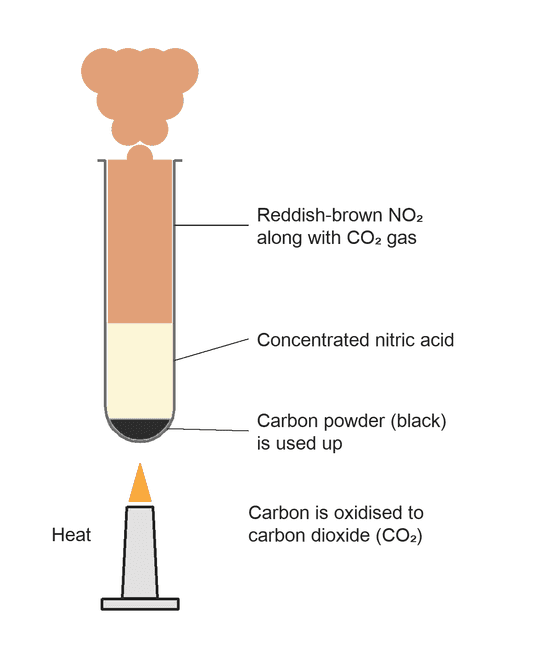
Reddish-brown fumes of NO₂ come off, mixed with colourless carbon dioxide, and the black carbon is used up.
Watch out: Carbon gives CO₂ here, not CO; nitric acid is a strong enough oxidising agent to oxidise it fully.
Therefore, C + 4HNO₃ (conc.) → CO₂ + 2H₂O + 4NO₂ (on heating).
- 131 mark
Question 13
State one relevant reason for each of the following:
(iv) Concentrated nitric acid appears yellow, when it is left for a while in a glass bottle.
Solve with AIWritten solution
Solution:
Concept: Nitric acid is unstable: in light, or on heating, part of it decomposes into nitrogen dioxide, water and oxygen. The reddish-brown NO₂ dissolves in the remaining acid and makes it yellow.
Step 1 — Find what happens on standing.
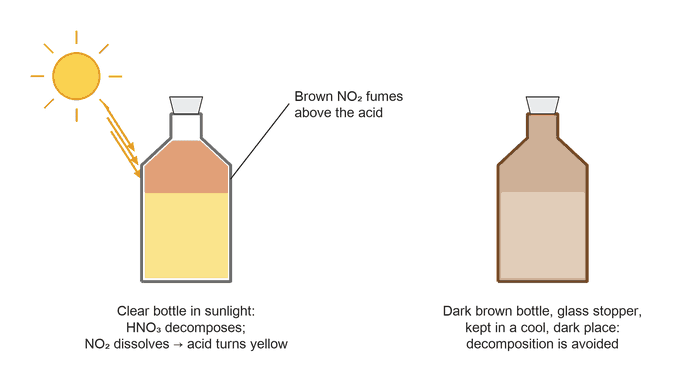
In light (even at room temperature), a small part of the concentrated nitric acid decomposes into nitrogen dioxide, water and oxygen.
Step 2 — Explain the colour.
The reddish-brown nitrogen dioxide dissolves in the acid, and a little of this brown gas in the colourless acid makes it look yellow. This is why nitric acid is stored in dark brown bottles, away from light.
Watch out: Pure nitric acid is colourless; the yellow colour is not an impurity from the bottle but NO₂ from the acid's own decomposition.
Therefore, the acid turns yellow because it decomposes in light to nitrogen dioxide, which dissolves in the acid.
- 143 marks
Question 14
Identify the acid in each case:
(a) The acid formed when sulphur reacts with concentrated nitric acid.
(b) An acid, which on adding to lead nitrate solution produces a white precipitate which is soluble on heating.
(c) The acid formed when potassium nitrate reacts with a least volatile acid.
Solve with AIWritten solution
Solution:
Concept: Each acid is named from what it does: the acid formed when sulphur is oxidised by nitric acid, the acid whose lead salt is a white precipitate that dissolves in hot water, and the volatile acid driven out of a nitrate by the least volatile acid (concentrated sulphuric acid).
Step 1 — (a) The acid formed from sulphur.
Concentrated nitric acid oxidises sulphur to sulphuric acid, H₂SO₄.
Step 2 — (b) The acid that gives a white precipitate soluble on heating.
Hydrochloric acid, HCl, added to lead nitrate solution gives a white precipitate of lead chloride. Lead chloride is only slightly soluble in cold water but dissolves in hot water, so the precipitate disappears on heating.
Sulphuric acid would also give a white precipitate (lead sulphate), but lead sulphate does not dissolve on heating, so it does not fit.
Step 3 — (c) The acid formed from potassium nitrate.
The least volatile acid is concentrated sulphuric acid. Heated with potassium nitrate, it displaces the volatile nitric acid, HNO₃, which distils over.
Watch out: In (b), lead sulphate and lead chloride are both white; only lead chloride dissolves in hot water.
Therefore, (a) sulphuric acid (H₂SO₄); (b) hydrochloric acid (HCl); (c) nitric acid (HNO₃).
- 151 mark
Question 15
The salt formed when concentrated sulphuric acid reacts with above :
Solve with AIAnswer
- Correct
(A)
(B)
(C)
(D)
Answer: (A)
Concept: Sulphuric acid has two replaceable hydrogen atoms. Below 200 °C potassium replaces only one of them (the acid salt KHSO₄); above 200 °C the acid salt reacts with more nitrate and both hydrogens are replaced, giving the normal salt, potassium sulphate.
Step 1 — Write the reaction below 200 °C.
This is the laboratory method, which stops at the acid salt.
Step 2 — Write the reaction above 200 °C.
At the higher temperature the potassium hydrogen sulphate reacts with more potassium nitrate and gives the normal salt.
Adding the two steps gives the overall reaction above 200 °C:
Step 3 — Name the salt.
The salt formed above 200 °C is potassium sulphate, K₂SO₄, which is option (A). This hard salt sticks to the retort, which is why the laboratory temperature is kept below 200 °C.
Watch out: KHSO₄ is the answer for 'below 200 °C'; read the temperature in the stem.
Why the other options are wrong:
- (B) : K₂SO₃ is potassium sulphite. This is not a redox reaction: sulphur stays at +6 throughout, so a sulphite (sulphur at +4) cannot form.
- (C) : KHSO₄ is the acid salt formed below 200 °C, not above it.
- (D) : KHSO₃ is potassium hydrogen sulphite, a salt of sulphurous acid; it is not formed from sulphuric acid here.
Therefore, the salt formed above 200 °C is K₂SO₄, option (A).
- 161 mark
Question 16
Complete and balance the following equations:
(c) + Conc.
Solve with AIWritten solution
Solution:
Concept: Copper lies below hydrogen in the activity series, so it cannot set hydrogen free from an acid. Concentrated nitric acid still attacks it, because the acid is a strong oxidising agent: it oxidises copper to copper nitrate and is itself reduced to nitrogen dioxide, NO₂, a reddish-brown gas.
Step 1 — Complete the products.
Copper is oxidised to copper nitrate; the concentrated acid is reduced to nitrogen dioxide; water is also formed.
Step 2 — Balance the equation.
One copper atom needs four molecules of the acid: two give the nitrate ions of Cu(NO₃)₂ and two are reduced to NO₂.
Step 3 — Check that the equation is balanced.
We count each kind of atom on both sides of the completed equation; every count must be the same on the left and the right.
Atom Left side Right side Cu 1 1 N 4 4 H 4 4 O 12 12 Step 4 — Note what is seen.
Reddish-brown fumes of nitrogen dioxide are given off and a greenish-blue solution of copper nitrate forms.
Watch out: Cold, dilute nitric acid gives NO with copper and concentrated acid gives NO₂; neither gives hydrogen, so never write H₂ as a product of copper and nitric acid.
Therefore, Cu + 4HNO₃ (conc.) → Cu(NO₃)₂ + 2H₂O + 2NO₂↑.
- 171 mark
Question 17
Give balanced equation for the following reactions:
(a) Copper reacts with concentrated Nitric acid.
Solve with AIWritten solution
Solution:
Concept: Copper lies below hydrogen in the activity series, so it cannot set hydrogen free from an acid. Concentrated nitric acid still attacks it, because the acid is a strong oxidising agent: it oxidises copper to copper nitrate and is itself reduced to nitrogen dioxide, NO₂, a reddish-brown gas.
Step 1 — Decide the products.
Concentrated nitric acid oxidises copper to copper nitrate and is reduced to nitrogen dioxide; water is also formed.
Step 2 — Write the balanced equation.
Four molecules of the acid are needed for each copper atom: two supply the nitrate ions and two are reduced to NO₂.
Step 3 — Check that the equation is balanced.
We count each kind of atom on both sides of the copper–nitric acid equation; every count must be the same on the left and the right.
Atom Left side Right side Cu 1 1 N 4 4 H 4 4 O 12 12 Step 4 — Note what is seen.
The copper dissolves with reddish-brown fumes of NO₂, and the solution turns greenish blue.
Watch out: Cold, dilute nitric acid gives NO with copper and concentrated acid gives NO₂; neither gives hydrogen, so never write H₂ as a product of copper and nitric acid.
Therefore, Cu + 4HNO₃ (conc.) → Cu(NO₃)₂ + 2H₂O + 2NO₂↑.
- 181 mark
Question 18
Name the gas produced during each of the following reactions:
When copper is treated with hot, concentrated nitric acid.
Solve with AIWritten solution
Solution:
Concept: Copper lies below hydrogen in the activity series, so it cannot set hydrogen free from an acid. Concentrated nitric acid still attacks it, because the acid is a strong oxidising agent: it oxidises copper to copper nitrate and is itself reduced to nitrogen dioxide, NO₂, a reddish-brown gas.
Step 1 — Write the reaction.
Hot, concentrated nitric acid oxidises copper to copper nitrate and is reduced to nitrogen dioxide.
Step 2 — Name the gas.
The gas produced is nitrogen dioxide, NO₂, seen as reddish-brown fumes. (With cold, dilute nitric acid the gas would be nitric oxide, NO, instead.)
Watch out: The acid here is concentrated, so the gas is NO₂, not NO, and never hydrogen.
Therefore, the gas produced is nitrogen dioxide (NO₂).
- 191 mark
Question 19
Give balanced equations for the following:
Oxidation of sulphur with hot concentrated nitric acid.
Solve with AIWritten solution
Solution:
Concept: Hot, concentrated nitric acid oxidises the non-metal sulphur all the way to sulphuric acid (sulphur goes from oxidation state 0 to +6) and is itself reduced to reddish-brown nitrogen dioxide.
Step 1 — Decide the products.
Sulphur is oxidised to sulphuric acid; the acid is reduced to nitrogen dioxide; water is also formed.
Step 2 — Write the balanced equation.
One sulphur atom (0 → +6) loses six electrons, so six molecules of the acid are needed, each reduced to one NO₂ (nitrogen +5 → +4).
Step 3 — Check that the equation is balanced.
We count each kind of atom on both sides of the sulphur–nitric acid equation; every count must be the same on the left and the right.
Atom Left side Right side S 1 1 N 6 6 H 6 6 O 18 18 Step 4 — Note what is seen.
Reddish-brown fumes are given off as the yellow sulphur dissolves.
Watch out: Sulphur is oxidised to H₂SO₄, not to SO₂; with nitric acid as the oxidising agent the gas evolved is NO₂.
Therefore, S + 6HNO₃ (conc.) → H₂SO₄ + 2H₂O + 6NO₂ (on heating).
- 202 marks
Question 20
Seema added a few pieces of copper turnings to a test tube containing concentrated acid P and she noticed that a reddish-brown gas evolved.
(a) Name the acid P used by Seema.
(b) Write a balanced chemical equation for the reaction that took place.
Solve with AIWritten solution
Solution:
Concept: A reddish-brown gas given off by copper and an acid is nitrogen dioxide. Copper lies below hydrogen in the activity series, so only an oxidising acid attacks it; of the common concentrated acids, only nitric acid gives nitrogen dioxide.
Step 1 — (a) Identify the acid P.
Copper gives no gas with dilute hydrochloric or dilute sulphuric acid, and hot concentrated sulphuric acid gives colourless sulphur dioxide. A reddish-brown gas (NO₂) comes only from nitric acid, so P is concentrated nitric acid, HNO₃.
Step 2 — (b) Write the balanced equation.
Concentrated nitric acid oxidises copper to copper nitrate and is reduced to nitrogen dioxide.
Atom Left side Right side Cu 1 1 N 4 4 H 4 4 O 12 12 The copper dissolves as copper nitrate (greenish-blue solution), and the reddish-brown gas that Seema saw is nitrogen dioxide.
Watch out: A reddish-brown gas points to NO₂, which only nitric acid can give here; the brown colour is not chlorine (greenish yellow) or SO₂ (colourless).
Therefore, (a) P is concentrated nitric acid; (b) Cu + 4HNO₃ → Cu(NO₃)₂ + 2H₂O + 2NO₂.
- 211 mark
Question 21
Smith wrote the following statements incorrectly. Insert a word to correct the statements.
Copper reacts with nitric acid to form nitrogen dioxide gas.
Solve with AIWritten solution
Solution:
Concept: The gas given by copper and nitric acid depends on the concentration of the acid: concentrated acid gives nitrogen dioxide, while cold, dilute acid gives nitric oxide.
Step 1 — Find what is missing.
The statement is true only for concentrated nitric acid, so the word concentrated must be inserted before 'nitric acid'.
Step 2 — Check with the equations.
With concentrated acid the gas is nitrogen dioxide:
With cold, dilute acid the gas would be nitric oxide instead:
Watch out: Inserting 'dilute' would make the statement wrong, because dilute acid gives NO, not NO₂.
Therefore, the corrected statement is: Copper reacts with concentrated nitric acid to form nitrogen dioxide gas.
- 224 marks
Question 22
Given below is the diagram for the laboratory preparation of Nitric Acid.
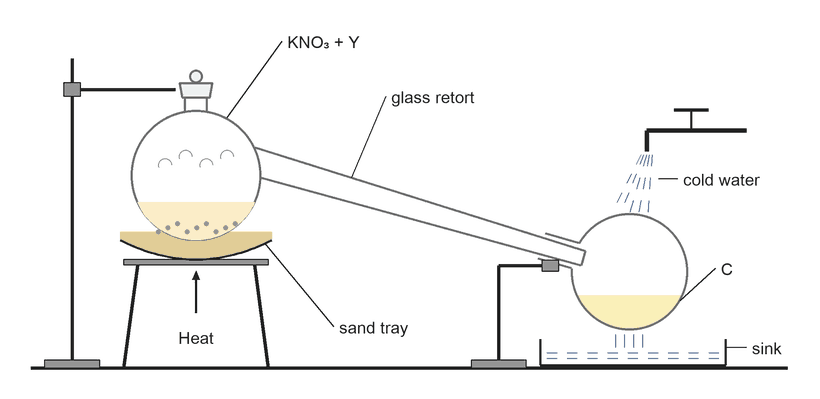
(a) Name the reactant labelled Y.
(b) Write a balanced equation for the reaction between Y and .
(c) The complete apparatus is made up of glass. Why?
(d) State why concentrated appears slightly yellowish in colour when left standing in a glass bottle for a long time.
Solve with AIWritten solution
Solution:
Concept: In the laboratory, nitric acid is made by heating a nitrate (potassium or sodium nitrate, a solid) with concentrated sulphuric acid (a liquid) in an all-glass retort, gently, below 200 °C. Sulphuric acid is non-volatile, so it displaces the volatile nitric acid, which distils over and condenses in a receiver cooled by running water.
Step 1 — (a) Name the reactant Y.
The retort holds potassium nitrate and the non-volatile acid that displaces nitric acid from it, so Y is concentrated sulphuric acid.
Step 2 — (b) Write the balanced equation.
Below 200 °C, concentrated sulphuric acid and potassium nitrate give potassium hydrogen sulphate and nitric acid.
Atom Left side Right side K 1 1 S 1 1 N 1 1 H 2 2 O 7 7 Step 3 — (c) Explain the all-glass apparatus.
Nitric acid vapours are highly corrosive and attack rubber and cork. So the retort has a glass stopper and its neck fits straight into the receiver, with no cork or rubber joints; glass is not attacked by the acid.
Step 4 — (d) Explain the yellowish colour.
On standing, especially in light, a part of the nitric acid decomposes into nitrogen dioxide, water and oxygen.
The reddish-brown nitrogen dioxide dissolves in the acid and gives it a yellowish colour.
Watch out: The reaction is kept below 200 °C, so the salt formed is KHSO₄; writing K₂SO₄ gives the reaction above 200 °C.
Therefore, (a) Y is concentrated sulphuric acid; (b) KNO₃ + H₂SO₄ → KHSO₄ + HNO₃ (below 200 °C); (c) nitric acid vapours attack rubber and cork; (d) the acid decomposes to NO₂, which dissolves in it and makes it yellowish.
- 231 mark
Question 23
Complete the following sentences by choosing the correct option from the brackets:
............... does not give hydrogen gas when it reacts with cold and very dilute nitric acid. [Cu / Mn]
Solve with AIWritten solution
Solution:
Concept: Nitric acid usually gives no hydrogen with metals, because it is an oxidising agent and oxidises any hydrogen formed to water. Very dilute (about 1%) nitric acid is too weak an oxidising agent to do this, so the active metals magnesium and manganese give hydrogen with it.
Step 1 — Look at manganese.
Manganese is above hydrogen in the activity series, so it displaces hydrogen from cold, very dilute nitric acid.
Step 2 — Look at copper.
Copper lies below hydrogen in the activity series, so it cannot set hydrogen free from any acid. Nitric acid oxidises copper to copper nitrate and is itself reduced to an oxide of nitrogen, so no hydrogen is given off.
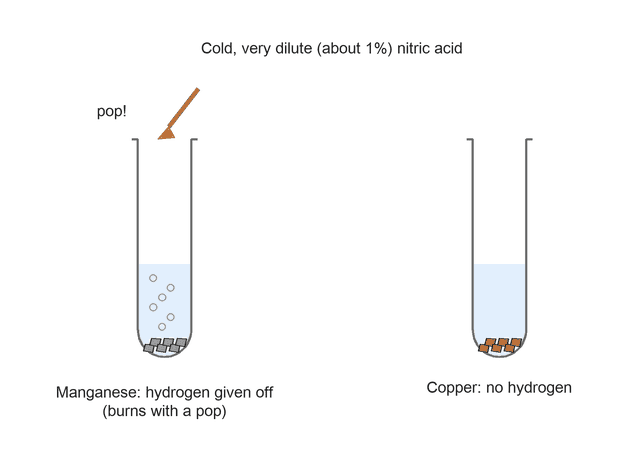
Watch out: The exception to 'nitric acid gives no hydrogen' is only for Mg and Mn with very dilute acid.
Therefore, Cu does not give hydrogen gas when it reacts with cold and very dilute nitric acid.
- 242 marks
Question 24
Study the reaction given below and answer the questions that follow:
(Conc.)
(a) Give one reason for maintaining the temperature below 200°C.
(b) Why is concentrated Sulphuric acid used in the above reaction?
Solve with AIWritten solution
Solution:
Concept: Below 200 °C the reaction stops at the acid salt, sodium hydrogen sulphate, which stays fluid and is easy to remove from the retort. Concentrated sulphuric acid is used because it is non-volatile (high boiling point), so only the volatile nitric acid distils over.
Step 1 — (a) See what happens above 200 °C.
Above 200 °C the acid salt reacts with more sodium nitrate and forms the normal salt, sodium sulphate.
Sodium sulphate forms a hard crust that sticks to the walls of the retort and is difficult to remove. The higher temperature may also crack the glass apparatus, decompose some of the nitric acid and waste fuel. Any one of these is a valid reason.
Step 2 — (b) Explain the use of concentrated sulphuric acid.
Concentrated sulphuric acid has a high boiling point (it is non-volatile). When it is heated with sodium nitrate, it displaces the more volatile nitric acid, which distils over and is condensed, while the sulphuric acid stays behind in the retort. Being concentrated, it also holds very little water, so the nitric acid collected is concentrated.
Watch out: The reason in (b) is that sulphuric acid is NON-volatile (it is not because it is a stronger acid).
Therefore, (a) above 200 °C sodium sulphate forms a hard crust that sticks to the retort (and HNO₃ decomposes, fuel is wasted); (b) conc. H₂SO₄ is non-volatile, so it displaces the volatile nitric acid, which distils over.
- 253 marks
Question 25
Anil is a laboratory assistant in a college. He prepared nitric acid but stored it in a transparent container exposed to sunlight. After a few days, brown fumes were observed in the container and the acid turned slightly yellowish in colour.
(a) What was the error made by Anil while storing the acid?
(b) Why were brown fumes observed in the container?
(c) How can the yellowish tinge in the acid be removed?
Solve with AIWritten solution
Solution:
Concept: Nitric acid decomposes in light (even at room temperature), giving reddish-brown nitrogen dioxide. The nitrogen dioxide that dissolves in the acid makes it yellow, and the yellow colour goes when this dissolved gas is removed.
Step 1 — (a) Find the error.
Anil stored the acid in a transparent container exposed to sunlight. It should be kept in a dark brown glass bottle with a glass stopper, in a cool, dark place.
Step 2 — (b) Explain the brown fumes.
Sunlight decomposed a part of the nitric acid into nitrogen dioxide, water and oxygen.
Nitrogen dioxide is a reddish-brown gas, so it collected above the acid as brown fumes; some of it dissolved in the acid and turned it yellowish.
Step 3 — (c) Remove the yellow tinge.
Bubble dry air or carbon dioxide through the warm acid. The gas stream carries away the dissolved nitrogen dioxide, and the acid becomes colourless.
Another way is to add excess water: the nitrogen dioxide dissolves in the water and the colour disappears, but the acid is then more dilute.
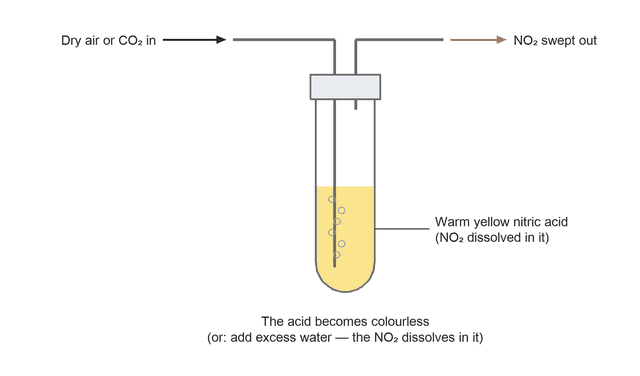
Watch out: A colourless (transparent) bottle is the error, even if it is made of glass; the light must be kept out.
Therefore, (a) the acid was stored in a transparent container in sunlight; (b) light decomposed the acid into reddish-brown NO₂; (c) bubble dry air or CO₂ through the warm acid (or add excess water).
- 262 marks
Question 26
Carbon reacts with an acid to form carbon dioxide, water and nitrogen dioxide.
(a) Name the acid used in the reaction.
(b) Write a balanced chemical equation for the reaction that occurs.
Solve with AIWritten solution
Solution:
Concept: An acid that oxidises carbon to carbon dioxide and gives off nitrogen dioxide must be an oxidising acid whose own reduction gives NO₂, that is, concentrated nitric acid.
Step 1 — (a) Name the acid.
Nitrogen dioxide is the reduction product of concentrated nitric acid, so the acid is concentrated nitric acid, HNO₃. (Concentrated sulphuric acid would give SO₂, not NO₂.)
Step 2 — (b) Write the balanced equation.
Carbon (0 → +4) is oxidised to carbon dioxide, and each of four molecules of the acid is reduced to one NO₂ (nitrogen +5 → +4).
Atom Left side Right side C 1 1 N 4 4 H 4 4 O 12 12 Reddish-brown NO₂ comes off with colourless carbon dioxide.
Watch out: The products named in the stem (CO₂, H₂O, NO₂) fix the acid: only nitric acid contains the nitrogen that becomes NO₂.
Therefore, (a) concentrated nitric acid; (b) C + 4HNO₃ → CO₂ + 2H₂O + 4NO₂ (on heating).
- 275 marks
Question 27
The figure given below illustrates the apparatus used in the laboratory preparation of nitric acid.
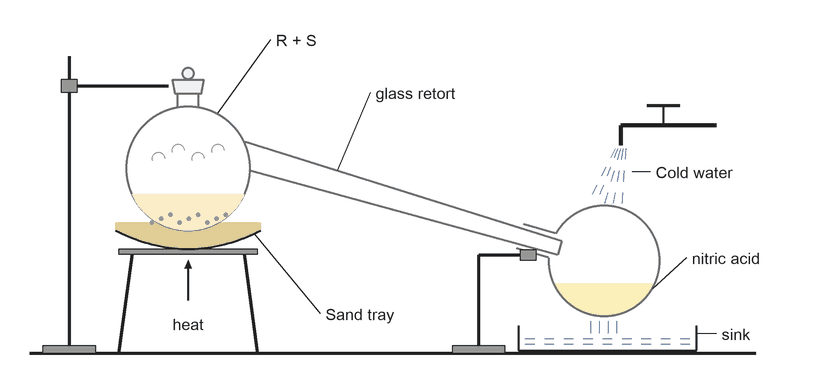
(a) Name:
(1) R (a liquid) and
(2) S (a solid)
(b) Why should we use only glass apparatus in the laboratory preparation of nitric acid?
(c) Write an equation to show how nitric acid undergoes decomposition.
(d) What do you observe when copper is oxidized by concentrated nitric acid?
Solve with AIWritten solution
Solution:
Concept: In the laboratory, nitric acid is made by heating a nitrate (potassium or sodium nitrate, a solid) with concentrated sulphuric acid (a liquid) in an all-glass retort, gently, below 200 °C. Sulphuric acid is non-volatile, so it displaces the volatile nitric acid, which distils over and condenses in a receiver cooled by running water.
Step 1 — (a) Name R and S.
R, the liquid in the retort, is concentrated sulphuric acid. S, the solid, is potassium nitrate (nitre); sodium nitrate can be used too.
Step 2 — (b) Explain the all-glass apparatus.
Nitric acid vapours are highly corrosive and attack rubber and cork, so no cork stoppers or rubber tubing can be used; glass is not attacked by the acid.
Step 3 — (c) Show the decomposition of nitric acid.
On heating, or in light, nitric acid decomposes into nitrogen dioxide, water and oxygen.
Atom Left side Right side N 4 4 H 4 4 O 12 12 The nitrogen dioxide formed dissolves in the acid and makes it yellow.
Step 4 — (d) State the observation with copper.
Concentrated nitric acid oxidises copper to copper nitrate and is reduced to nitrogen dioxide.
Reddish-brown fumes of nitrogen dioxide are given off, and the copper dissolves to form a greenish-blue solution of copper nitrate.
Watch out: R is the LIQUID (conc. H₂SO₄) and S is the SOLID (KNO₃); do not swap them.
Therefore, (a) R is concentrated sulphuric acid and S is potassium nitrate; (b) nitric acid vapours attack rubber and cork; (c) 4HNO₃ → 4NO₂ + 2H₂O + O₂; (d) reddish-brown fumes and a greenish-blue solution.
- 281 mark
Question 28
Select the compound / element from the box given below for each of the following statements:
The gas which on oxidation produces a coloured gas.
Solve with AIWritten solution
Solution:
Concept: Nitric oxide, NO, is a colourless gas. It combines at once with the oxygen of the air to form nitrogen dioxide, a reddish-brown (coloured) gas.
Step 1 — Find the gas that is oxidised to a coloured gas.
Nitric oxide is oxidised by oxygen to reddish-brown nitrogen dioxide, so the answer is NO.

Step 2 — Rule out the others.
Each of the other choices fails for a clear reason.
- H₂ on oxidation forms water, which is colourless.
- NO₂ is itself the coloured gas; it is the product here, not the gas that is oxidised.
- O₂ is the oxidising agent in this change, not the substance that is oxidised.
Watch out: The coloured gas is NO₂, but the question asks for the gas that PRODUCES it on oxidation.
Therefore, the gas is NO (nitric oxide).
- 293 marks
Question 29
Deepak spilled some concentrated nitric acid accidentally in the laboratory. To neutralize it, he sprinkled sodium carbonate powder on it.
(a) Write the equation for the reaction that took place when he sprinkled sodium carbonate on nitric acid.
(b) Name the gas evolved in the reaction above.
(c) Write the equation for the reaction that would take place if Deepak had sprinkled carbon over concentrated nitric acid.
Solve with AIWritten solution
Solution:
Concept: Sodium carbonate is a basic salt (a carbonate); nitric acid acts on it as an acid, giving a salt, water and carbon dioxide, which neutralises the spill. Carbon is a non-metal; concentrated nitric acid acts on it as an oxidising agent.
Step 1 — (a) Write the reaction with sodium carbonate.
Nitric acid reacts with sodium carbonate to form sodium nitrate, water and carbon dioxide.
Atom Left side Right side Na 2 2 C 1 1 N 2 2 H 2 2 O 9 9 Step 2 — (b) Name the gas.
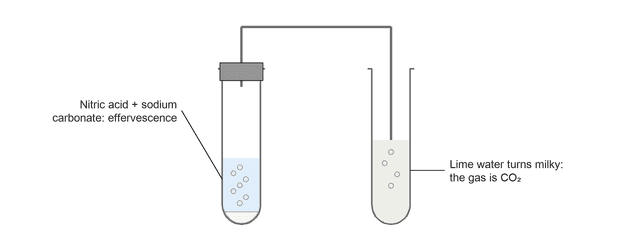
The gas evolved is carbon dioxide, CO₂. It comes off with brisk effervescence and turns lime water milky.
Step 3 — (c) Write the reaction with carbon.
Concentrated nitric acid (when warm) oxidises carbon to carbon dioxide and is reduced to reddish-brown nitrogen dioxide.
This would not neutralise the acid; instead it would give off poisonous brown NO₂ fumes.
Watch out: With sodium carbonate the reaction is neutralisation (no NO₂ is formed); with carbon it is oxidation.
Therefore, (a) Na₂CO₃ + 2HNO₃ → 2NaNO₃ + H₂O + CO₂; (b) carbon dioxide; (c) C + 4HNO₃ → CO₂ + 2H₂O + 4NO₂.