
Question 262 marksAsked 2026Easy
Carbon reacts with an acid to form carbon dioxide, water and nitrogen dioxide.
(a) Name the acid used in the reaction.
(b) Write a balanced chemical equation for the reaction that occurs.
Confirming your payment
Sign up now and get 250 free tokens.
Previous Year Questions · Question 26 of 29
Carbon reacts with an acid to form carbon dioxide, water and nitrogen dioxide.
(a) Name the acid used in the reaction.
(b) Write a balanced chemical equation for the reaction that occurs.
Solution:
Concept: An acid that oxidises carbon to carbon dioxide and gives off nitrogen dioxide must be an oxidising acid whose own reduction gives NO₂, that is, concentrated nitric acid.
Step 1 — (a) Name the acid.
Nitrogen dioxide is the reduction product of concentrated nitric acid, so the acid is concentrated nitric acid, HNO₃. (Concentrated sulphuric acid would give SO₂, not NO₂.)
Step 2 — (b) Write the balanced equation.
Carbon (0 → +4) is oxidised to carbon dioxide, and each of four molecules of the acid is reduced to one NO₂ (nitrogen +5 → +4).
| Atom | Left side | Right side |
|---|---|---|
| C | 1 | 1 |
| N | 4 | 4 |
| H | 4 | 4 |
| O | 12 | 12 |
Reddish-brown NO₂ comes off with colourless carbon dioxide.
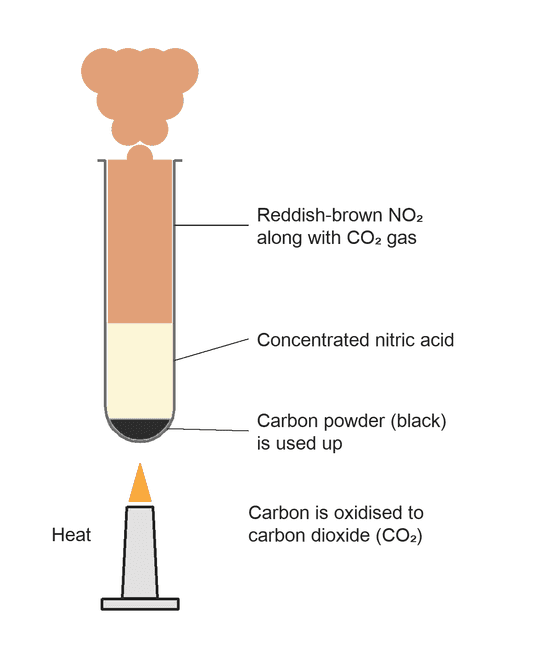
Watch out: The products named in the stem (CO₂, H₂O, NO₂) fix the acid: only nitric acid contains the nitrogen that becomes NO₂.
Therefore, (a) concentrated nitric acid; (b) C + 4HNO₃ → CO₂ + 2H₂O + 4NO₂ (on heating).