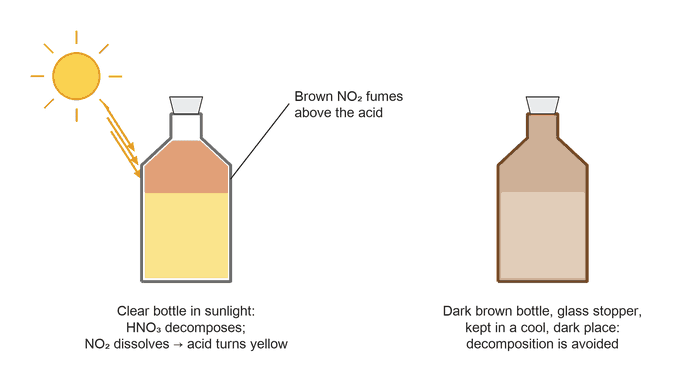
Anil is a laboratory assistant in a college. He prepared nitric acid but stored it in a transparent container exposed to sunlight. After a few days, brown fumes were observed in the container and the acid turned slightly yellowish in colour.
(a) What was the error made by Anil while storing the acid?
(b) Why were brown fumes observed in the container?
(c) How can the yellowish tinge in the acid be removed?
Solution:
Concept: Nitric acid decomposes in light (even at room temperature), giving reddish-brown nitrogen dioxide. The nitrogen dioxide that dissolves in the acid makes it yellow, and the yellow colour goes when this dissolved gas is removed.
Step 1 — (a) Find the error.
Anil stored the acid in a transparent container exposed to sunlight. It should be kept in a dark brown glass bottle with a glass stopper, in a cool, dark place.
Step 2 — (b) Explain the brown fumes.
Sunlight decomposed a part of the nitric acid into nitrogen dioxide, water and oxygen.
4HNO3heat or light4NO2+2H2O+O2
Nitrogen dioxide is a reddish-brown gas, so it collected above the acid as brown fumes; some of it dissolved in the acid and turned it yellowish.
Step 3 — (c) Remove the yellow tinge.
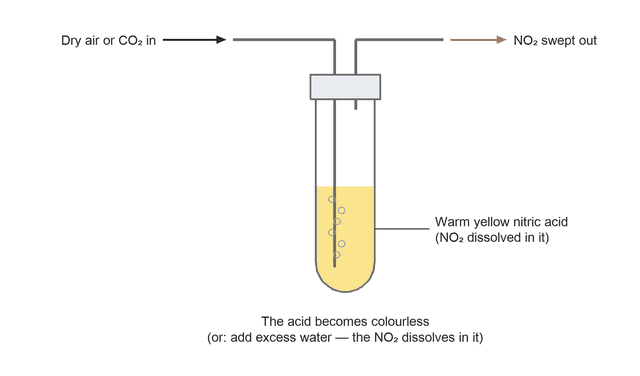
Bubble dry air or carbon dioxide through the warm acid. The gas stream carries away the dissolved nitrogen dioxide, and the acid becomes colourless.
Another way is to add excess water: the nitrogen dioxide dissolves in the water and the colour disappears, but the acid is then more dilute.
Watch out: A colourless (transparent) bottle is the error, even if it is made of glass; the light must be kept out.
Therefore, (a) the acid was stored in a transparent container in sunlight; (b) light decomposed the acid into reddish-brown NO₂; (c) bubble dry air or CO₂ through the warm acid (or add excess water).