
Question 242 marksAsked 2026Easy
Study the reaction given below and answer the questions that follow:
(Conc.)
(a) Give one reason for maintaining the temperature below 200°C.
(b) Why is concentrated Sulphuric acid used in the above reaction?
Confirming your payment
Sign up now and get 250 free tokens.
Previous Year Questions · Question 24 of 29
Study the reaction given below and answer the questions that follow:
(Conc.)
(a) Give one reason for maintaining the temperature below 200°C.
(b) Why is concentrated Sulphuric acid used in the above reaction?
Solution:
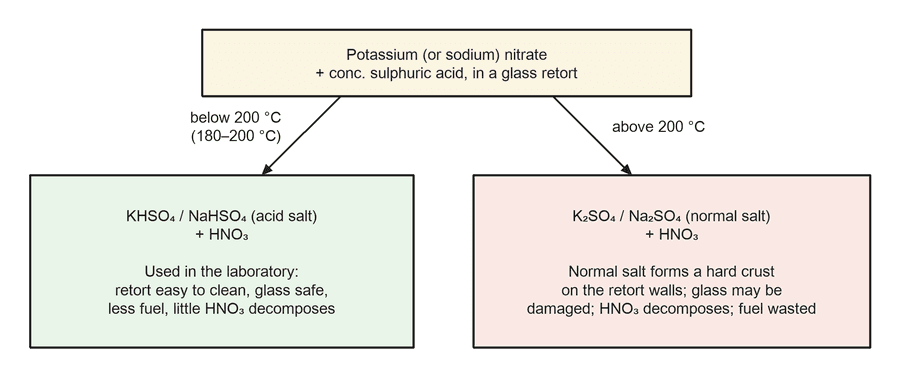
Concept: Below 200 °C the reaction stops at the acid salt, sodium hydrogen sulphate, which stays fluid and is easy to remove from the retort. Concentrated sulphuric acid is used because it is non-volatile (high boiling point), so only the volatile nitric acid distils over.
Step 1 — (a) See what happens above 200 °C.
Above 200 °C the acid salt reacts with more sodium nitrate and forms the normal salt, sodium sulphate.
Sodium sulphate forms a hard crust that sticks to the walls of the retort and is difficult to remove. The higher temperature may also crack the glass apparatus, decompose some of the nitric acid and waste fuel. Any one of these is a valid reason.
Step 2 — (b) Explain the use of concentrated sulphuric acid.
Concentrated sulphuric acid has a high boiling point (it is non-volatile). When it is heated with sodium nitrate, it displaces the more volatile nitric acid, which distils over and is condensed, while the sulphuric acid stays behind in the retort. Being concentrated, it also holds very little water, so the nitric acid collected is concentrated.
Watch out: The reason in (b) is that sulphuric acid is NON-volatile (it is not because it is a stronger acid).
Therefore, (a) above 200 °C sodium sulphate forms a hard crust that sticks to the retort (and HNO₃ decomposes, fuel is wasted); (b) conc. H₂SO₄ is non-volatile, so it displaces the volatile nitric acid, which distils over.