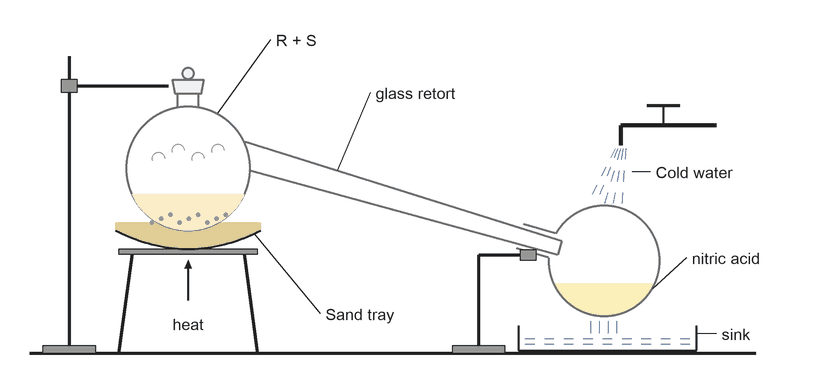
The figure given below illustrates the apparatus used in the laboratory preparation of nitric acid.
Question 275 marksAsked 2026Medium
The figure given below illustrates the apparatus used in the laboratory preparation of nitric acid.
(a) Name:
(1) R (a liquid) and
(2) S (a solid)
(b) Why should we use only glass apparatus in the laboratory preparation of nitric acid?
(c) Write an equation to show how nitric acid undergoes decomposition.
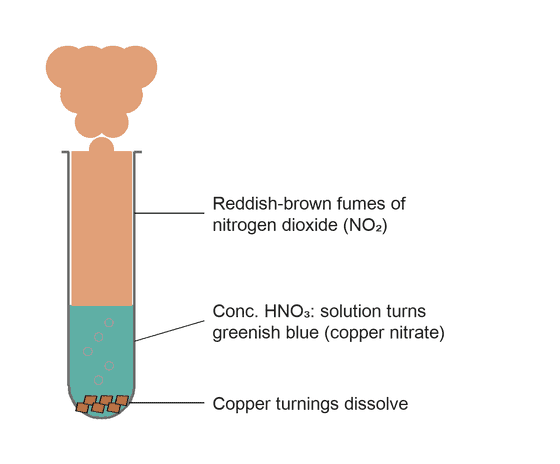
(d) What do you observe when copper is oxidized by concentrated nitric acid?
Solution:
Concept: In the laboratory, nitric acid is made by heating a nitrate (potassium or sodium nitrate, a solid) with concentrated sulphuric acid (a liquid) in an all-glass retort, gently, below 200 °C. Sulphuric acid is non-volatile, so it displaces the volatile nitric acid, which distils over and condenses in a receiver cooled by running water.
Step 1 — (a) Name R and S.
R, the liquid in the retort, is concentrated sulphuric acid. S, the solid, is potassium nitrate (nitre); sodium nitrate can be used too.
KNO3+H2SO4(conc.)below 200∘CKHSO4+HNO3
Step 2 — (b) Explain the all-glass apparatus.
Nitric acid vapours are highly corrosive and attack rubber and cork, so no cork stoppers or rubber tubing can be used; glass is not attacked by the acid.
Step 3 — (c) Show the decomposition of nitric acid.
On heating, or in light, nitric acid decomposes into nitrogen dioxide, water and oxygen.
4HNO3heat or light4NO2+2H2O+O2
Atom
Left side
Right side
N
4
4
H
4
4
O
12
12
The nitrogen dioxide formed dissolves in the acid and makes it yellow.
Step 4 — (d) State the observation with copper.
Concentrated nitric acid oxidises copper to copper nitrate and is reduced to nitrogen dioxide.
Cu+4HNO3(conc.)→Cu(NO3)2+2H2O+2NO2↑
Reddish-brown fumes of nitrogen dioxide are given off, and the copper dissolves to form a greenish-blue solution of copper nitrate.
Watch out: R is the LIQUID (conc. H₂SO₄) and S is the SOLID (KNO₃); do not swap them.
Therefore, (a) R is concentrated sulphuric acid and S is potassium nitrate; (b) nitric acid vapours attack rubber and cork; (c) 4HNO₃ → 4NO₂ + 2H₂O + O₂; (d) reddish-brown fumes and a greenish-blue solution.