(i) What is the type of salt formed when the reactants are heated at a suitable temperature for the preparation of…
Question 72 marksAsked 2018Easy
(i) What is the type of salt formed when the reactants are heated at a suitable temperature for the preparation of Nitric acid?
(ii) State why for the preparation of Nitric acid, the complete apparatus is made up of glass.
Solution:
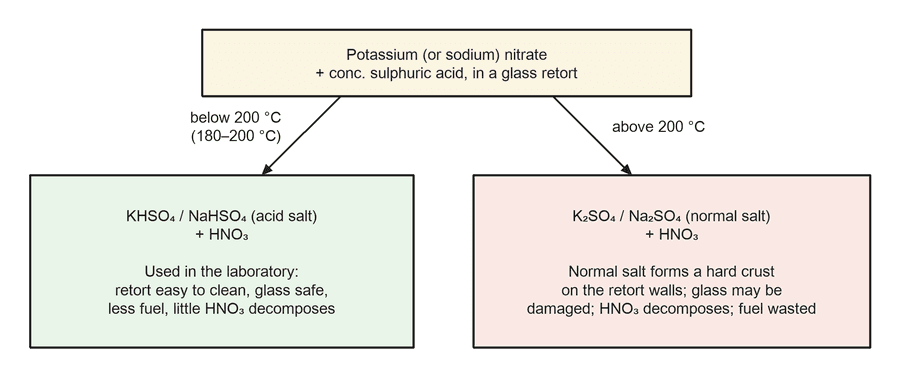
Concept: Sulphuric acid has two replaceable hydrogen atoms. At the temperature used in the laboratory (below 200 °C) the metal of the nitrate replaces only one of them, so an acid salt is left in the retort. Nitric acid vapours are highly corrosive and attack rubber and cork.
Step 1 — (i) Find the salt formed.
Heated gently with concentrated sulphuric acid below 200 °C, potassium nitrate gives nitric acid and potassium hydrogen sulphate (potassium bisulphate), KHSO₄.
KNO3+H2SO4(conc.)below 200∘CKHSO4+HNO3
KHSO₄ still contains a replaceable hydrogen atom, so it is an acid salt (with sodium nitrate the acid salt is NaHSO₄). Above 200 °C the normal salt K₂SO₄ would form, which is avoided.
Step 2 — (ii) Explain the all-glass apparatus.
Nitric acid vapours are highly corrosive: they attack rubber and cork, which would be eaten away and would also spoil the acid. Glass is not attacked, so the retort has a glass stopper and its neck fits straight into the receiver, with no cork or rubber joints.
Watch out: The question asks for the TYPE of salt: answer 'acid salt', and name KHSO₄ as the example.
Therefore, (i) an acid salt (KHSO₄, or NaHSO₄ from sodium nitrate) is formed; (ii) the apparatus is all glass because nitric acid vapours attack rubber and cork, but not glass.