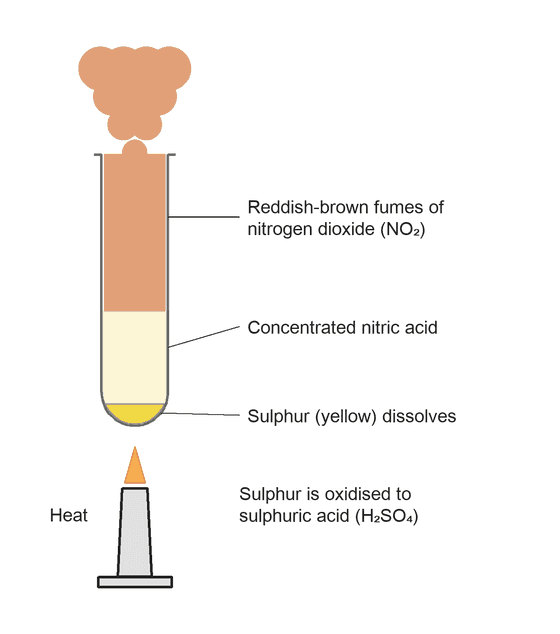
(a) The acid formed when sulphur reacts with concentrated nitric acid.
(b) An acid, which on adding to lead nitrate solution produces a white precipitate which is soluble on heating.
(c) The acid formed when potassium nitrate reacts with a least volatile acid.
Solution:
Concept: Each acid is named from what it does: the acid formed when sulphur is oxidised by nitric acid, the acid whose lead salt is a white precipitate that dissolves in hot water, and the volatile acid driven out of a nitrate by the least volatile acid (concentrated sulphuric acid).
Step 1 — (a) The acid formed from sulphur.
Concentrated nitric acid oxidises sulphur to sulphuric acid, H₂SO₄.
S+6HNO3(conc.)ΔH2SO4+2H2O+6NO2↑
Step 2 — (b) The acid that gives a white precipitate soluble on heating.
Hydrochloric acid, HCl, added to lead nitrate solution gives a white precipitate of lead chloride. Lead chloride is only slightly soluble in cold water but dissolves in hot water, so the precipitate disappears on heating.
Pb(NO3)2+2HCl→PbCl2↓+2HNO3
Sulphuric acid would also give a white precipitate (lead sulphate), but lead sulphate does not dissolve on heating, so it does not fit.
Step 3 — (c) The acid formed from potassium nitrate.
The least volatile acid is concentrated sulphuric acid. Heated with potassium nitrate, it displaces the volatile nitric acid, HNO₃, which distils over.
KNO3+H2SO4(conc.)below 200∘CKHSO4+HNO3
Watch out: In (b), lead sulphate and lead chloride are both white; only lead chloride dissolves in hot water.