
Question 151 markMCQAsked 2023Easy
The salt formed when concentrated sulphuric acid reacts with above :
Confirming your payment
Sign up now and get 250 free tokens.
Previous Year Questions · Question 15 of 29
The salt formed when concentrated sulphuric acid reacts with above :
(A)
(B)
(C)
(D)
Answer: (A)
Concept: Sulphuric acid has two replaceable hydrogen atoms. Below 200 °C potassium replaces only one of them (the acid salt KHSO₄); above 200 °C the acid salt reacts with more nitrate and both hydrogens are replaced, giving the normal salt, potassium sulphate.
Step 1 — Write the reaction below 200 °C.
This is the laboratory method, which stops at the acid salt.
Step 2 — Write the reaction above 200 °C.
At the higher temperature the potassium hydrogen sulphate reacts with more potassium nitrate and gives the normal salt.
Adding the two steps gives the overall reaction above 200 °C:
Step 3 — Name the salt.
The salt formed above 200 °C is potassium sulphate, K₂SO₄, which is option (A). This hard salt sticks to the retort, which is why the laboratory temperature is kept below 200 °C.
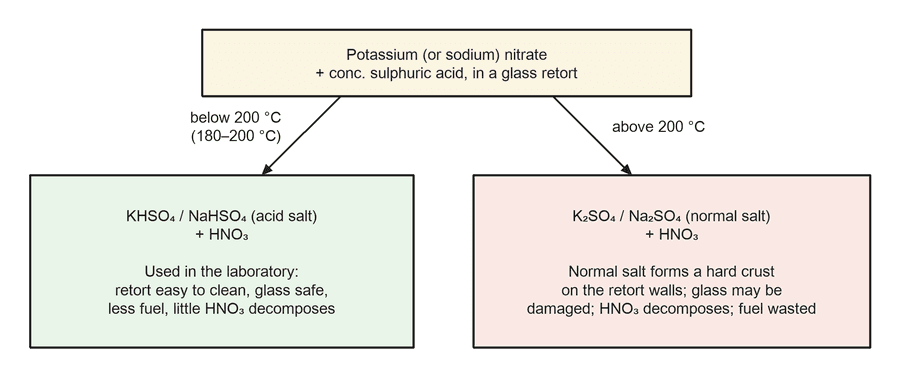
Watch out: KHSO₄ is the answer for 'below 200 °C'; read the temperature in the stem.
Why the other options are wrong:
Therefore, the salt formed above 200 °C is K₂SO₄, option (A).