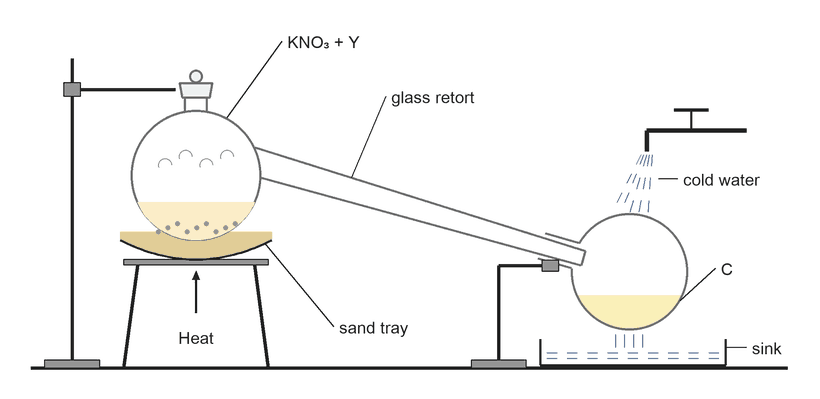
Given below is the diagram for the laboratory preparation of Nitric Acid.
Question 224 marksAsked 2025Medium
Given below is the diagram for the laboratory preparation of Nitric Acid.
(a) Name the reactant labelled Y.
(b) Write a balanced equation for the reaction between Y and KNO3.
(c) The complete apparatus is made up of glass. Why?
(d) State why concentrated HNO3 appears slightly yellowish in colour when left standing in a glass bottle for a long time.
Solution:
Concept: In the laboratory, nitric acid is made by heating a nitrate (potassium or sodium nitrate, a solid) with concentrated sulphuric acid (a liquid) in an all-glass retort, gently, below 200 °C. Sulphuric acid is non-volatile, so it displaces the volatile nitric acid, which distils over and condenses in a receiver cooled by running water.
Step 1 — (a) Name the reactant Y.
The retort holds potassium nitrate and the non-volatile acid that displaces nitric acid from it, so Y is concentrated sulphuric acid.
Step 2 — (b) Write the balanced equation.
Below 200 °C, concentrated sulphuric acid and potassium nitrate give potassium hydrogen sulphate and nitric acid.
KNO3+H2SO4(conc.)below 200∘CKHSO4+HNO3
Atom
Left side
Right side
K
1
1
S
1
1
N
1
1
H
2
2
O
7
7
Step 3 — (c) Explain the all-glass apparatus.
Nitric acid vapours are highly corrosive and attack rubber and cork. So the retort has a glass stopper and its neck fits straight into the receiver, with no cork or rubber joints; glass is not attacked by the acid.
Step 4 — (d) Explain the yellowish colour.
On standing, especially in light, a part of the nitric acid decomposes into nitrogen dioxide, water and oxygen.
4HNO3heat or light4NO2+2H2O+O2
The reddish-brown nitrogen dioxide dissolves in the acid and gives it a yellowish colour.
Watch out: The reaction is kept below 200 °C, so the salt formed is KHSO₄; writing K₂SO₄ gives the reaction above 200 °C.
Therefore, (a) Y is concentrated sulphuric acid; (b) KNO₃ + H₂SO₄ → KHSO₄ + HNO₃ (below 200 °C); (c) nitric acid vapours attack rubber and cork; (d) the acid decomposes to NO₂, which dissolves in it and makes it yellowish.