Give a balanced chemical equation for each of the following
Question 44 marksAsked 2017Medium
Give a balanced chemical equation for each of the following:
(i) Action of conc. Nitric acid on Sulphur.
(ii) Catalytic oxidation of Ammonia.
(iii) Laboratory preparation of Nitric acid.
(iv) Reaction of Ammonia with Nitric acid.
Solution:
Concept: Nitric acid shows three kinds of behaviour in this question: as an oxidising agent (with sulphur), in its manufacture (catalytic oxidation of ammonia) and laboratory preparation, and as an acid (neutralised by the base ammonia). Each equation is written with its conditions and checked atom by atom.
Step 1 — (i) Conc. nitric acid on sulphur.
Hot, concentrated nitric acid oxidises sulphur to sulphuric acid and is reduced to nitrogen dioxide.
S+6HNO3(conc.)ΔH2SO4+2H2O+6NO2↑
Atom
Left side
Right side
S
1
1
N
6
6
H
6
6
O
18
18
Step 2 — (ii) Catalytic oxidation of ammonia.
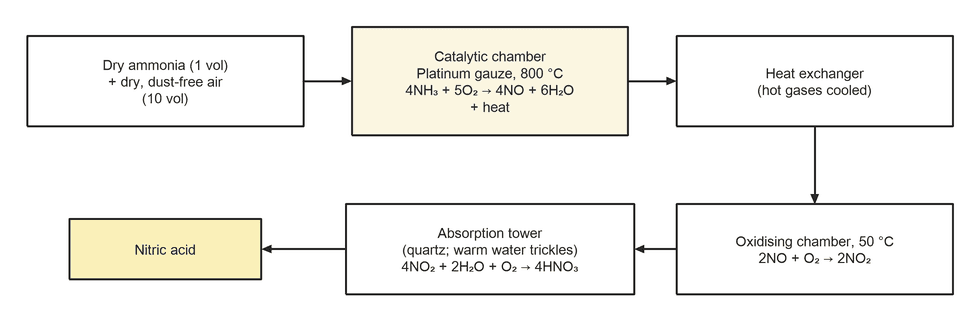
This is the first step of the Ostwald process. Dry ammonia mixed with dust-free air (1 : 10 by volume) is passed over a platinum gauze catalyst at about 800 °C. The reaction gives out heat, which keeps the catalyst hot.
4NH3+5O2Pt, 800∘C4NO+6H2O+heat
Atom
Left side
Right side
N
4
4
H
12
12
O
10
10
Step 3 — (iii) Laboratory preparation of nitric acid.
Potassium nitrate is heated gently with concentrated sulphuric acid in an all-glass retort, below 200 °C. The non-volatile sulphuric acid displaces the volatile nitric acid, whose vapours are condensed in a receiver cooled by water.
KNO3+H2SO4(conc.)below 200∘CKHSO4+HNO3
Atom
Left side
Right side
K
1
1
S
1
1
N
1
1
H
2
2
O
7
7
Step 4 — (iv) Ammonia with nitric acid.
Ammonia is a base, so nitric acid neutralises it and forms the salt ammonium nitrate (used as a fertiliser). No water is formed, because ammonia simply takes up the H⁺ ion of the acid.
NH3+HNO3→NH4NO3
Watch out: In (iii) the temperature is kept below 200 °C, so the product is the acid salt KHSO₄, not K₂SO₄.