
Question 103 marksAsked 2019Easy
Identify the substances underlined :
(i) The catalyst used to oxidise ammonia.
(ii) The organic compound which when solidified, forms an ice like mass.
(iii) The dilute acid which is an oxidizing agent.
Confirming your payment
Sign up now and get 250 free tokens.
Previous Year Questions · Question 10 of 29
Identify the substances underlined :
(i) The catalyst used to oxidise ammonia.
(ii) The organic compound which when solidified, forms an ice like mass.
(iii) The dilute acid which is an oxidizing agent.
Solution:
Concept: Each clue points to one substance: the catalyst of the Ostwald process, the organic acid that freezes into an ice-like solid, and the one common dilute acid that acts as an oxidising agent instead of giving hydrogen with metals.
Step 1 — (i) The catalyst used to oxidise ammonia.
In the Ostwald process, ammonia is oxidised by air over platinum (platinum gauze) at about 800 °C.
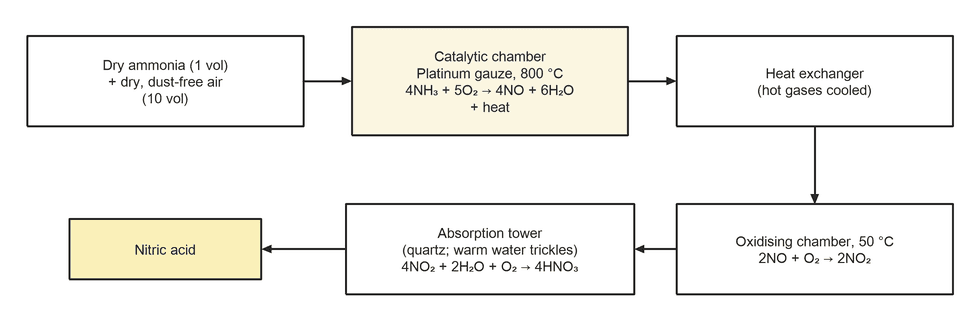
Step 2 — (ii) The organic compound that forms an ice-like mass.
Pure (anhydrous) acetic acid, glacial acetic acid (ethanoic acid, CH₃COOH), freezes at about 17 °C (16.6 °C) into a colourless, ice-like crystalline mass; this is why it is called 'glacial'.
Step 3 — (iii) The dilute acid which is an oxidising agent.
Dilute nitric acid oxidises metals such as copper and is itself reduced to nitric oxide. Dilute hydrochloric and sulphuric acids do not do this; they give hydrogen with active metals.
Watch out: The dilute acid in (iii) is nitric acid; dilute sulphuric acid is not an oxidising agent (only the hot, concentrated acid is).
Therefore, (i) platinum; (ii) glacial acetic acid (ethanoic acid); (iii) dilute nitric acid.