
Question 93 marksAsked 2019Medium
Complete the following equations:
(i)
(ii)
(iii)
Confirming your payment
Sign up now and get 250 free tokens.
Previous Year Questions · Question 9 of 29
Complete the following equations:
(i)
(ii)
(iii)
Solution:
Concept: Concentrated nitric acid and hot concentrated sulphuric acid are oxidising acids: they oxidise non-metals (sulphur, carbon) and are themselves reduced, nitric acid to an oxide of nitrogen and sulphuric acid to sulphur dioxide. Dilute nitric acid with copper gives nitric oxide.
Step 1 — (i) Sulphur with concentrated nitric acid.
Sulphur is oxidised to sulphuric acid and the acid is reduced to nitrogen dioxide.
| Atom | Left side | Right side |
|---|---|---|
| S | 1 | 1 |
| N | 6 | 6 |
| H | 6 | 6 |
| O | 18 | 18 |
Step 2 — (ii) Carbon with concentrated sulphuric acid.
Hot, concentrated sulphuric acid oxidises carbon to carbon dioxide and is reduced to sulphur dioxide; water is also formed.
| Atom | Left side | Right side |
|---|---|---|
| C | 1 | 1 |
| S | 2 | 2 |
| H | 4 | 4 |
| O | 8 | 8 |
Step 3 — (iii) Copper with dilute nitric acid.
Copper is oxidised to copper nitrate and the dilute acid is reduced to nitric oxide.
| Atom | Left side | Right side |
|---|---|---|
| Cu | 3 | 3 |
| N | 8 | 8 |
| H | 8 | 8 |
| O | 24 | 24 |
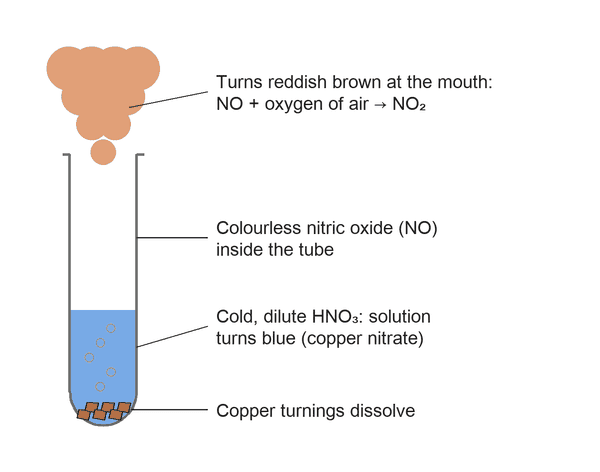
Watch out: In (ii) the acid is sulphuric acid, so its reduced product is SO₂ (not NO₂); in (iii) the acid is dilute, so the gas is NO (not NO₂).
Therefore, (i) S + 6HNO₃ → H₂SO₄ + 2H₂O + 6NO₂; (ii) C + 2H₂SO₄ → CO₂ + 2SO₂ + 2H₂O; (iii) 3Cu + 8HNO₃ → 3Cu(NO₃)₂ + 4H₂O + 2NO.