
Opening your dashboard
Class 9 Maths Chapter 14: Rectilinear Figures Solutions
57 textbook questions with step-by-step answers, free to read, for ICSE 2026-27.
Get talked through Ch 14, not just shown the answer
Reading a finished solution is not the same as being able to do it. The AI tutor takes one question at a time and works it with you, in your own words, until you can.
- Ask it out loud, in your own words
- It gives you the next step, not the answer
- Stuck on part (ii)? Start there
57 questions with solutions
1–3 marks · Mixed difficulty
- 11 mark
Question 1
One angle of a seven-sided polygon is 114° and each of the other six angles is x°. Then the magnitude of x is :
Solve with AIAnswer
- Correct
(A) 131°
(B) 132°
(C) 135°
(D) 130°
Answer: (A) 131°
Concept: The interior angles of a polygon with sides add up to right angles, or . The exterior angles of any polygon (one at each vertex) add up to .
Step 1 — Find the angle sum.
A seven-sided polygon has .
Step 2 — Form the equation.
One angle is and the other six are each.
Watch out: There are six equal angles, not seven; the 114° angle is counted once.
Why the other options are wrong:
- (B) 132°: 132° gives a total of (), not .
- (C) 135°: 135° gives a total of (), not .
- (D) 130°: 130° gives a total of (), not .
Therefore, x = 131, option (A).
- 21 mark
Question 2
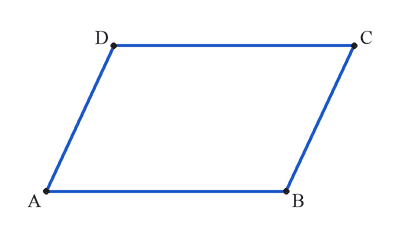
In a parallelogram ABCD, ∠A – ∠C is equal to :
 Solve with AI
Answer
(A) 90°
(B) 120°
- Correct
(C) 0°
(D) 180°
Answer: (C) 0°
Concept: In a parallelogram, opposite sides are equal and parallel, opposite angles are equal, adjacent angles add up to (co-interior angles), and the diagonals bisect each other.
Step 1 — Use the angle property.
∠A and ∠C are opposite angles of the parallelogram, and opposite angles of a parallelogram are equal.
Step 2 — Subtract.
Two equal angles have a difference of zero.
Watch out: ∠A and ∠C are OPPOSITE angles (equal), not adjacent angles (which add up to 180°).
Why the other options are wrong:
- (A) 90°: A difference of 90° would need ∠A and ∠C to be unequal, but opposite angles are equal.
- (B) 120°: A difference of 120° would also need ∠A and ∠C to be unequal.
- (D) 180°: 180° is the SUM of two adjacent angles, such as ∠A + ∠B, not the difference of opposite angles.
Therefore, ∠A − ∠C = 0°, option (C).
- 31 mark
Question 3
If each interior angle of a polygon is 144°; the number of sides in it is :
Solve with AIAnswer
(A) 5
- Correct
(B) 10
(C) 6
(D) 7
Answer: (B) 10
Concept: At each vertex, the interior angle and the exterior angle make a straight line, so they add up to . In a regular polygon all exterior angles are equal and add up to , so each exterior angle is and .
Step 1 — Find each exterior angle.
Each interior angle is 144°, so every exterior angle is the same size.
Step 2 — Count the sides.
The exterior angles add up to 360°, so we divide 360° by one exterior angle.
Watch out: Divide 360° by the EXTERIOR angle, not by the interior angle.
Why the other options are wrong:
- (A) 5: A polygon with 5 equal angles has interior angles of 108° each.
- (C) 6: A polygon with 6 equal angles has interior angles of 120° each.
- (D) 7: A polygon with 7 equal angles has interior angles of about 128.6° each.
Therefore, the polygon has 10 sides, option (B).
- 41 mark
Question 4
The sum of the interior angles of a regular polygon is equal to six times the sum of its exterior angles. The number of sides of the polygon is :
Solve with AIAnswer
- Correct
(A) 14
(B) 10
(C) 12
(D) 16
Answer: (A) 14
Concept: The interior angles of a polygon with sides add up to right angles, or . The exterior angles of any polygon (one at each vertex) add up to .
Step 1 — Form the equation.
The interior angles add up to , and the exterior angles add up to 360°.
Watch out: The exterior angles of every polygon add up to 360°, whatever the number of sides.
Why the other options are wrong:
- (B) 10: For 10 sides the interior angles add up to , which is only 4 times .
- (C) 12: For 12 sides the sum is , which is 5 times .
- (D) 16: For 16 sides the sum is , which is 7 times .
Therefore, the polygon has 14 sides, option (A).
- 51 mark
Question 5
An exterior angle and an interior angle of a regular polygon are in the ratio 2 : 7. The number of sides in the polygon is :
Solve with AIAnswer
(A) 12
(B) 6
(C) 4
- Correct
(D) 9
Answer: (D) 9
Concept: At each vertex, the interior angle and the exterior angle make a straight line, so they add up to . In a regular polygon all exterior angles are equal and add up to , so each exterior angle is and .
Step 1 — Split 180° in the ratio 2 : 7.
The exterior and interior angles at a vertex add up to 180°, so the exterior angle is 2 parts out of 9.
Step 2 — Count the sides.
We divide 360° by one exterior angle.
Watch out: The parts of the ratio add up to 2 + 7 = 9, so each part is 180° ÷ 9.
Why the other options are wrong:
- (A) 12: For 12 sides the exterior angle is 30° and the interior angle 150°, a ratio of 1 : 5.
- (B) 6: For 6 sides the angles are 60° and 120°, a ratio of 1 : 2.
- (C) 4: For 4 sides the angles are 90° and 90°, a ratio of 1 : 1.
Therefore, the polygon has 9 sides, option (D).
- 63 marks
Question 6
The sum of the interior angles of a polygon is four times the sum of its exterior angles. Find the number of sides in the polygon.
Solve with AIWritten solution
Solution:
Concept: The interior angles of a polygon with sides add up to right angles, or . The exterior angles of any polygon (one at each vertex) add up to .
Given: Sum of interior angles = 4 × sum of exterior angles.
Step 1 — Form the equation.
The interior angles of an -sided polygon add up to and the exterior angles to ; the first is four times the second.
Step 2 — Check.
We put n = 10 back into the angle sum.
Watch out: The exterior angles always add up to 360°; they do not depend on n.
Therefore, the polygon has 10 sides.
- 73 marks
Question 7
The angles of a pentagon are in the ratio 4 : 8 : 6 : 4 : 5. Find each angle of the pentagon.
Solve with AIWritten solution
Solution:
Concept: The interior angles of a polygon with sides add up to right angles, or . The exterior angles of any polygon (one at each vertex) add up to .
Given: Angles of a pentagon in the ratio 4 : 8 : 6 : 4 : 5.
Step 1 — Find the angle sum.
A pentagon has 5 sides.
Step 2 — Use the ratio.
Let the angles be , , , and degrees.
Step 3 — Find each angle.
We multiply each part of the ratio by 20.
Watch out: The ratio has 5 terms (4 appears twice), so the total number of parts is 27.
Therefore, the angles are 80°, 160°, 120°, 80° and 100°.
- 83 marks
Question 8
One angle of a six-sided polygon is 140° and the other angles are equal. Find the measure of each equal angle.
Solve with AIWritten solution
Solution:
Concept: The interior angles of a polygon with sides add up to right angles, or . The exterior angles of any polygon (one at each vertex) add up to .
Given: One angle 140°, the other five angles equal.
Step 1 — Find the angle sum.
A six-sided polygon has .
Step 2 — Form the equation.
One angle is 140° and the other five are equal; let each be degrees.
Watch out: A hexagon has five other angles, not six.
Therefore, each equal angle is 116°.
- 93 marks
Question 9
In a polygon, there are 5 right angles and the remaining angles are equal to 195° each. Find the number of sides in the polygon.
Solve with AIWritten solution
Solution:
Concept: The interior angles of a polygon with sides add up to right angles, or . The exterior angles of any polygon (one at each vertex) add up to . An angle of 195° is a reflex angle, so this polygon is not convex; the angle-sum rule still holds.
Given: 5 right angles, all other angles 195°.
Step 1 — Write the angle sum in two ways.
Let the polygon have sides. Five angles are 90° and the other angles are 195° each; together they must make .
Step 2 — Check.
For n = 11 there are 6 angles of 195°.
Watch out: The number of 195° angles is n − 5, not n.
Therefore, the polygon has 11 sides.
- 103 marks
Question 10
Three angles of a seven sided polygon are 132° each and remaining four angles are equal. Find the value of each equal angle.
Solve with AIWritten solution
Solution:
Concept: The interior angles of a polygon with sides add up to right angles, or . The exterior angles of any polygon (one at each vertex) add up to .
Given: Three angles of 132° each, the other four equal.
Step 1 — Find the angle sum.
A seven-sided polygon has .
Step 2 — Form the equation.
Three angles are 132° each; let each of the other four be degrees.
Watch out: Multiply 132° by 3 before subtracting from 900°.
Therefore, each equal angle is 126°.
- 113 marks
Question 11
Two angles of an eight sided polygon are 142° and 176°. If the remaining angles are equal to each other; find the magnitude of each of the equal angles.
Solve with AIWritten solution
Solution:
Concept: The interior angles of a polygon with sides add up to right angles, or . The exterior angles of any polygon (one at each vertex) add up to .
Given: Two angles 142° and 176°, the other six equal.
Step 1 — Find the angle sum.
An eight-sided polygon has .
Step 2 — Form the equation.
Two angles are 142° and 176°; the remaining angles are equal, each degrees.
Watch out: 8 − 2 = 6 equal angles remain.
Therefore, each equal angle is 127°.
- 123 marks
Question 12
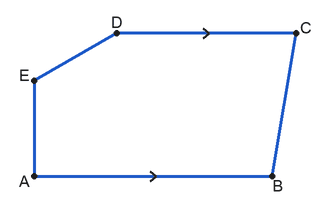
In a pentagon ABCDE, AB is parallel to DC and ∠A : ∠E : ∠D = 3 : 4 : 5. Find angle E.
 Solve with AI
Written solution
Solution:
Concept: The interior angles of a polygon with sides add up to right angles, or . The exterior angles of any polygon (one at each vertex) add up to . A pair of parallel sides gives co-interior angles that add up to 180°.
Given: Pentagon ABCDE with AB ∥ DC and ∠A : ∠E : ∠D = 3 : 4 : 5.
Step 1 — Angles B and C.
AB ∥ DC and BC is a transversal, so ∠B and ∠C are co-interior angles and add up to 180°.
Step 2 — Use the angle sum of the pentagon.
The five angles of a pentagon add up to 540°, so the other three angles share what is left.
Step 3 — Use the ratio.
Let ∠A = , ∠E = and ∠D = degrees.
Watch out: ∠E is the SECOND term of the ratio (4 parts), not the last.
Therefore, ∠E = 120°.
- 133 marks
Question 13
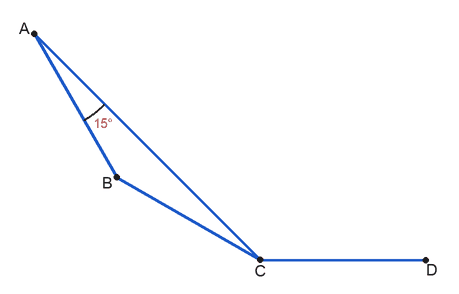
AB, BC and CD are the three consecutive sides of a regular polygon. If ∠BAC = 15°; find,
(i) each interior angle of the polygon.
(ii) each exterior angle of the polygon.
(iii) number of sides of the polygon.
Solve with AIWritten solution
Solution:
Concept: At each vertex, the interior angle and the exterior angle make a straight line, so they add up to . In a regular polygon all exterior angles are equal and add up to , so each exterior angle is and .
Given: AB, BC, CD consecutive sides of a regular polygon, ∠BAC = 15°.
Step 1 — Interior angle ABC.
The sides of a regular polygon are equal, so AB = BC; triangle ABC is isosceles, and its base angle ∠BCA equals ∠BAC, which is 15°. ∠ABC is an interior angle of the polygon.
Step 2 — Exterior angle.
The interior and exterior angles at a vertex add up to 180°.
Step 3 — Number of sides.
We divide 360° by one exterior angle.
Watch out: ∠BAC is not an exterior angle; it is a base angle of the isosceles triangle ABC.
Therefore, (i) each interior angle = 150°, (ii) each exterior angle = 30°, (iii) the polygon has 12 sides.
- 143 marks
Question 14
The ratio between an exterior angle and an interior angle of a regular polygon is 2 : 3. Find the number of sides in the polygon.
Solve with AIWritten solution
Solution:
Concept: At each vertex, the interior angle and the exterior angle make a straight line, so they add up to . In a regular polygon all exterior angles are equal and add up to , so each exterior angle is and .
Given: Exterior angle : interior angle = 2 : 3.
Step 1 — Split 180° in the ratio 2 : 3.
Let the exterior angle be and the interior angle degrees; they add up to 180°.
Step 2 — Count the sides.
We divide 360° by one exterior angle.
Watch out: The exterior angle is 2x = 72°, not x = 36°.
Therefore, the polygon has 5 sides.
- 151 mark
Question 15
A quadrilateral ABCD is a trapezium, if :
Solve with AIAnswer
(A) AB = DC
(B) AD = BC
(C) ∠A + ∠C = 180°
- Correct
(D) ∠B + ∠C = 180°
Answer: (D) ∠B + ∠C = 180°
Concept: Two lines cut by a transversal are parallel when a pair of co-interior angles adds up to 180°.
Step 1 — Recall the definition.
A trapezium is a quadrilateral with one pair of parallel sides.
Step 2 — Test option (D).
∠B and ∠C lie on the same side of the transversal BC, between the lines AB and DC. If these co-interior angles add up to 180°, then AB ∥ DC.
Watch out: ∠A and ∠C are opposite angles, not co-interior angles on one transversal.
Why the other options are wrong:
- (A): A quadrilateral can have AB = DC with no pair of sides parallel, so equal sides alone do not make a trapezium.
- (B): A quadrilateral can have AD = BC with no pair of sides parallel.
- (C): ∠A and ∠C are opposite angles, not co-interior angles, so their sum tells us nothing about parallel sides.
Therefore, ∠B + ∠C = 180° makes AB ∥ DC, option (D).
- 161 mark
Question 16
If the diagonals of a square ABCD intersect each other at point O, the triangle OAB is :
 Solve with AI
Answer
(A) an equilateral triangle.
(B) a right-angled but not an isosceles triangle.
(C) an isosceles but not a right-angled triangle.
- Correct
(D) an isosceles right-angled triangle
Answer: (D) an isosceles right-angled triangle
Concept: The diagonals of a square are equal, bisect each other and meet at right angles.
Step 1 — Use the diagonals of a square.
The diagonals of a square are equal and bisect each other, so OA = OB (each is half of a diagonal).
Step 2 — Use the right angle.
The diagonals of a square also meet at right angles, so ∠AOB = 90°.
Watch out: OA and OB are halves of the two diagonals; they are equal because the diagonals are equal.
Why the other options are wrong:
- (A) an equilateral triangle: ∠AOB = 90°, so the triangle cannot be equilateral (all of its angles would be 60°).
- (B): OA = OB, so the triangle is isosceles.
- (C): ∠AOB = 90°, so the triangle is right-angled.
Therefore, ΔOAB is an isosceles right-angled triangle, option (D).
- 171 mark
Question 17
A quadrilateral in which the diagonals are equal and bisect each other at right angles is a :
Solve with AIAnswer
(A) rectangle which is not a square.
(B) rhombus which is not a square.
- Correct
(C) square.
(D) kite which is not a square.
Answer: (C) square.
Concept: Each extra diagonal property narrows the shape: bisecting → parallelogram; at right angles → rhombus; equal as well → square.
Step 1 — Diagonals that bisect each other.
If the diagonals bisect each other, the quadrilateral is a parallelogram.
Step 2 — Add the right angle.
If they also meet at right angles, all four sides are equal, so it is a rhombus.
Step 3 — Add equal diagonals.
A rhombus with equal diagonals has all its angles equal to 90°, so it is a square.
Watch out: All three facts are needed together; each one alone gives a wider family.
Why the other options are wrong:
- (A) rectangle which is not a square: The diagonals of a rectangle that is not a square do not meet at right angles.
- (B) rhombus which is not a square: The diagonals of a rhombus that is not a square are not equal.
- (D) kite which is not a square: The diagonals of a kite that is not a rhombus do not bisect each other.
Therefore, the quadrilateral is a square, option (C).
- 181 mark
Question 18
Which of the following is not true for a parallelogram :
Solve with AIAnswer
(A) opposite sides are equal
(B) opposite angles are equal
- Correct
(C) opposite angles are bisected by the diagonals
(D) diagonals bisect each other
Answer: (C) opposite angles are bisected by the diagonals
Concept: In a parallelogram, opposite sides are equal and parallel, opposite angles are equal, adjacent angles add up to (co-interior angles), and the diagonals bisect each other.
Step 1 — Check the true properties.
In every parallelogram, opposite sides are equal, opposite angles are equal and the diagonals bisect each other.
Step 2 — Check the angle bisector property.
A diagonal bisects the angles at its ends only when all four sides are equal, that is in a rhombus or a square. In a general parallelogram it does not.
Watch out: The property "diagonals bisect each other" (true) is different from "diagonals bisect the angles" (not always true).
Why the other options are wrong:
- (A) opposite sides are equal: Opposite sides of a parallelogram are always equal, so this is true.
- (B) opposite angles are equal: Opposite angles of a parallelogram are always equal, so this is true.
- (D) diagonals bisect each other: The diagonals of a parallelogram always bisect each other, so this is true.
Therefore, the statement that is not true for every parallelogram is (C).
- 191 mark
Question 19
If the diagonals of a quadrilateral bisect each other at right angle, the quadrilateral is :
Solve with AIAnswer
(A) square
- Correct
(B) rhombus
(C) parallelogram
(D) rectangle
Answer: (B) rhombus
Concept: Diagonals that bisect each other give a parallelogram; if they also meet at right angles, it is a rhombus.
Step 1 — Diagonals that bisect each other.
If the diagonals bisect each other, the quadrilateral is a parallelogram.
Step 2 — Add the right angle.
If they also meet at right angles, each side is the hypotenuse of a congruent right triangle, so all four sides are equal: the quadrilateral is a rhombus.
Watch out: A square also needs EQUAL diagonals, which is not given.
Note: Every rhombus is also a parallelogram, so (C) is true as well; (B) is the complete description, so the printed key (B) is kept.
Why the other options are wrong:
- (A) square: A square also needs the diagonals to be equal, which is not given.
- (C) parallelogram: "Parallelogram" is true, but it is not the complete answer; the right angle makes it a rhombus.
- (D) rectangle: The diagonals of a rectangle are equal but need not be perpendicular.
Therefore, the quadrilateral is a rhombus, option (B).
- 203 marks
Question 20
State, 'true' or 'false' :
(i) The diagonals of a rectangle bisect each other.
(ii) The diagonals of a quadrilateral bisect each other.
(iii) The diagonals of a parallelogram bisect each other at right angle.
(iv) Each diagonal of a rhombus bisects it.
(v) The quadrilateral, whose four sides are equal, is a square.
(vi) Every rhombus is a parallelogram.
(vii) Every parallelogram is a rhombus.
(viii) Diagonals of a rhombus are equal.
(ix) If two adjacent sides of a parallelogram are equal, it is a rhombus.
(x) If the diagonals of a quadrilateral bisect each other at right angle, the quadrilateral is a square.
Solve with AIWritten solution
Solution:
Concept: Each special quadrilateral has all the properties of the wider family it belongs to, plus its own.
Step 1 — Recall the properties.
A parallelogram's diagonals bisect each other. A rectangle is a parallelogram with right angles, a rhombus is a parallelogram with equal sides, and a square is both.
Step 2 — Judge each statement.
We test each statement against these properties.
- (i) True: A rectangle is a parallelogram, and the diagonals of every parallelogram bisect each other.
- (ii) False: This holds only for parallelograms. In a kite, for example, one diagonal is not bisected.
- (iii) False: They bisect each other, but they meet at right angles only in a rhombus or a square.
- (iv) True: Each diagonal divides a rhombus into two congruent triangles (SSS), so it bisects the rhombus.
- (v) False: Four equal sides make a rhombus; it is a square only if one angle is also 90°.
- (vi) True: Both pairs of opposite sides of a rhombus are parallel.
- (vii) False: The sides of a parallelogram need not all be equal.
- (viii) False: The diagonals of a rhombus are equal only when it is a square.
- (ix) True: Opposite sides of a parallelogram are already equal, so two equal adjacent sides make all four sides equal.
- (x) False: Such a quadrilateral is a rhombus; it is a square only if the diagonals are also equal.
Watch out: The properties "bisect each other" and "bisect at right angles" are different properties.
Therefore, (i) True, (ii) False, (iii) False, (iv) True, (v) False, (vi) True, (vii) False, (viii) False, (ix) True, (x) False.
- 213 marks
Question 21
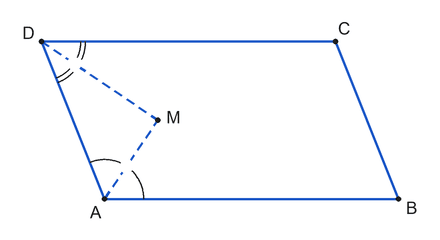
In the figure, given alongside, AM bisects angle A and DM bisects angle D of parallelogram ABCD. Prove that : ∠AMD = 90°.
 Solve with AI
Written solution
Solution:
Concept: In a parallelogram, opposite sides are equal and parallel, opposite angles are equal, adjacent angles add up to (co-interior angles), and the diagonals bisect each other.
Given: ABCD is a parallelogram, AM bisects ∠A and DM bisects ∠D.
Step 1 — Adjacent angles A and D.
AB ∥ DC with AD as a transversal, so ∠A and ∠D are co-interior angles and add up to 180°.
Step 2 — Halve the angles.
AM bisects ∠A and DM bisects ∠D, so the angles of triangle AMD at A and D are half of ∠A and half of ∠D.
Step 3 — Angle sum of triangle AMD.
The three angles of triangle AMD add up to 180°.
Watch out: Half of ∠A plus half of ∠D is half of 180°, whatever the size of ∠A.
Therefore, ∠AMD = 90°. Hence proved.
- 223 marks
Question 22
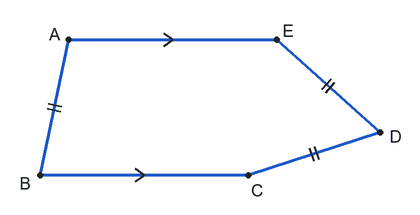
In the following figure, AE and BC are equal and parallel and the three sides AB, CD and DE are equal to one another. If angle A is 102°. Find angles AEC and BCD.
 Solve with AI
Written solution
Solution:
Concept: A quadrilateral is a parallelogram if one pair of opposite sides is equal and parallel, or if both pairs of opposite sides are equal, or if its diagonals bisect each other.
Given: AE = BC and AE ∥ BC; AB, CD and DE are equal; ∠A = 102°.
Step 1 — ABCE is a parallelogram.
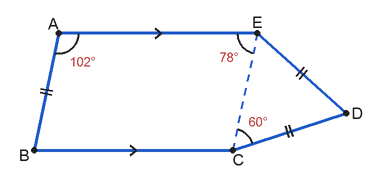
Join EC. AE = BC and AE ∥ BC, and a quadrilateral with one pair of opposite sides equal and parallel is a parallelogram. So EC = AB and EC ∥ AB.
Step 2 — Find ∠AEC.
AB ∥ EC with AE as a transversal, so ∠A and ∠AEC are co-interior angles.
Step 3 — Triangle CDE is equilateral.
EC = AB, and the given sides AB, CD and DE are equal, so all three sides of triangle CDE are equal. Each of its angles is 60°, so ∠ECD = 60°.
Step 4 — Find ∠BCD.
∠BCE equals ∠A, because they are opposite angles of the parallelogram ABCE; so ∠BCE is 102°. ∠BCD is made of ∠BCE and ∠ECD.
Watch out: Join EC first; the equilateral triangle only appears once EC is drawn.
Therefore, ∠AEC = 78° and ∠BCD = 162°.
- 233 marks
Question 23
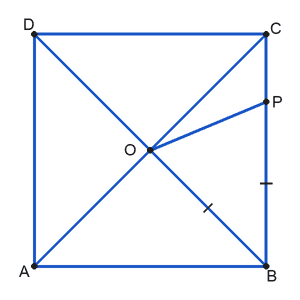
In a square ABCD, diagonals meet at O. P is a point on BC, such that OB = BP.
Show that :
(i) ∠POC =
(ii) ∠BDC = 2 ∠POC
(iii) ∠BOP = 3 ∠COP
Solve with AIWritten solution
Solution:
Concept: The diagonals of a square are equal, bisect each other at right angles, and make with the sides. In a triangle, the sides opposite equal angles are equal, and the angles opposite equal sides are equal.
Given: ABCD a square, diagonals meet at O, P on BC with OB = BP.
Step 1 — Known angles.
The diagonals of a square meet at right angles and make 45° with each side, so ∠OBP = 45° and ∠BOC = 90°.
Step 2 — Isosceles triangle OBP.
OB = BP, so the angles opposite these sides are equal: ∠BOP = ∠BPO. The angles of triangle OBP add up to 180°.
Step 3 — Part (i).
∠POC is the part of the right angle BOC that is left over.
So ∠POC = .
Step 4 — Part (ii).
∠BDC is the angle between a diagonal and a side, so it is 45°.
So ∠BDC = 2∠POC.
Step 5 — Part (iii).
We compare ∠BOP with ∠COP.
So ∠BOP = 3∠COP.
Watch out: OB = BP makes the angles at O and P equal, not the angles at B and O.
Therefore, ∠POC = , ∠BDC = 2∠POC and ∠BOP = 3∠COP. Hence proved.
- 243 marks
Question 24
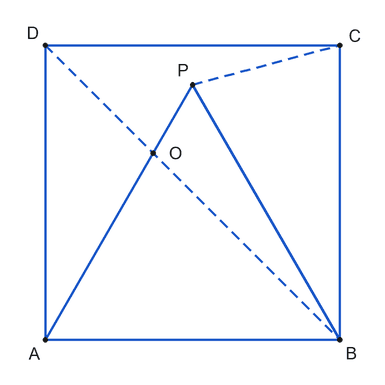
The given figure shows a square ABCD and an equilateral triangle ABP.
Calculate :
(i) ∠AOB
(ii) ∠BPC
(iii) ∠PCD
(iv) reflex ∠APC
 Solve with AI
Written solution
Solution:
Concept: Each angle of a square is and a diagonal makes with a side; each angle of an equilateral triangle is . In a triangle, the sides opposite equal angles are equal, and the angles opposite equal sides are equal.
Given: Square ABCD, equilateral triangle ABP, AP meets the diagonal BD at O.
Step 1 — Part (i): angle AOB.
In triangle AOB, ∠OAB is the angle PAB of the equilateral triangle, so ∠OAB = 60°; and ∠OBA is the angle DBA between a diagonal and a side of the square, so ∠OBA = 45°.
Step 2 — Part (ii): angle BPC.
∠PBC is what is left of the right angle ABC after ∠ABP = 60°. Also, BP = AB (equilateral triangle) and AB = BC (square), so triangle BPC is isosceles and its base angles at P and C are equal.
Step 3 — Part (iii): angle PCD.
∠BCP equals ∠BPC, which is 75°; ∠PCD is the rest of the right angle BCD.
Step 4 — Part (iv): reflex angle APC.
The angle APC (less than 180°) is made of ∠APB and ∠BPC; the reflex angle is the rest of 360°.
Watch out: BP equals AB and AB equals BC, so triangle BPC is isosceles with its equal angles at P and C.
Therefore, (i) ∠AOB = 75°, (ii) ∠BPC = 75°, (iii) ∠PCD = 15°, (iv) reflex ∠APC = 225°.
- 253 marks
Question 25
In the given figure; ABCD is a rhombus with angle A = 67°.
If DEC is an equilateral triangle, calculate :
(i) ∠CBE
(ii) ∠DBE
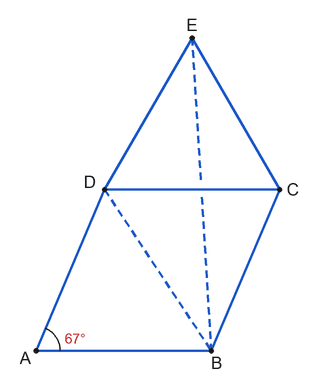 Solve with AI
Written solution
Solution:
Concept: All sides of a rhombus are equal, its opposite angles are equal and each diagonal bisects the angles at its ends. Each angle of an equilateral triangle is . In a triangle, the sides opposite equal angles are equal, and the angles opposite equal sides are equal.
Given: Rhombus ABCD with ∠A = 67°, DEC an equilateral triangle.
Step 1 — Angles of the rhombus.
Opposite angles of a rhombus are equal, and adjacent angles add up to 180°.
So ∠BCD = ∠A, which is 67°.
Step 2 — Part (i): angle CBE.
∠BCE is made of ∠BCD and ∠DCE (60°, equilateral triangle). CB, CD and CE are all equal (sides of the rhombus and of the equilateral triangle), so triangle BCE is isosceles with equal angles at B and E.
So ∠CBE = 26.5°, that is 26°30′.
Step 3 — Part (ii): angle DBE.
The diagonal BD of a rhombus bisects ∠B, and ∠DBE is ∠DBC minus ∠CBE.
Watch out: CE, CD and CB are equal, so the equal angles of triangle BCE are at B and E.
Therefore, (i) ∠CBE = 26°30′, (ii) ∠DBE = 30°.
- 263 marks
Question 26
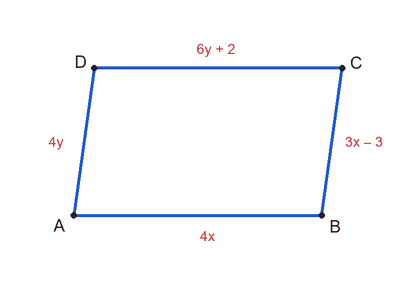
In each of the following figures, ABCD is a parallelogram.
(i)
(ii)
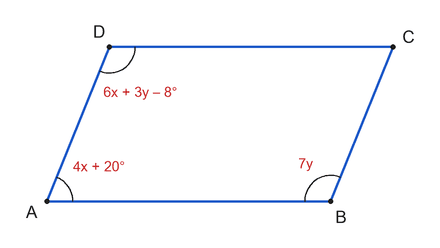
In each case, given above, find the values of x and y.
Solve with AIWritten solution
Solution:
Concept: In a parallelogram, opposite sides are equal and parallel, opposite angles are equal, adjacent angles add up to (co-interior angles), and the diagonals bisect each other.
Given: ABCD is a parallelogram in both figures.
Step 1 — Part (i): equal opposite sides.
Opposite sides of a parallelogram are equal: AB = DC and AD = BC.
Step 2 — Part (i): solve.
From (2), . We put this into (1) and multiply through by 4.
Step 3 — Part (ii): equal opposite angles.
Opposite angles are equal, so ∠D = ∠B.
We call this equation (3).
Step 4 — Part (ii): adjacent angles.
Adjacent angles A and B add up to 180°.
We call this equation (4).
Step 5 — Part (ii): solve.
Multiply (3) by 7 and (4) by 4, then add, so that cancels.
Putting into (4):
Step 6 — Check.
We put x = 12 and y = 16 back into the angles.
∠B and ∠D are equal, and 68° + 112° makes 180°, as adjacent angles must.
Watch out: In (ii), x and y are numbers; the angles are 4x + 20°, 7y° and so on, so x and y themselves carry no degree sign.
Therefore, (i) x = 5 and y = 3; (ii) x = 12 and y = 16.
- 273 marks
Question 27
The angles of a quadrilateral are in the ratio 3 : 4 : 5 : 6. Show that the quadrilateral is a trapezium.
Solve with AIWritten solution
Solution:
Concept: A trapezium has exactly one pair of parallel sides. Two sides are parallel when the co-interior angles between them add up to .
Given: Angles in the ratio 3 : 4 : 5 : 6.
Step 1 — Find the angles.
Let the angles be , , and degrees; the angles of a quadrilateral add up to 360°.
So the angles are 60°, 80°, 100° and 120°.
Step 2 — Look for co-interior angles.
Taking the angles in order round the quadrilateral as ∠A, ∠B, ∠C, ∠D:
∠A and ∠D are co-interior angles on the transversal AD, so AB ∥ DC.
Step 3 — Check the other pair.
We also test the sides AD and BC.
This is not 180°, so AD is not parallel to BC. Exactly one pair of opposite sides is parallel.
Watch out: This works because the ratio lists the angles in order round the figure; 60° and 120° are then neighbours.
Therefore, the quadrilateral is a trapezium. Hence proved.
- 283 marks
Question 28
In a parallelogram ABCD, AB = 20 cm and AD = 12 cm. The bisector of angle A meets DC at E and BC produced at F. Find the length of CF.
 Solve with AI
Written solution
Solution:
Concept: When a line bisects an angle of a parallelogram, it makes equal alternate angles with the opposite side, so it cuts off an isosceles triangle.
Given: Parallelogram ABCD with AB = 20 cm, AD = 12 cm; the bisector of ∠A meets DC at E and BC produced at F.
Step 1 — Triangle ABF is isosceles.
AD ∥ BF (BC produced), so ∠DAF = ∠AFB (alternate angles).
AF bisects ∠A, so ∠DAF = ∠FAB.
Hence ∠FAB = ∠AFB, and the sides opposite these equal angles are equal: BF = AB, so BF is 20 cm.
Step 2 — Find CF.
BC = AD (opposite sides of the parallelogram), so BC is 12 cm; C lies between B and F.
Watch out: BF equals AB (20 cm), not AD.
Therefore, CF = 8 cm.
- 291 mark
Question 29
If the opposite sides of a quadrilateral are equal, the quadrilateral is :
Solve with AIAnswer
(A) rectangle
- Correct
(B) parallelogram
(C) square
(D) rhombus
Answer: (B) parallelogram
Concept: A quadrilateral is a parallelogram if one pair of opposite sides is equal and parallel, or if both pairs of opposite sides are equal, or if its diagonals bisect each other.
Step 1 — Use the test for a parallelogram.
If both pairs of opposite sides of a quadrilateral are equal, the diagonal splits it into two congruent triangles (SSS), which makes both pairs of opposite sides parallel.
Watch out: Nothing about right angles or all-equal sides is given.
Why the other options are wrong:
- (A) rectangle: A rectangle also needs a right angle, which is not given.
- (C) square: A square needs all four sides equal and a right angle.
- (D) rhombus: A rhombus needs all four sides equal, not just opposite sides.
Therefore, the quadrilateral is a parallelogram, option (B).
- 301 mark
Question 30
If the opposite angles of a quadrilateral are equal, the quadrilateral is :
Solve with AIAnswer
(A) rectangle
- Correct
(B) parallelogram
(C) square
(D) rhombus
Answer: (B) parallelogram
Concept: Two lines are parallel when co-interior angles add up to 180°. The angles of a quadrilateral add up to 360°.
Step 1 — Add the angles.
If ∠A = ∠C and ∠B = ∠D, the angle sum 360° gives 2∠A + 2∠B = 360°, so ∠A + ∠B = 180°.
Step 2 — Read the parallel sides.
∠A and ∠B are co-interior angles on the transversal AB, so AD ∥ BC; in the same way AB ∥ DC.
Watch out: Equal opposite angles do not force them to be 90°.
Why the other options are wrong:
- (A) rectangle: The angles need not be 90°, so it need not be a rectangle.
- (C) square: Neither right angles nor equal sides are given.
- (D) rhombus: Equal sides are not given.
Therefore, the quadrilateral is a parallelogram, option (B).
- 311 mark
Question 31
If three angles of a quadrilateral are equal to 90° each, then the quadrilateral is:
Solve with AIAnswer
- Correct
(A) rectangle
(B) not a square
(C) parallelogram
(D) rhombus
Answer: (A) rectangle
Concept: The angles of a quadrilateral add up to .
Step 1 — Find the fourth angle.
The angles of a quadrilateral add up to 360°.
Step 2 — Name the shape.
A quadrilateral whose four angles are all 90° is a rectangle.
Watch out: The fourth angle is forced to be 90° as well.
Note: Every rectangle is a parallelogram, so (C) is also true; (A) is the complete description, so the printed key (A) is kept.
Why the other options are wrong:
- (B) not a square: It may well be a square, if the sides are also equal, so "not a square" cannot be claimed.
- (C) parallelogram: "Parallelogram" is true but incomplete; the right angles make it a rectangle.
- (D) rhombus: Equal sides are not given, so it need not be a rhombus.
Therefore, the quadrilateral is a rectangle, option (A).
- 321 mark
Question 32
If three angles of a quadrilateral are equal, then the quadrilateral is :
Solve with AIAnswer
(A) rectangle
(B) rhombus
- Correct
(C) not a parallelogram
(D) parallelogram
Answer: (C) not a parallelogram
Concept: Opposite angles of a parallelogram are equal; the angles of a quadrilateral add up to .
Step 1 — Write the angles.
Let the three equal angles be each. The fourth angle is .
Step 2 — Test for a parallelogram.
In a parallelogram opposite angles are equal, so the fourth angle would have to equal .
So the quadrilateral is a parallelogram only in the special case (a rectangle). In every other case it is not a parallelogram.
Watch out: Three equal angles are possible without being right angles, e.g. 80°, 80°, 80° and 120°.
Note: When all three equal angles are the figure is a rectangle, which is a parallelogram; the key describes the general case, so the printed key (C) is kept.
Why the other options are wrong:
- (A) rectangle: It is a rectangle only in the special case .
- (B) rhombus: Nothing about the sides is given.
- (D) parallelogram: Opposite angles are unequal whenever , so it is not a parallelogram in general.
Therefore, in general the quadrilateral is not a parallelogram, option (C).
- 331 mark
Question 33
BEC is an equilateral triangle inside the square ABCD. The value of angle ECD is:
 Solve with AI
Answer
(A) 60°
- Correct
(B) 30°
(C) 75°
(D) 45°
Answer: (B) 30°
Concept: Each angle of a square is and each angle of an equilateral triangle is .
Step 1 — Known angles at C.
∠BCD = 90° (angle of the square) and ∠BCE = 60° (angle of the equilateral triangle); E lies inside the square.
Step 2 — Subtract.
∠ECD is the part of ∠BCD outside the triangle.
Watch out: ∠ECD is the gap between CE and CD, not the angle of the triangle.
Why the other options are wrong:
- (A) 60°: 60° is ∠BCE, not ∠ECD.
- (C) 75°: 75° is ∠CDE, a base angle of the isosceles triangle CDE (the sides CD, CB and CE are all equal).
- (D) 45°: 45° is the angle a diagonal of the square makes with a side; CE is not a diagonal.
Therefore, ∠ECD = 30°, option (B).
- 343 marks
Question 34
E is the mid-point of side AB and F is the mid point of side DC of parallelogram ABCD. Prove that AEFD is a parallelogram.
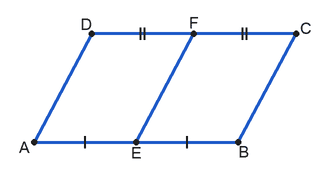 Solve with AI
Written solution
Solution:
Concept: A quadrilateral is a parallelogram if one pair of opposite sides is equal and parallel, or if both pairs of opposite sides are equal, or if its diagonals bisect each other.
Given: ABCD a parallelogram, E the mid-point of AB, F the mid-point of DC.
Step 1 — Opposite sides of ABCD.
AB = DC and AB ∥ DC, because they are opposite sides of the parallelogram ABCD.
Step 2 — Halves are equal.
E and F are the mid-points of AB and DC, so AE is half of AB and DF is half of DC. Halves of equal lengths are equal, so AE = DF.
Step 3 — Halves are parallel.
AE lies along AB and DF lies along DC, so AE ∥ DF.
Step 4 — Apply the test.
In AEFD, the opposite sides AE and DF are equal and parallel, so AEFD is a parallelogram.
Watch out: The pair to use is AE and DF (opposite sides of AEFD), not AE and EF.
Therefore, AEFD is a parallelogram. Hence proved.
- 353 marks
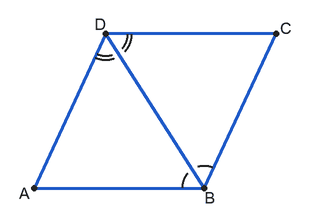
Question 35
The diagonal BD of a parallelogram ABCD bisects angles B and D. Prove that ABCD is a rhombus.
 Solve with AI
Written solution
Solution:
Concept: In a parallelogram, opposite sides are equal and parallel, opposite angles are equal, adjacent angles add up to (co-interior angles), and the diagonals bisect each other. A parallelogram with two equal adjacent sides is a rhombus.
Given: ABCD a parallelogram whose diagonal BD bisects ∠B and ∠D.
Step 1 — Use the bisector.
BD bisects ∠B, so ∠ABD = ∠CBD.
Step 2 — Use the parallel sides.
AD ∥ BC with BD as a transversal, so ∠ADB = ∠CBD (alternate angles).
Step 3 — Triangle ABD is isosceles.
From Steps 1 and 2, ∠ABD = ∠ADB. The sides opposite these angles are equal, so AD = AB.
Step 4 — All four sides equal.
In a parallelogram AB = DC and AD = BC.
With AD = AB, all four sides are equal, so ABCD is a rhombus.
Watch out: The equal angles ∠ABD and ∠ADB lie opposite AD and AB respectively, so it is AD = AB that follows.
Therefore, ABCD is a rhombus. Hence proved.
- 363 marks
Question 36
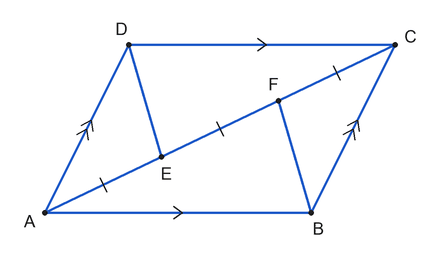
The alongside figure shows a parallelogram ABCD in which AE = EF = FC. Prove that :
(i) DE is parallel to FB
(ii) DE = FB
(iii) DEBF is a parallelogram.
 Solve with AI
Written solution
Solution:
Concept: In a parallelogram, opposite sides are equal and parallel, opposite angles are equal, adjacent angles add up to (co-interior angles), and the diagonals bisect each other. A quadrilateral is a parallelogram if one pair of opposite sides is equal and parallel, or if both pairs of opposite sides are equal, or if its diagonals bisect each other.
Given: ABCD a parallelogram; AE, EF and FC are equal parts of the diagonal AC.
Step 1 — Congruent triangles.
Compare triangles ADE and CBF: AD = CB (opposite sides), ∠DAE = ∠BCF (alternate angles, AD ∥ BC with AC as transversal), and AE = CF (given). So ΔADE ≅ ΔCBF by SAS.
Step 2 — Part (ii).
Corresponding parts of congruent triangles are equal, so DE = FB.
Step 3 — Part (i).
Also ∠AED = ∠CFB. Their supplements on the line AC are equal too, so ∠DEF = ∠BFE. These are alternate angles for DE and FB with the transversal EF, so DE ∥ FB.
Step 4 — Part (iii).
In DEBF, the opposite sides DE and FB are equal and parallel, so DEBF is a parallelogram.
Watch out: ∠DEF and ∠BFE are the alternate angles, not ∠AED and ∠CFB themselves.
Therefore, (i) DE ∥ FB, (ii) DE = FB and (iii) DEBF is a parallelogram. Hence proved.
- 373 marks
Question 37
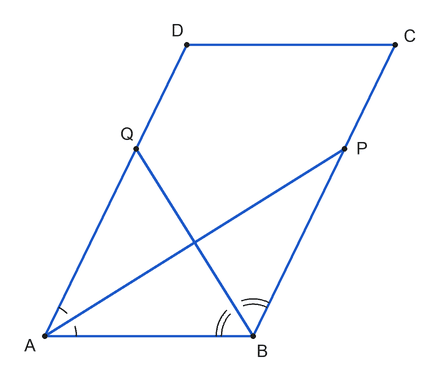
In the alongside figure, ABCD is a parallelogram in which AP bisects angle A and BQ bisects angle B. Prove that :
(i) AQ = BP
(ii) PQ = CD.
(iii) ABPQ is a parallelogram
 Solve with AI
Written solution
Solution:
Concept: When a line bisects an angle of a parallelogram, it makes equal alternate angles with the opposite side, so it cuts off an isosceles triangle. A quadrilateral is a parallelogram if one pair of opposite sides is equal and parallel, or if both pairs of opposite sides are equal, or if its diagonals bisect each other.
Given: ABCD a parallelogram; AP bisects ∠A (P on BC) and BQ bisects ∠B (Q on AD).
Step 1 — Triangle ABP is isosceles.
AD ∥ BC, so ∠PAD = ∠APB (alternate angles).
AP bisects ∠A, so ∠PAD = ∠PAB.
Hence ∠PAB = ∠APB, and the sides opposite them are equal: BP = AB.
Step 2 — Triangle ABQ is isosceles.
In the same way, ∠QBC = ∠BQA (alternate angles) and ∠QBC = ∠QBA (BQ bisects ∠B).
So ∠QBA = ∠BQA, and AQ = AB.
Step 3 — Part (i).
AQ and BP are both equal to AB, so AQ = BP.
Step 4 — Part (iii).
AQ lies along AD and BP along BC, so AQ ∥ BP; and AQ = BP. One pair of opposite sides is equal and parallel, so ABPQ is a parallelogram.
Step 5 — Part (ii).
Opposite sides of the parallelogram ABPQ are equal, so PQ = AB; and AB = CD (parallelogram ABCD).
So PQ = CD.
Watch out: Prove part (iii) before part (ii); (ii) uses the parallelogram ABPQ.
Therefore, (i) AQ = BP, (ii) PQ = CD and (iii) ABPQ is a parallelogram. Hence proved.
- 383 marks
Question 38
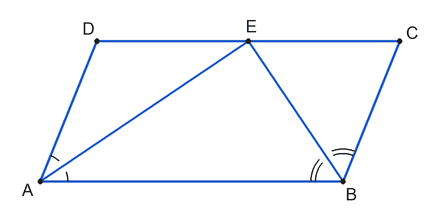
In the given figure, ABCD is a parallelogram. Prove that : AB = 2 BC.
 Solve with AI
Written solution
Solution:
Concept: When a line bisects an angle of a parallelogram, it makes equal alternate angles with the opposite side, so it cuts off an isosceles triangle.
Given: ABCD a parallelogram; AE and BE bisect ∠A and ∠B and meet at E on DC (marked in the figure).
Step 1 — Read the figure.
The figure marks AE as the bisector of ∠A and BE as the bisector of ∠B, with E on DC.
Step 2 — DE = AD.
AB ∥ DC, so ∠DEA = ∠EAB (alternate angles), and ∠EAB = ∠DAE (AE bisects ∠A). So in triangle ADE, ∠DEA = ∠DAE, and the sides opposite them are equal: DE = AD.
Step 3 — CE = BC.
In the same way, ∠CEB = ∠EBA (alternate angles) and ∠EBA = ∠CBE (BE bisects ∠B). So in triangle BCE, ∠CEB = ∠CBE, and CE = BC.
Step 4 — Add.
AB = DC (opposite sides), DC = DE + EC, and AD = BC.
Watch out: DE equals AD (the side next to it), not AB.
Therefore, AB = 2BC. Hence proved.
- 393 marks
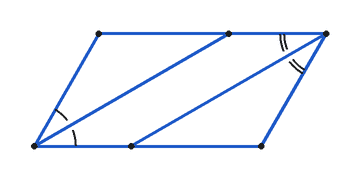
Question 39
Prove that the bisectors of opposite angles of a parallelogram are parallel.
 Solve with AI
Written solution
Solution:
Concept: In a parallelogram, opposite sides are equal and parallel, opposite angles are equal, adjacent angles add up to (co-interior angles), and the diagonals bisect each other. Two lines are parallel when a pair of corresponding angles is equal.
Step 1 — Set up.
Let ABCD be a parallelogram, AP the bisector of ∠A (P on DC) and CQ the bisector of ∠C (Q on AB).
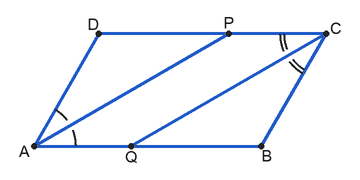
Step 2 — Equal half-angles.
Opposite angles of a parallelogram are equal, so their halves are equal.
Since ∠A = ∠C, ∠PAB = ∠QCD.
Step 3 — Alternate angles.
DC ∥ AB with QC as a transversal, so ∠QCD = ∠CQB (alternate angles).
Hence ∠PAB = ∠CQB.
Step 4 — Corresponding angles.
∠PAB and ∠CQB are corresponding angles for the lines AP and QC with the transversal AB. They are equal, so AP ∥ QC.
Watch out: Use the bisectors of OPPOSITE angles (A and C); the bisectors of adjacent angles meet at 90°.
Therefore, AP ∥ QC: the bisectors of opposite angles of a parallelogram are parallel. Hence proved.
- 403 marks
Question 40
Prove that the bisectors of interior angles of a parallelogram form a rectangle.
 Solve with AI
Written solution
Solution:
Concept: In a parallelogram, opposite sides are equal and parallel, opposite angles are equal, adjacent angles add up to (co-interior angles), and the diagonals bisect each other. A quadrilateral with all four angles 90° is a rectangle.
Step 1 — Name the points.
Let ABCD be a parallelogram. Let the bisectors of ∠A and ∠B meet at P, of ∠B and ∠C at Q, of ∠C and ∠D at R, and of ∠D and ∠A at S.

Step 2 — One angle of PQRS.
AD ∥ BC, so ∠A + ∠B = 180° (co-interior angles). In triangle APB the angles at A and B are halves of these.
S lies on line AP and Q on line BP, so ∠SPQ is either ∠APB itself or vertically opposite to it. Either way ∠SPQ = 90°.
Step 3 — The other angles.
In the same way, using ∠B + ∠C, ∠C + ∠D and ∠D + ∠A (each 180°), we get ∠PQR = 90°, ∠QRS = 90° and ∠RSP = 90°.
Step 4 — Conclude.
PQRS has all four angles equal to 90°, so it is a rectangle.
Watch out: The right angle comes from ADJACENT angles adding up to 180°.
Therefore, the bisectors form a rectangle PQRS. Hence proved.
- 413 marks
Question 41
Prove that the bisectors of the interior angles of a rectangle form a square.
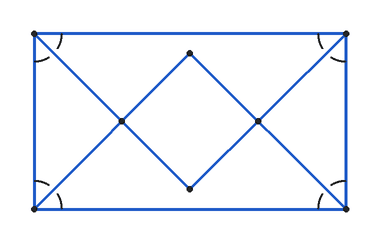 Solve with AI
Written solution
Solution:
Concept: The bisectors of the angles of any parallelogram form a rectangle. In a rectangle every angle is , so each half-angle is .
Step 1 — PQRS is a rectangle.
Let ABCD be a rectangle, and let the bisectors of ∠A, ∠B meet at P, of ∠B, ∠C at Q, of ∠C, ∠D at R, and of ∠D, ∠A at S. A rectangle is a parallelogram, so (as in Q8) PQRS is a rectangle.
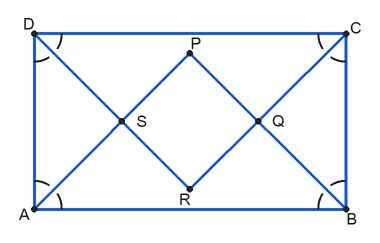
Step 2 — Isosceles triangle APB.
Each angle of the rectangle is 90°, so every half-angle is 45°. In triangle APB, ∠PAB and ∠PBA are both 45°, so PA = PB.
Step 3 — Congruent triangles ASD and BQC.
AD = BC, ∠SAD = ∠QBC (both 45°) and ∠SDA = ∠QCB (both 45°). So ΔASD ≅ ΔBQC (ASA), and AS = BQ.
Step 4 — Two adjacent sides equal.
S lies on AP and Q lies on BP. Subtracting equal lengths from equal lengths:
Since PA = PB and AS = BQ, we get PS = PQ.
Step 5 — Conclude.
A rectangle with two adjacent sides equal is a square.
Watch out: Show two ADJACENT sides of PQRS are equal (PS and PQ), not opposite sides.
Therefore, the bisectors of the angles of a rectangle form a square PQRS. Hence proved.
- 423 marks
Question 42
In parallelogram ABCD, the bisector of angle A meets DC at P and AB = 2AD.
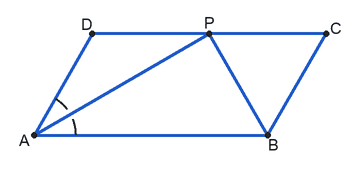
Prove that :
(i) BP bisects angle B.
(ii) Angle APB = 90°.
Solve with AIWritten solution
Solution:
Concept: When a line bisects an angle of a parallelogram, it makes equal alternate angles with the opposite side, so it cuts off an isosceles triangle.
Given: ABCD a parallelogram, the bisector of ∠A meets DC at P, AB = 2AD.
Step 1 — DP = AD.
AB ∥ DC, so ∠DPA = ∠PAB (alternate angles), and ∠PAB = ∠DAP (AP bisects ∠A). So in triangle ADP, ∠DPA = ∠DAP, and DP = AD.
Step 2 — PC = BC.
DC = AB and AB = 2AD, so P is the mid-point of DC.
Also AD = BC, so PC = BC.
Step 3 — Part (i).
In triangle BCP, PC = BC, so ∠CBP = ∠CPB.
Also ∠CPB = ∠PBA (alternate angles, DC ∥ AB).
So ∠CBP = ∠PBA, and BP bisects ∠B.
Step 4 — Part (ii).
∠A + ∠B = 180° (co-interior angles), and AP, BP bisect them.
Watch out: AB = 2AD is what makes PC equal to BC; without it BP would not bisect ∠B.
Therefore, (i) BP bisects ∠B and (ii) ∠APB = 90°. Hence proved.
- 433 marks
Question 43
Points M and N are taken on the diagonal AC of a parallelogram ABCD such that AM = CN. Prove that BMDN is a parallelogram.
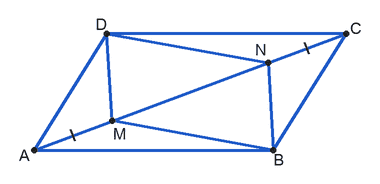 Solve with AI
Written solution
Solution:
Concept: A quadrilateral is a parallelogram if one pair of opposite sides is equal and parallel, or if both pairs of opposite sides are equal, or if its diagonals bisect each other.
Given: ABCD a parallelogram, M and N on AC with AM = CN.
Step 1 — Diagonals of ABCD.
Let the diagonals AC and BD meet at O. The diagonals of a parallelogram bisect each other, so OA = OC and OB = OD.

Step 2 — OM = ON.
M and N lie on AC with AM = CN.
Since OA = OC and AM = CN, OM = ON.
Step 3 — Apply the test.
The diagonals of BMDN are BD and MN. They bisect each other at O (OB = OD and OM = ON), so BMDN is a parallelogram.
Watch out: The diagonals of BMDN are BD and MN, not AC.
Therefore, BMDN is a parallelogram. Hence proved.
- 443 marks
Question 44
In the following figure, ABCD is a parallelogram. Prove that :
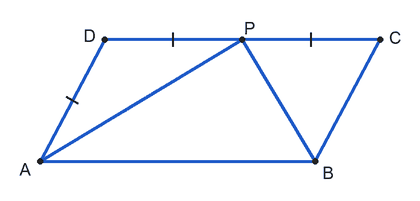
(i) AP bisects angle A
(ii) BP bisects angle B
(iii) ∠DAP + ∠CBP = ∠APB
Solve with AIWritten solution
Solution:
Concept: In a parallelogram, opposite sides are equal and parallel, opposite angles are equal, adjacent angles add up to (co-interior angles), and the diagonals bisect each other. In a triangle, the sides opposite equal angles are equal, and the angles opposite equal sides are equal.
Given: ABCD a parallelogram; AD, DP and PC are equal (marked in the figure).
Step 1 — Read the figure.
The marks in the figure show that AD, DP and PC are equal.
Step 2 — Part (i).
In triangle ADP, AD = DP, so ∠DAP = ∠DPA.
Also ∠DPA = ∠PAB (alternate angles, DC ∥ AB).
So ∠DAP = ∠PAB, and AP bisects ∠A.
Step 3 — Part (ii).
BC = AD (opposite sides), so PC = BC.
In triangle BCP, ∠CBP = ∠CPB, and ∠CPB = ∠PBA (alternate angles).
So ∠CBP = ∠PBA, and BP bisects ∠B.
Step 4 — Part (iii).
∠A + ∠B = 180° (co-interior angles), and AP, BP bisect them, so ∠DAP and ∠CBP are halves of ∠A and ∠B.
In triangle APB the angles at A and B also add up to 90°, so the third angle is the rest of 180°.
Watch out: ∠DAP + ∠CBP and ∠APB are both 90°; that is why they are equal.
Therefore, (i) AP bisects ∠A, (ii) BP bisects ∠B and (iii) ∠DAP + ∠CBP = ∠APB. Hence proved.
- 453 marks
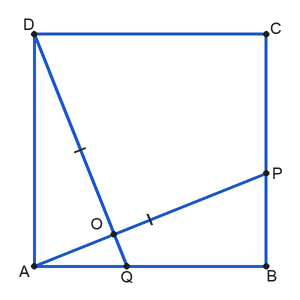
Question 45
ABCD is a square. A is joined to a point P on BC and D is joined to a point Q on AB. If AP = DQ; prove that AP and DQ are perpendicular to each other.
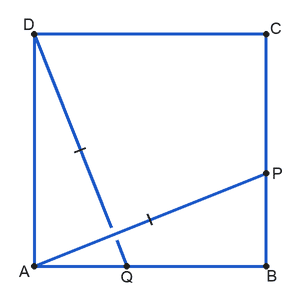 Solve with AI
Written solution
Solution:
Concept: Two right triangles are congruent if the hypotenuse and one side are equal (RHS). The angles of a triangle add up to 180°.
Given: ABCD a square, P on BC, Q on AB, AP = DQ.
Step 1 — Congruent triangles.
Let AP and DQ meet at O. In triangles ABP and DAQ: ∠ABP = ∠DAQ (both 90°, angles of the square), AP = DQ (given, the hypotenuses) and AB = DA (sides of the square). So ΔABP ≅ ΔDAQ (RHS), and ∠BAP = ∠ADQ.
Step 2 — Angles in triangle DAQ.
Triangle DAQ is right-angled at A, so its other two angles add up to 90°: ∠ADQ + ∠AQD = 90°.
Replacing ∠ADQ by ∠BAP gives ∠BAP + ∠AQD = 90°.
Step 3 — Angle at O.
In triangle AOQ, ∠OAQ is ∠BAP and ∠OQA is ∠AQD.
Watch out: Match the triangles in the right order (A ↔ D, B ↔ A, P ↔ Q) so that the equal angles are the corresponding ones.
Therefore, AP and DQ are perpendicular to each other. Hence proved.
- 463 marks
Question 46
In a quadrilateral ABCD, AB = AD and CB = CD. Prove that :
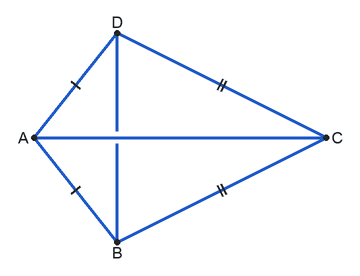
(i) AC bisects angle BAD.
(ii) AC is perpendicular bisector of BD.
Solve with AIWritten solution
Solution:
Concept: Triangles are congruent by SSS or SAS; congruent triangles have equal corresponding parts.
Given: Quadrilateral ABCD with AB = AD and CB = CD.
Step 1 — Part (i).
In triangles ABC and ADC: AB = AD, CB = CD and AC is common. So ΔABC ≅ ΔADC (SSS), and ∠BAC = ∠DAC. So AC bisects ∠BAD.
Step 2 — Congruent triangles ABO and ADO.
Let AC meet BD at O. In triangles ABO and ADO: AB = AD, ∠BAO = ∠DAO (part (i)) and AO is common. So ΔABO ≅ ΔADO (SAS), giving BO = DO and ∠AOB = ∠AOD.
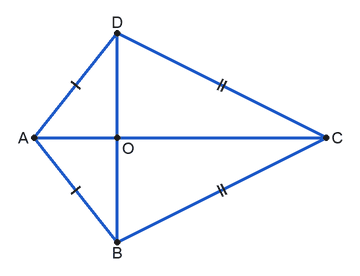
Step 3 — Part (ii).
∠AOB and ∠AOD lie on the straight line BD, so they add up to 180°; being equal, each is 90°. AC therefore bisects BD at right angles.
Watch out: Two equal adjacent angles on a straight line must each be 90°.
Therefore, (i) AC bisects ∠BAD and (ii) AC is the perpendicular bisector of BD. Hence proved.
- 473 marks
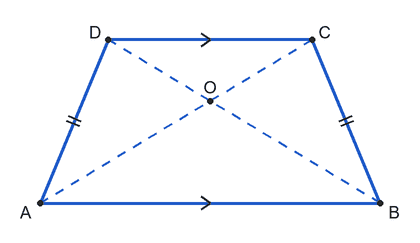
Question 47
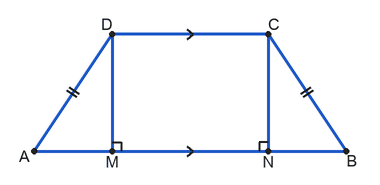
The following figure shows a trapezium ABCD in which AB is parallel to DC and AD = BC.
Prove that :
(i) ∠DAB = ∠CBA
(ii) ∠ADC = ∠BCD
(iii) AC = BD
(iv) OA = OB and OC = OD
 Solve with AI
Written solution
Solution:
Concept: Two right triangles are congruent by RHS; triangles are congruent by SAS. The distance between two parallel lines is the same everywhere.
Given: Trapezium ABCD with AB ∥ DC and AD = BC.
Step 1 — Construction.
Draw DM ⟂ AB and CN ⟂ AB. DC ∥ AB, so DM = CN (the distance between the parallel lines).
Step 2 — Part (i).
In triangles DAM and CBN: ∠DMA = ∠CNB (both 90°), AD = BC (hypotenuses) and DM = CN. So ΔDAM ≅ ΔCBN (RHS), giving ∠DAB = ∠CBA.
Step 3 — Part (ii).
DC ∥ AB, so ∠ADC = 180° − ∠DAB and ∠BCD = 180° − ∠CBA (co-interior angles). Equal angles have equal supplements, so ∠ADC = ∠BCD.
Step 4 — Part (iii).
In triangles ADB and BCA: AD = BC, ∠DAB = ∠CBA and AB is common. So ΔADB ≅ ΔBCA (SAS), giving AC = BD.
Step 5 — Part (iv).
From the same congruence, ∠ABD = ∠BAC, that is ∠OBA = ∠OAB, so OA = OB. Then:
Since AC = BD and OA = OB, OC = OD.
Watch out: Prove ∠DAB = ∠CBA first; parts (iii) and (iv) depend on it.
Therefore, (i) ∠DAB = ∠CBA, (ii) ∠ADC = ∠BCD, (iii) AC = BD and (iv) OA = OB and OC = OD. Hence proved.
- 483 marks
Question 48
The difference between an exterior angle of (n – 1) sided regular polygon and an exterior angle of (n + 2) sided regular polygon is 6°. Find the value of n.
Solve with AIWritten solution
Solution:
Concept: At each vertex, the interior angle and the exterior angle make a straight line, so they add up to . In a regular polygon all exterior angles are equal and add up to , so each exterior angle is and .
Given: Exterior angle of an (n − 1)-gon minus exterior angle of an (n + 2)-gon = 6°.
Step 1 — Form the equation.
Each exterior angle of a regular -sided polygon is . The polygon with fewer sides, , has the bigger exterior angle.
Step 2 — Solve the quadratic.
We expand and factorise.
The number of sides is positive, so .
Step 3 — Check.
The polygons have 12 and 15 sides.
Watch out: Subtract in the right order: fewer sides means a larger exterior angle.
Therefore, n = 13.
- 493 marks
Question 49
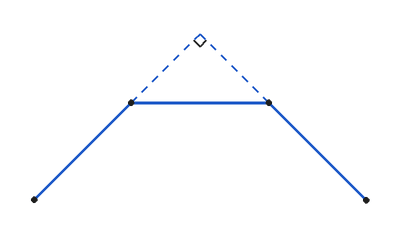
Two alternate sides of a regular polygon, when produced, meet at right angle. Find :
(i) the value of each exterior angle of the polygon;
(ii) the number of sides in the polygon.
Solve with AIWritten solution
Solution:
Concept: At each vertex, the interior angle and the exterior angle make a straight line, so they add up to . In a regular polygon all exterior angles are equal and add up to , so each exterior angle is and .
Given: Two alternate sides, produced, meet at 90°.
Step 1 — Make the triangle.
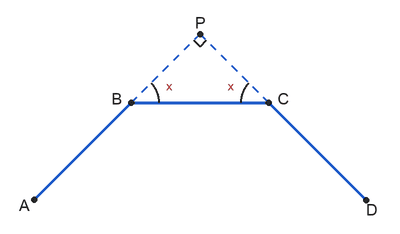
Let AB, BC and CD be consecutive sides. AB and CD are alternate sides; produce them to meet at P. The angles of triangle PBC at B and C are exterior angles of the polygon, and ∠P = 90°.
Step 2 — Part (i).
Let each exterior angle be ; the angles of triangle PBC add up to 180°.
Step 3 — Part (ii).
We divide 360° by one exterior angle.
Watch out: The angles at B and C of the triangle are EXTERIOR angles of the polygon.
Therefore, (i) each exterior angle = 45°, (ii) the polygon has 8 sides.
- 503 marks
Question 50
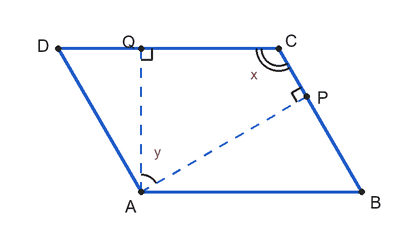
In parallelogram ABCD, AP and AQ are perpendiculars from vertex of obtuse angle A as shown. If ∠x : ∠y = 2 : 1; find the angles of the parallelogram.
 Solve with AI
Written solution
Solution:
Concept: In a parallelogram, opposite sides are equal and parallel, opposite angles are equal, adjacent angles add up to (co-interior angles), and the diagonals bisect each other. The angles of a quadrilateral add up to .
Given: ABCD a parallelogram, AP ⟂ BC, AQ ⟂ DC, ∠x : ∠y = 2 : 1.
Step 1 — Angles of quadrilateral APCQ.
AQ ⟂ DC and AP ⟂ BC, so the angles of APCQ at Q and P are 90° each. The figure shows ∠x at C and ∠y at A. The four angles add up to 360°.
Step 2 — Use the ratio.
∠x : ∠y = 2 : 1, so ∠x is 2 parts of 3.
Step 3 — Angles of the parallelogram.
∠x is ∠C of the parallelogram, so ∠C = 120° and the opposite angle ∠A = 120°. Adjacent angles add up to 180°.
∠D equals ∠B, so ∠D is 60° too.
Watch out: ∠y is the angle between the two perpendiculars, not ∠A of the parallelogram.
Therefore, ∠A = 120°, ∠C = 120°, ∠B = 60° and ∠D = 60°.
- 513 marks
Question 51
In the given figure, AP is bisector of ∠A and CQ is bisector of ∠C of parallelogram ABCD. Prove that APCQ is a parallelogram
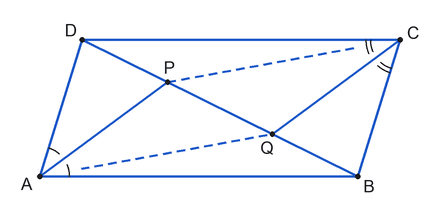
(Join AC and show that diagonals AC and PQ bisect each other.)
Solve with AIWritten solution
Solution:
Concept: A quadrilateral is a parallelogram if one pair of opposite sides is equal and parallel, or if both pairs of opposite sides are equal, or if its diagonals bisect each other.
Given: ABCD a parallelogram; AP bisects ∠A and CQ bisects ∠C, with P and Q on BD.
Step 1 — Congruent triangles ADP and CBQ.
AD = CB (opposite sides); ∠ADP = ∠CBQ (alternate angles, AD ∥ BC with DB as transversal); ∠DAP = ½∠A and ∠BCQ = ½∠C, which are equal because ∠A = ∠C. So ΔADP ≅ ΔCBQ (ASA), and DP = BQ.
Step 2 — Diagonals of ABCD.
Join AC and let it meet BD at O. The diagonals of ABCD bisect each other, so OA = OC and OD = OB.

Step 3 — OP = OQ.
P and Q lie on BD.
Since OD = OB and DP = BQ, OP = OQ.
Step 4 — Apply the test.
In APCQ the diagonals AC and PQ bisect each other at O, so APCQ is a parallelogram.
Watch out: The diagonals of APCQ are AC and PQ; PQ is part of BD.
Therefore, APCQ is a parallelogram. Hence proved.
- 523 marks
Question 52
In case of a parallelogram prove that :
(i) the bisectors of any two adjacent angles intersect at 90°.
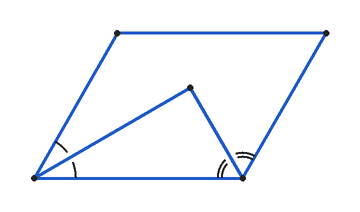
(ii) the bisectors of opposite angles are parallel to each other.
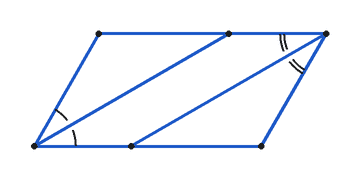 Solve with AI
Written solution
Solution:
Concept: In a parallelogram, opposite sides are equal and parallel, opposite angles are equal, adjacent angles add up to (co-interior angles), and the diagonals bisect each other.
Step 1 — Part (i).
Let ABCD be a parallelogram and let the bisectors of ∠A and ∠B meet at P. ∠A + ∠B = 180° (co-interior angles), so the halves add up to 90°.

Step 2 — Part (ii): equal half-angles.
Let AE bisect ∠A (E on DC) and CF bisect ∠C (F on AB). Since ∠A = ∠C, ∠EAB = ∠FCD.
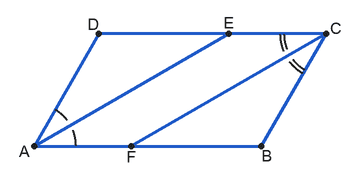
Step 3 — Part (ii): parallel lines.
∠FCD = ∠CFB (alternate angles, DC ∥ AB). So ∠EAB = ∠CFB, which are corresponding angles for AE and FC with the transversal AB. Hence AE ∥ FC.
Watch out: Adjacent angles are supplementary; opposite angles are equal; do not mix them up.
Therefore, (i) the bisectors of two adjacent angles meet at 90° and (ii) the bisectors of opposite angles are parallel. Hence proved.
- 533 marks
Question 53
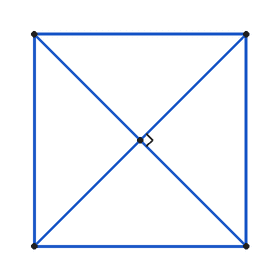
The diagonals of a rectangle intersect each other at right angles. Prove that the rectangle is a square.
 Solve with AI
Written solution
Solution:
Concept: A rectangle is a parallelogram with right angles; its diagonals bisect each other. A rectangle with two adjacent sides equal is a square.
Step 1 — Set up.
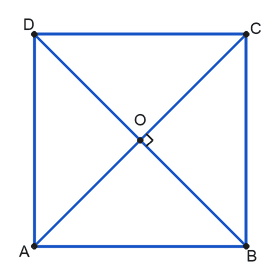
Let the diagonals of rectangle ABCD meet at O at right angles. The diagonals bisect each other, so OA = OC.
Step 2 — Congruent triangles.
In triangles AOB and COB: OA = OC, ∠AOB = ∠COB (both 90°) and OB is common. So ΔAOB ≅ ΔCOB (SAS), and AB = CB.
Step 3 — Conclude.
A rectangle with two adjacent sides equal has all four sides equal, so it is a square.
Watch out: AB and CB are ADJACENT sides; showing opposite sides equal proves nothing new.
Therefore, the rectangle is a square. Hence proved.
- 543 marks
Question 54
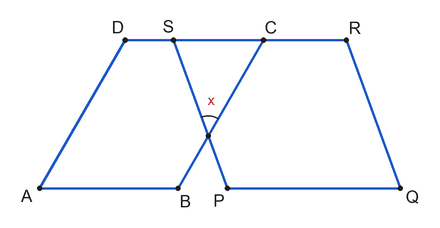
In the following figure, ABCD and PQRS are two parallelograms such that ∠D = 120° and ∠Q = 70°. Find the value of x.
 Solve with AI
Written solution
Solution:
Concept: In a parallelogram, opposite sides are equal and parallel, opposite angles are equal, adjacent angles add up to (co-interior angles), and the diagonals bisect each other. Vertically opposite angles are equal.
Given: ABCD and PQRS parallelograms, ∠D = 120°, ∠Q = 70°.
Step 1 — Name the meeting point.
Let BC and PS meet at X. The points A, B, P, Q lie on one line.
Step 2 — Angle at B.
∠ABC = ∠D (opposite angles of ABCD), so ∠ABC is 120°; ∠CBP is the rest of the straight angle at B.
Step 3 — Angle at P.
∠SPQ = 180° − ∠Q (adjacent angles of PQRS), and ∠SPB is the rest of the straight angle at P.
Step 4 — Triangle BXP.
The angles of triangle BXP add up to 180°.
The angle x is vertically opposite to ∠BXP, so x = 50°.
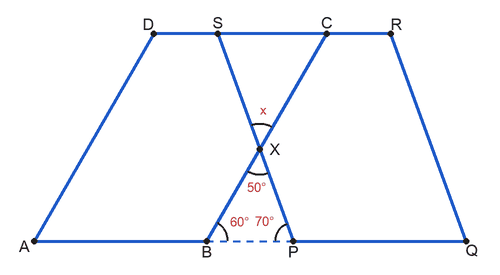
Watch out: Use the angle INSIDE triangle BXP at each base point (60° and 70°), not the parallelogram angles themselves.
Therefore, x = 50°.
- 553 marks
Question 55
In the following figure, ABCD is a rhombus and DCFE is a square.
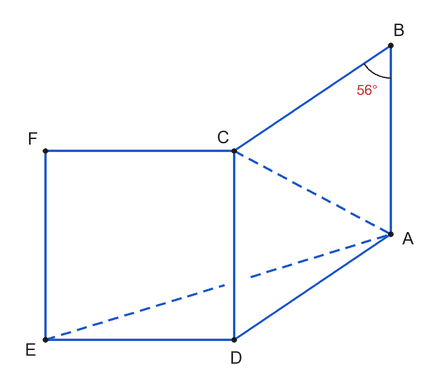
If ∠ABC = 56°, find :
(i) ∠DAE
(ii) ∠FEA
(iii) ∠EAC
(iv) ∠AEC
Solve with AIWritten solution
Solution:
Concept: All sides of a rhombus are equal and a diagonal bisects its angles; a diagonal of a square makes with the sides. In a triangle, the sides opposite equal angles are equal, and the angles opposite equal sides are equal.
Given: ABCD a rhombus with ∠ABC = 56°, DCFE a square.
Step 1 — Known angles.
Opposite angles of the rhombus are equal, so ∠ADC = ∠ABC, which is 56°. Adjacent angles add up to 180°.
∠CDE = 90°, because DCFE is a square. Also, AD = DC (rhombus) and DC = DE (square), so AD = DE.
Step 2 — Part (i).
∠ADE is made of ∠ADC and ∠CDE. Triangle ADE is isosceles (AD = DE), so its angles at A and E are equal.
Step 3 — Part (ii).
∠DEA = ∠DAE, so ∠DEA is also 17°; ∠FEA is the rest of the right angle FED.
Step 4 — Part (iii).
The diagonal AC of the rhombus bisects ∠DAB.
Step 5 — Part (iv).
The diagonal EC of the square makes 45° with ED, so ∠DEC = 45°.
Watch out: AD and DE are both equal to DC, so triangle ADE is isosceles; that is the key step.
Therefore, (i) ∠DAE = 17°, (ii) ∠FEA = 73°, (iii) ∠EAC = 45°, (iv) ∠AEC = 28°.
- 563 marks
Question 56
In parallelogram ABCD, E is the mid-point of side AB and CE bisects angle BCD. Prove that:
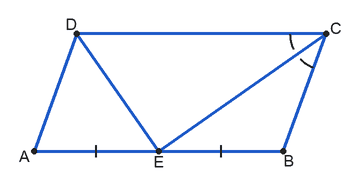
(i) AE = AD
(ii) DE bisects angle ADC
(iii) angle DEC is a right angle
Solve with AIWritten solution
Solution:
Concept: When a line bisects an angle of a parallelogram, it makes equal alternate angles with the opposite side, so it cuts off an isosceles triangle.
Given: ABCD a parallelogram, E the mid-point of AB, CE bisects ∠BCD.
Step 1 — Part (i).
∠BEC = ∠ECD (alternate angles, AB ∥ DC), and ∠ECD = ∠ECB (CE bisects ∠C).
So in triangle BCE, ∠BEC = ∠ECB, and BE = BC.
E is the mid-point of AB, so AE = BE; and BC = AD.
Hence AE = AD.
Step 2 — Part (ii).
In triangle ADE, AE = AD, so ∠ADE = ∠AED.
Also ∠AED = ∠EDC (alternate angles).
So ∠ADE = ∠EDC, and DE bisects ∠ADC.
Step 3 — Part (iii).
∠C + ∠D = 180° (co-interior angles), and CE, DE bisect them.
Watch out: BE = BC comes from the isosceles triangle; AE = BE comes from the mid-point. Both are needed.
Therefore, (i) AE = AD, (ii) DE bisects ∠ADC and (iii) ∠DEC is a right angle. Hence proved.
- 573 marks
Question 57
In parallelogram ABCD, X and Y are mid-points of opposite sides AB and DC respectively. Prove that :

(i) AX = YC
(ii) AX is parallel to YC
(iii) AXCY is a parallelogram
Solve with AIWritten solution
Solution:
Concept: A quadrilateral is a parallelogram if one pair of opposite sides is equal and parallel, or if both pairs of opposite sides are equal, or if its diagonals bisect each other.
Given: ABCD a parallelogram, X the mid-point of AB, Y the mid-point of DC.
Step 1 — Part (i).
AB = DC (opposite sides). X and Y are mid-points, so AX is half of AB and YC is half of DC; halves of equal lengths are equal, so AX = YC.
Step 2 — Part (ii).
AX lies along AB and YC lies along DC, and AB ∥ DC, so AX ∥ YC.
Step 3 — Part (iii).
In AXCY, the opposite sides AX and YC are equal and parallel, so AXCY is a parallelogram.
Watch out: AX and YC are opposite sides of AXCY (A to X, then C to Y).
Therefore, (i) AX = YC, (ii) AX ∥ YC and (iii) AXCY is a parallelogram. Hence proved.
What Class 9 Maths Ch 14 covers
The sections of the chapter, in the order the book takes them. Every question above comes from one of these.
- 01Names of Polygons
- 02Regular Polygon
- 03Parallelogram
- 04Rectangle
- 05Rhombus
- 06Square
More ways to study this chapter
The same chapter asked three other ways. Practise it, revise it, and see what the board has set on Ch 14 before.
Class 9 Maths Ch 14 questions students ask
How many questions are there in Class 9 Maths Ch 14?
57 questions. Every one is solved step by step on this page.
Are these Class 9 Maths solutions free?
Yes. Every question and its full working is free to read, with no account needed.
Can I download the Class 9 Maths Ch 14 solutions as a PDF?
There is no PDF to download. Every solution is on this page instead, which means it is searchable, always the current syllabus, and readable on a phone. Use your browser's print option if you want it on paper.