
Question 353 marksEasy
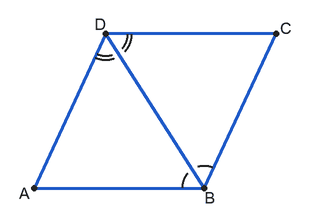
The diagonal BD of a parallelogram ABCD bisects angles B and D. Prove that ABCD is a rhombus.
Confirming your payment
Sign up now and get 250 free tokens.
Rectilinear Figures · Question 35 of 57
The diagonal BD of a parallelogram ABCD bisects angles B and D. Prove that ABCD is a rhombus.
Solution:
Concept: In a parallelogram, opposite sides are equal and parallel, opposite angles are equal, adjacent angles add up to (co-interior angles), and the diagonals bisect each other. A parallelogram with two equal adjacent sides is a rhombus.
Given: ABCD a parallelogram whose diagonal BD bisects ∠B and ∠D.
Step 1 — Use the bisector.
BD bisects ∠B, so ∠ABD = ∠CBD.
Step 2 — Use the parallel sides.
AD ∥ BC with BD as a transversal, so ∠ADB = ∠CBD (alternate angles).
Step 3 — Triangle ABD is isosceles.
From Steps 1 and 2, ∠ABD = ∠ADB. The sides opposite these angles are equal, so AD = AB.
Step 4 — All four sides equal.
In a parallelogram AB = DC and AD = BC.
With AD = AB, all four sides are equal, so ABCD is a rhombus.
Watch out: The equal angles ∠ABD and ∠ADB lie opposite AD and AB respectively, so it is AD = AB that follows.
Therefore, ABCD is a rhombus. Hence proved.