
Question 363 marksMedium
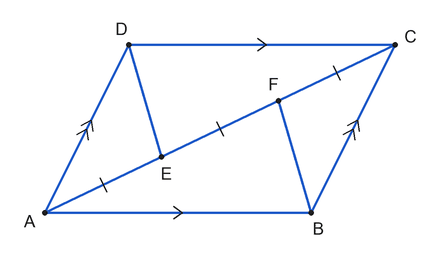
The alongside figure shows a parallelogram ABCD in which AE = EF = FC. Prove that :
(i) DE is parallel to FB
(ii) DE = FB
(iii) DEBF is a parallelogram.
Confirming your payment
Sign up now and get 250 free tokens.
Rectilinear Figures · Question 36 of 57
The alongside figure shows a parallelogram ABCD in which AE = EF = FC. Prove that :
(i) DE is parallel to FB
(ii) DE = FB
(iii) DEBF is a parallelogram.
Solution:
Concept: In a parallelogram, opposite sides are equal and parallel, opposite angles are equal, adjacent angles add up to (co-interior angles), and the diagonals bisect each other. A quadrilateral is a parallelogram if one pair of opposite sides is equal and parallel, or if both pairs of opposite sides are equal, or if its diagonals bisect each other.
Given: ABCD a parallelogram; AE, EF and FC are equal parts of the diagonal AC.
Step 1 — Congruent triangles.
Compare triangles ADE and CBF: AD = CB (opposite sides), ∠DAE = ∠BCF (alternate angles, AD ∥ BC with AC as transversal), and AE = CF (given). So ΔADE ≅ ΔCBF by SAS.
Step 2 — Part (ii).
Corresponding parts of congruent triangles are equal, so DE = FB.
Step 3 — Part (i).
Also ∠AED = ∠CFB. Their supplements on the line AC are equal too, so ∠DEF = ∠BFE. These are alternate angles for DE and FB with the transversal EF, so DE ∥ FB.
Step 4 — Part (iii).
In DEBF, the opposite sides DE and FB are equal and parallel, so DEBF is a parallelogram.
Watch out: ∠DEF and ∠BFE are the alternate angles, not ∠AED and ∠CFB themselves.
Therefore, (i) DE ∥ FB, (ii) DE = FB and (iii) DEBF is a parallelogram. Hence proved.