
Question 373 marksMedium
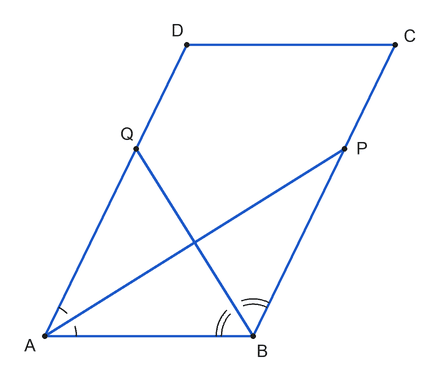
In the alongside figure, ABCD is a parallelogram in which AP bisects angle A and BQ bisects angle B. Prove that :
(i) AQ = BP
(ii) PQ = CD.
(iii) ABPQ is a parallelogram
Confirming your payment
Sign up now and get 250 free tokens.
Rectilinear Figures · Question 37 of 57
In the alongside figure, ABCD is a parallelogram in which AP bisects angle A and BQ bisects angle B. Prove that :
(i) AQ = BP
(ii) PQ = CD.
(iii) ABPQ is a parallelogram
Solution:
Concept: When a line bisects an angle of a parallelogram, it makes equal alternate angles with the opposite side, so it cuts off an isosceles triangle. A quadrilateral is a parallelogram if one pair of opposite sides is equal and parallel, or if both pairs of opposite sides are equal, or if its diagonals bisect each other.
Given: ABCD a parallelogram; AP bisects ∠A (P on BC) and BQ bisects ∠B (Q on AD).
Step 1 — Triangle ABP is isosceles.
AD ∥ BC, so ∠PAD = ∠APB (alternate angles).
AP bisects ∠A, so ∠PAD = ∠PAB.
Hence ∠PAB = ∠APB, and the sides opposite them are equal: BP = AB.
Step 2 — Triangle ABQ is isosceles.
In the same way, ∠QBC = ∠BQA (alternate angles) and ∠QBC = ∠QBA (BQ bisects ∠B).
So ∠QBA = ∠BQA, and AQ = AB.
Step 3 — Part (i).
AQ and BP are both equal to AB, so AQ = BP.
Step 4 — Part (iii).
AQ lies along AD and BP along BC, so AQ ∥ BP; and AQ = BP. One pair of opposite sides is equal and parallel, so ABPQ is a parallelogram.
Step 5 — Part (ii).
Opposite sides of the parallelogram ABPQ are equal, so PQ = AB; and AB = CD (parallelogram ABCD).
So PQ = CD.
Watch out: Prove part (iii) before part (ii); (ii) uses the parallelogram ABPQ.
Therefore, (i) AQ = BP, (ii) PQ = CD and (iii) ABPQ is a parallelogram. Hence proved.