
Question 443 marksMedium
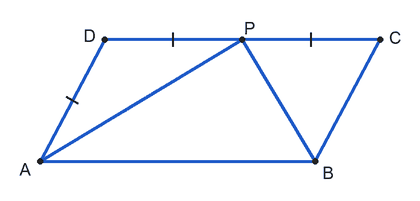
In the following figure, ABCD is a parallelogram. Prove that :
(i) AP bisects angle A
(ii) BP bisects angle B
(iii) ∠DAP + ∠CBP = ∠APB
Confirming your payment
Sign up now and get 250 free tokens.
Rectilinear Figures · Question 44 of 57
In the following figure, ABCD is a parallelogram. Prove that :
(i) AP bisects angle A
(ii) BP bisects angle B
(iii) ∠DAP + ∠CBP = ∠APB
Solution:
Concept: In a parallelogram, opposite sides are equal and parallel, opposite angles are equal, adjacent angles add up to (co-interior angles), and the diagonals bisect each other. In a triangle, the sides opposite equal angles are equal, and the angles opposite equal sides are equal.
Given: ABCD a parallelogram; AD, DP and PC are equal (marked in the figure).
Step 1 — Read the figure.
The marks in the figure show that AD, DP and PC are equal.
Step 2 — Part (i).
In triangle ADP, AD = DP, so ∠DAP = ∠DPA.
Also ∠DPA = ∠PAB (alternate angles, DC ∥ AB).
So ∠DAP = ∠PAB, and AP bisects ∠A.
Step 3 — Part (ii).
BC = AD (opposite sides), so PC = BC.
In triangle BCP, ∠CBP = ∠CPB, and ∠CPB = ∠PBA (alternate angles).
So ∠CBP = ∠PBA, and BP bisects ∠B.
Step 4 — Part (iii).
∠A + ∠B = 180° (co-interior angles), and AP, BP bisect them, so ∠DAP and ∠CBP are halves of ∠A and ∠B.
In triangle APB the angles at A and B also add up to 90°, so the third angle is the rest of 180°.
Watch out: ∠DAP + ∠CBP and ∠APB are both 90°; that is why they are equal.
Therefore, (i) AP bisects ∠A, (ii) BP bisects ∠B and (iii) ∠DAP + ∠CBP = ∠APB. Hence proved.