
Opening your dashboard
Class 9 Maths Chapter 14 Rectilinear Figures: Practice Questions
41 questions on Chapter 14, each worked through on its own page with the AI tutor. Class 9 Maths, ICSE 2026-27.
41 questions
1–5 marks · Mixed difficulty
- 11 mark
Question 1
Bloom's level: Remember
A closed plane figure bounded by at least three line segments is called a :
- 21 mark
Question 2
Bloom's level: Remember
A polygon with 7 sides is called a :
- 31 mark
Question 3
Bloom's level: Remember
Each exterior angle of a regular polygon of sides is :
- 41 mark
Question 4
Bloom's level: Understand
One of the interior angles of a polygon is . The polygon is :
- 51 mark
Question 5
Bloom's level: Understand
Which property of the diagonals is true for every rectangle but not for every parallelogram?
- 61 mark
Question 6
Bloom's level: Understand
In a rhombus, which of the following need not be true?
- 71 mark
Question 7
Bloom's level: Apply
Each exterior angle of a regular polygon is one-fifth of each of its interior angles. The number of sides of the polygon is :
- 81 mark
Question 8
Bloom's level: Apply
The sum of the interior angles of a polygon is . The number of sides of the polygon is :
- 91 mark
Question 9
Bloom's level: Understand
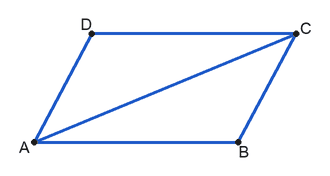
ABCD is a parallelogram and AC is one of its diagonals. Which statement of congruence is correct?
- 101 mark
Question 10
Bloom's level: Understand
Assertion (A) : In a parallelogram PQRS, if , then .
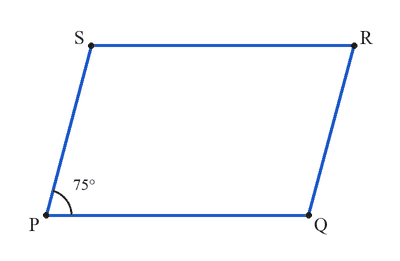
Reason (R) : Consecutive (conjoined) angles of a parallelogram are supplementary.
- 111 mark
Question 11
Bloom's level: Analyse
Assertion (A) : A quadrilateral whose diagonals are equal and perpendicular to each other must be a square.
Reason (R) : The diagonals of a square are equal and perpendicular to each other.
- 121 mark
Question 12
Bloom's level: Evaluate
Assertion (A) : Every square is a rectangle.
Reason (R) : A rectangle is a parallelogram in which each angle is a right angle.
- 131 mark
Question 13
Bloom's level: Remember
What does the word rectilinear mean? What is a rectilinear figure?
- 142 marks
Question 14
Bloom's level: Understand
Explain, by joining one vertex of a hexagon to all its other vertices, why the sum of the interior angles of a hexagon is 8 right angles. Check your answer with the formula right angles.
- 152 marks
Question 15
Bloom's level: Apply
Each exterior angle of a regular polygon is . Find the number of sides of the polygon and the sum of its interior angles.
- 162 marks
Question 16
Bloom's level: Apply
In a parallelogram ABCD, cm, cm and cm.
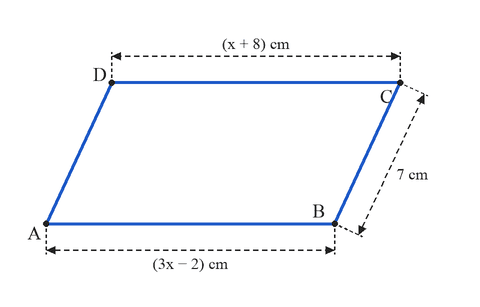
Find and the perimeter of the parallelogram.
- 172 marks
Question 17
Bloom's level: Apply
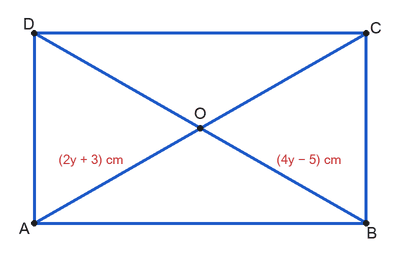
The diagonals of a rectangle ABCD meet at O. If cm and cm, find and the length of the diagonal BD.
- 182 marks
Question 18
Bloom's level: Apply
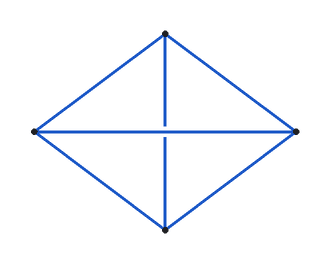
The diagonals of a rhombus are 18 cm and 24 cm long. Find the length of each side of the rhombus.
- 192 marks
Question 19
Bloom's level: Understand
A square is a special rectangle and also a special rhombus. Write :
(i) one property of a square that a rectangle need not have;
(ii) one property of a square that a rhombus need not have.
- 202 marks
Question 20
Bloom's level: Analyse
The diagonals of a quadrilateral are each 10 cm long and bisect each other, but they are not perpendicular. Name the quadrilateral, giving reasons. What one extra condition on the diagonals would make it a square?
- 212 marks
Question 21
Bloom's level: Analyse
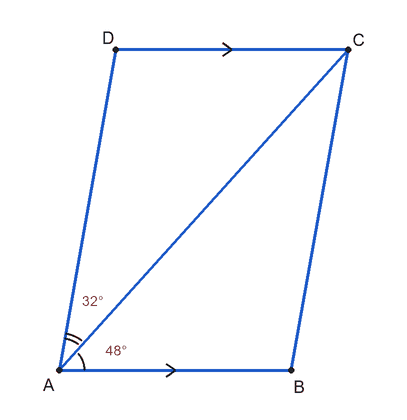
In the given figure, ABCD is a parallelogram, and . Find , and .
- 222 marks
Question 22
Bloom's level: Evaluate
Meera says that it is possible to draw a regular polygon in which each interior angle is . Is she right? Justify your answer.
- 233 marks
Question 23
Bloom's level: Apply
The interior angles of a hexagon are , , , , and . Find and the largest angle of the hexagon. Is the hexagon convex?
- 244 marks
Question 24
Bloom's level: Analyse
The diagonals PR and QS of a parallelogram PQRS meet at O. cm, cm and cm.
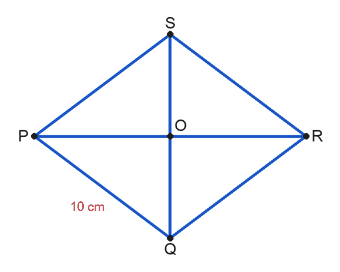
(i) Find OP and OQ.
(ii) Show that .
(iii) What special kind of parallelogram is PQRS? Give a reason and find its perimeter.
- 253 marks
Question 25
Bloom's level: Apply
ABCD is a rhombus with . Its diagonals meet at O. Find :
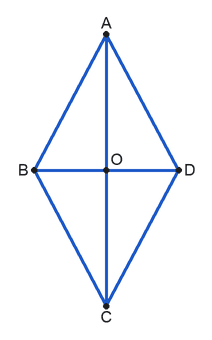
(i)
(ii)
(iii)
- 264 marks
Question 26
Bloom's level: Evaluate
A worker makes a wooden frame ABCD for a window.
(a) He checks that cm and cm, and says the frame is a rectangle. Is this check enough? Explain.
(b) He then finds that both diagonals measure 94.3 cm. Can he now be sure the frame is a rectangle? Justify.
(c) Another worker measures only the two diagonals, finds them equal, and says the frame is a rectangle. Is she right? Explain with an example.
- 274 marks
Question 27
Bloom's level: Apply
Case study: Honeycombs and some floors are covered with regular hexagonal tiles with no gaps and no overlaps. This works only if the angles of the tiles meeting at a point add up to exactly .
(a) Find each interior angle of a regular hexagon.
(b) How many regular hexagons meet at each corner point? Show that they fit exactly.
(c) Can a floor be covered using only regular pentagons in this way? Can two regular octagons and one square fit together exactly at a point? Justify both answers.
- 285 marks
Question 28
Bloom's level: Analyse
Case study: A folding (scissor) gate is made of metal strips, each 20 cm long, joined so that they form a row of identical rhombuses. As the gate is pulled open or pushed shut, the angles of the rhombuses change but the sides stay 20 cm.
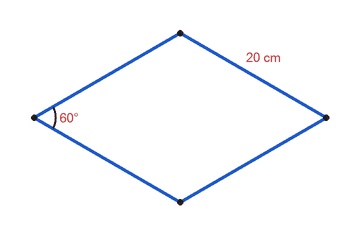
(a) When one angle of each rhombus is , find the length of its shorter diagonal. Give a reason.
(b) For the same position, find the longer diagonal. (Take .)
(c) When the gate is pulled so that each rhombus becomes a square, find the length of each diagonal (take ). Explain why the two diagonals are now equal.
- 294 marks
Question 29
Bloom's level: Create
(a) Design a hexagon in which two angles are each and the other four angles are equal. Find each of the four equal angles and state whether your hexagon is convex or concave.
(b) Now design a hexagon in which two angles are again each, but the other four are in the ratio . Find these four angles and decide whether this hexagon is convex or concave.
- 305 marks
Question 30
Bloom's level: Create
A builder has only a measuring tape. He wants to be sure that a floor ABCD is a square.
(a) Design a short sequence of measurements he can make, and state which property of the chapter each measurement uses.
(b) Apply your test: he finds m and m. Is the floor a square? (Take .)
(c) Explain why measuring only the four sides would not be enough.
- 314 marks
Question 31
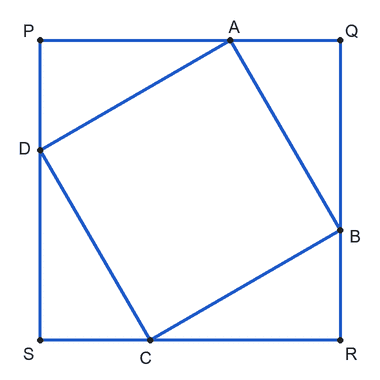
A, B, C and D are points on the sides PQ, QR, RS and SP respectively of a square PQRS such that SC = RB = QA = PD. Prove that ABCD is a square.
- 321 mark
Question 32
The sum of all the interior angles of a nonagon (a polygon with 9 sides) is :
- 331 mark
Question 33
In a regular polygon, each interior angle is greater than each exterior angle. The number of sides of the polygon is :
- 341 mark
Question 34
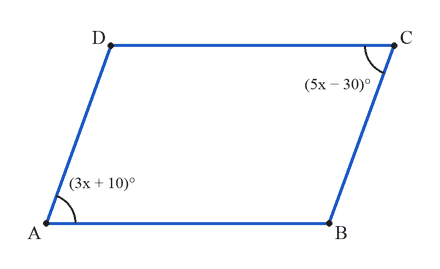
In parallelogram , and . The measure of is :
- 352 marks
Question 35
The sum of the interior angles of a regular polygon is .
(i) Find the number of sides of the polygon.
(ii) Find the size of each interior angle and of each exterior angle.
- 363 marks
Question 36
In parallelogram , the bisector of meets the side at .
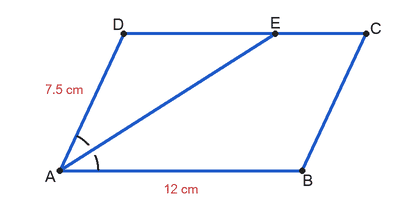
(i) Prove that .
(ii) If cm and cm, find .
- 372 marks
Question 37
The diagonals of a rectangle meet at . If and , find :

(i) the value of
(ii)
- 383 marks
Question 38
In rhombus , .
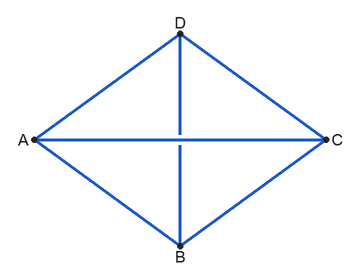
(i) Find .
(ii) Find and .
(iii) Write the angle between the diagonals and .
- 394 marks
Question 39
In the figure, is a square and is an equilateral triangle drawn outside the square on the side . is joined.

(i) Find .
(ii) Find and .
(iii) Find .
- 404 marks
Question 40
(i) Copy and complete the table by writing Yes or No for each quadrilateral. (Take the parallelogram to be one that is neither a rectangle nor a rhombus.)
Quadrilateral Diagonals bisect each other Diagonals are equal Diagonals are perpendicular Diagonals bisect the angles at the vertices Parallelogram Rectangle Rhombus Square (ii) Prove that the diagonals of a rectangle are equal.
- 414 marks
Question 41
is a rhombus. The side is produced to so that . and are joined.
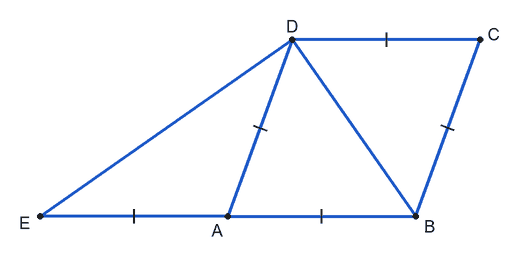
(i) Name the equal angles in and write why they are equal.
(ii) Name the equal angles in and write why they are equal.
(iii) Prove that .