
Question 253 marksMedium
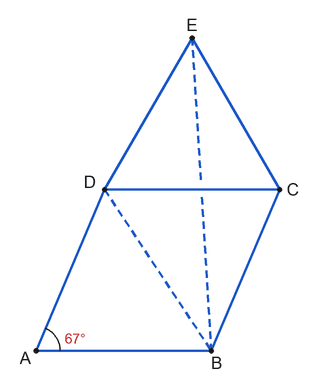
In the given figure; ABCD is a rhombus with angle A = 67°.
If DEC is an equilateral triangle, calculate :
(i) ∠CBE
(ii) ∠DBE
Confirming your payment
Sign up now and get 250 free tokens.
Rectilinear Figures · Question 25 of 57
In the given figure; ABCD is a rhombus with angle A = 67°.
If DEC is an equilateral triangle, calculate :
(i) ∠CBE
(ii) ∠DBE
Solution:
Concept: All sides of a rhombus are equal, its opposite angles are equal and each diagonal bisects the angles at its ends. Each angle of an equilateral triangle is . In a triangle, the sides opposite equal angles are equal, and the angles opposite equal sides are equal.
Given: Rhombus ABCD with ∠A = 67°, DEC an equilateral triangle.
Step 1 — Angles of the rhombus.
Opposite angles of a rhombus are equal, and adjacent angles add up to 180°.
So ∠BCD = ∠A, which is 67°.
Step 2 — Part (i): angle CBE.
∠BCE is made of ∠BCD and ∠DCE (60°, equilateral triangle). CB, CD and CE are all equal (sides of the rhombus and of the equilateral triangle), so triangle BCE is isosceles with equal angles at B and E.
So ∠CBE = 26.5°, that is 26°30′.
Step 3 — Part (ii): angle DBE.
The diagonal BD of a rhombus bisects ∠B, and ∠DBE is ∠DBC minus ∠CBE.
Watch out: CE, CD and CB are equal, so the equal angles of triangle BCE are at B and E.
Therefore, (i) ∠CBE = 26°30′, (ii) ∠DBE = 30°.