
Question 243 marksMedium
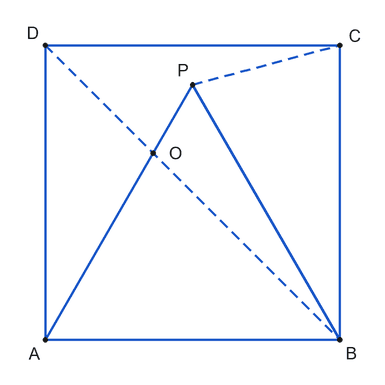
The given figure shows a square ABCD and an equilateral triangle ABP.
Calculate :
(i) ∠AOB
(ii) ∠BPC
(iii) ∠PCD
(iv) reflex ∠APC
Confirming your payment
Sign up now and get 250 free tokens.
Rectilinear Figures · Question 24 of 57
The given figure shows a square ABCD and an equilateral triangle ABP.
Calculate :
(i) ∠AOB
(ii) ∠BPC
(iii) ∠PCD
(iv) reflex ∠APC
Solution:
Concept: Each angle of a square is and a diagonal makes with a side; each angle of an equilateral triangle is . In a triangle, the sides opposite equal angles are equal, and the angles opposite equal sides are equal.
Given: Square ABCD, equilateral triangle ABP, AP meets the diagonal BD at O.
Step 1 — Part (i): angle AOB.
In triangle AOB, ∠OAB is the angle PAB of the equilateral triangle, so ∠OAB = 60°; and ∠OBA is the angle DBA between a diagonal and a side of the square, so ∠OBA = 45°.
Step 2 — Part (ii): angle BPC.
∠PBC is what is left of the right angle ABC after ∠ABP = 60°. Also, BP = AB (equilateral triangle) and AB = BC (square), so triangle BPC is isosceles and its base angles at P and C are equal.
Step 3 — Part (iii): angle PCD.
∠BCP equals ∠BPC, which is 75°; ∠PCD is the rest of the right angle BCD.
Step 4 — Part (iv): reflex angle APC.
The angle APC (less than 180°) is made of ∠APB and ∠BPC; the reflex angle is the rest of 360°.
Watch out: BP equals AB and AB equals BC, so triangle BPC is isosceles with its equal angles at P and C.
Therefore, (i) ∠AOB = 75°, (ii) ∠BPC = 75°, (iii) ∠PCD = 15°, (iv) reflex ∠APC = 225°.