
Question 263 marksMedium
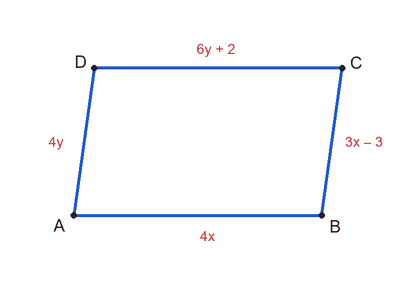
In each of the following figures, ABCD is a parallelogram.
(i)
(ii)
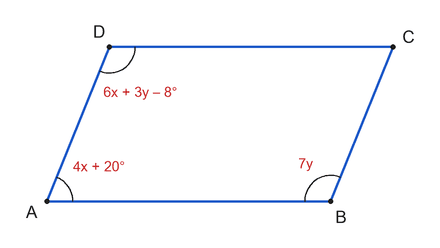
In each case, given above, find the values of x and y.
Confirming your payment
Sign up now and get 250 free tokens.
Rectilinear Figures · Question 26 of 57
In each of the following figures, ABCD is a parallelogram.
(i)
(ii)
In each case, given above, find the values of x and y.
Solution:
Concept: In a parallelogram, opposite sides are equal and parallel, opposite angles are equal, adjacent angles add up to (co-interior angles), and the diagonals bisect each other.
Given: ABCD is a parallelogram in both figures.
Step 1 — Part (i): equal opposite sides.
Opposite sides of a parallelogram are equal: AB = DC and AD = BC.
Step 2 — Part (i): solve.
From (2), . We put this into (1) and multiply through by 4.
Step 3 — Part (ii): equal opposite angles.
Opposite angles are equal, so ∠D = ∠B.
We call this equation (3).
Step 4 — Part (ii): adjacent angles.
Adjacent angles A and B add up to 180°.
We call this equation (4).
Step 5 — Part (ii): solve.
Multiply (3) by 7 and (4) by 4, then add, so that cancels.
Putting into (4):
Step 6 — Check.
We put x = 12 and y = 16 back into the angles.
∠B and ∠D are equal, and 68° + 112° makes 180°, as adjacent angles must.
Watch out: In (ii), x and y are numbers; the angles are 4x + 20°, 7y° and so on, so x and y themselves carry no degree sign.
Therefore, (i) x = 5 and y = 3; (ii) x = 12 and y = 16.