
Question 423 marksMedium
In parallelogram ABCD, the bisector of angle A meets DC at P and AB = 2AD.
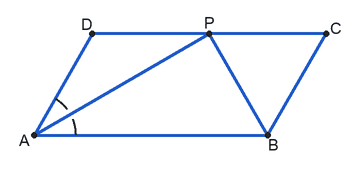
Prove that :
(i) BP bisects angle B.
(ii) Angle APB = 90°.
Confirming your payment
Sign up now and get 250 free tokens.
Rectilinear Figures · Question 42 of 57
In parallelogram ABCD, the bisector of angle A meets DC at P and AB = 2AD.
Prove that :
(i) BP bisects angle B.
(ii) Angle APB = 90°.
Solution:
Concept: When a line bisects an angle of a parallelogram, it makes equal alternate angles with the opposite side, so it cuts off an isosceles triangle.
Given: ABCD a parallelogram, the bisector of ∠A meets DC at P, AB = 2AD.
Step 1 — DP = AD.
AB ∥ DC, so ∠DPA = ∠PAB (alternate angles), and ∠PAB = ∠DAP (AP bisects ∠A). So in triangle ADP, ∠DPA = ∠DAP, and DP = AD.
Step 2 — PC = BC.
DC = AB and AB = 2AD, so P is the mid-point of DC.
Also AD = BC, so PC = BC.
Step 3 — Part (i).
In triangle BCP, PC = BC, so ∠CBP = ∠CPB.
Also ∠CPB = ∠PBA (alternate angles, DC ∥ AB).
So ∠CBP = ∠PBA, and BP bisects ∠B.
Step 4 — Part (ii).
∠A + ∠B = 180° (co-interior angles), and AP, BP bisect them.
Watch out: AB = 2AD is what makes PC equal to BC; without it BP would not bisect ∠B.
Therefore, (i) BP bisects ∠B and (ii) ∠APB = 90°. Hence proved.