
Question 513 marksMedium
In the given figure, AP is bisector of ∠A and CQ is bisector of ∠C of parallelogram ABCD. Prove that APCQ is a parallelogram
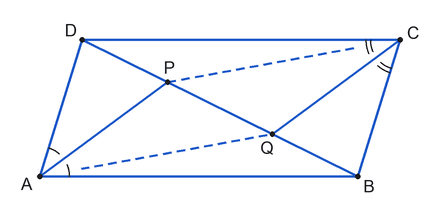
(Join AC and show that diagonals AC and PQ bisect each other.)
Confirming your payment
Sign up now and get 250 free tokens.
Rectilinear Figures · Question 51 of 57
In the given figure, AP is bisector of ∠A and CQ is bisector of ∠C of parallelogram ABCD. Prove that APCQ is a parallelogram
(Join AC and show that diagonals AC and PQ bisect each other.)
Solution:
Concept: A quadrilateral is a parallelogram if one pair of opposite sides is equal and parallel, or if both pairs of opposite sides are equal, or if its diagonals bisect each other.
Given: ABCD a parallelogram; AP bisects ∠A and CQ bisects ∠C, with P and Q on BD.
Step 1 — Congruent triangles ADP and CBQ.
AD = CB (opposite sides); ∠ADP = ∠CBQ (alternate angles, AD ∥ BC with DB as transversal); ∠DAP = ½∠A and ∠BCQ = ½∠C, which are equal because ∠A = ∠C. So ΔADP ≅ ΔCBQ (ASA), and DP = BQ.
Step 2 — Diagonals of ABCD.
Join AC and let it meet BD at O. The diagonals of ABCD bisect each other, so OA = OC and OD = OB.

Step 3 — OP = OQ.
P and Q lie on BD.
Since OD = OB and DP = BQ, OP = OQ.
Step 4 — Apply the test.
In APCQ the diagonals AC and PQ bisect each other at O, so APCQ is a parallelogram.
Watch out: The diagonals of APCQ are AC and PQ; PQ is part of BD.
Therefore, APCQ is a parallelogram. Hence proved.