
Question 223 marksMedium
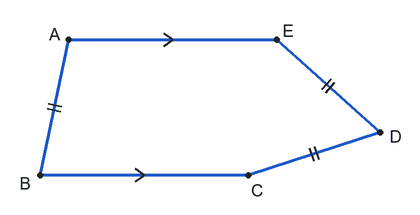
In the following figure, AE and BC are equal and parallel and the three sides AB, CD and DE are equal to one another. If angle A is 102°. Find angles AEC and BCD.
Confirming your payment
Sign up now and get 250 free tokens.
Rectilinear Figures · Question 22 of 57
In the following figure, AE and BC are equal and parallel and the three sides AB, CD and DE are equal to one another. If angle A is 102°. Find angles AEC and BCD.
Solution:
Concept: A quadrilateral is a parallelogram if one pair of opposite sides is equal and parallel, or if both pairs of opposite sides are equal, or if its diagonals bisect each other.
Given: AE = BC and AE ∥ BC; AB, CD and DE are equal; ∠A = 102°.
Step 1 — ABCE is a parallelogram.
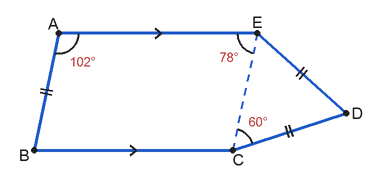
Join EC. AE = BC and AE ∥ BC, and a quadrilateral with one pair of opposite sides equal and parallel is a parallelogram. So EC = AB and EC ∥ AB.
Step 2 — Find ∠AEC.
AB ∥ EC with AE as a transversal, so ∠A and ∠AEC are co-interior angles.
Step 3 — Triangle CDE is equilateral.
EC = AB, and the given sides AB, CD and DE are equal, so all three sides of triangle CDE are equal. Each of its angles is 60°, so ∠ECD = 60°.
Step 4 — Find ∠BCD.
∠BCE equals ∠A, because they are opposite angles of the parallelogram ABCE; so ∠BCE is 102°. ∠BCD is made of ∠BCE and ∠ECD.
Watch out: Join EC first; the equilateral triangle only appears once EC is drawn.
Therefore, ∠AEC = 78° and ∠BCD = 162°.