
Question 473 marksMedium
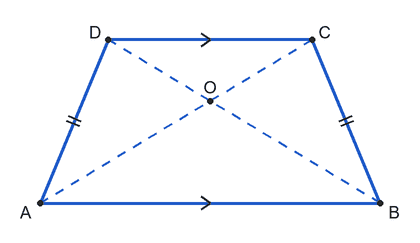
The following figure shows a trapezium ABCD in which AB is parallel to DC and AD = BC.
Prove that :
(i) ∠DAB = ∠CBA
(ii) ∠ADC = ∠BCD
(iii) AC = BD
(iv) OA = OB and OC = OD
Confirming your payment
Sign up now and get 250 free tokens.
Rectilinear Figures · Question 47 of 57
The following figure shows a trapezium ABCD in which AB is parallel to DC and AD = BC.
Prove that :
(i) ∠DAB = ∠CBA
(ii) ∠ADC = ∠BCD
(iii) AC = BD
(iv) OA = OB and OC = OD
Solution:
Concept: Two right triangles are congruent by RHS; triangles are congruent by SAS. The distance between two parallel lines is the same everywhere.
Given: Trapezium ABCD with AB ∥ DC and AD = BC.
Step 1 — Construction.
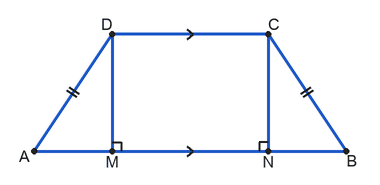
Draw DM ⟂ AB and CN ⟂ AB. DC ∥ AB, so DM = CN (the distance between the parallel lines).
Step 2 — Part (i).
In triangles DAM and CBN: ∠DMA = ∠CNB (both 90°), AD = BC (hypotenuses) and DM = CN. So ΔDAM ≅ ΔCBN (RHS), giving ∠DAB = ∠CBA.
Step 3 — Part (ii).
DC ∥ AB, so ∠ADC = 180° − ∠DAB and ∠BCD = 180° − ∠CBA (co-interior angles). Equal angles have equal supplements, so ∠ADC = ∠BCD.
Step 4 — Part (iii).
In triangles ADB and BCA: AD = BC, ∠DAB = ∠CBA and AB is common. So ΔADB ≅ ΔBCA (SAS), giving AC = BD.
Step 5 — Part (iv).
From the same congruence, ∠ABD = ∠BAC, that is ∠OBA = ∠OAB, so OA = OB. Then:
Since AC = BD and OA = OB, OC = OD.
Watch out: Prove ∠DAB = ∠CBA first; parts (iii) and (iv) depend on it.
Therefore, (i) ∠DAB = ∠CBA, (ii) ∠ADC = ∠BCD, (iii) AC = BD and (iv) OA = OB and OC = OD. Hence proved.