
Opening your dashboard
Class 9 Maths Chapter 14 Rectilinear Figures: Competency-Based Questions (CBQ)
40 questions on Chapter 14, each worked through on its own page with the AI tutor. Class 9 Maths, ICSE 2026-27.
40 questions
1–5 marks · Mixed difficulty
- 11 mark
Question 1
Competency: Application
The ₹ 20 coin has 12 straight edges. Take its shape to be a regular polygon of 12 sides.
Each interior angle of this polygon is
- 21 mark
Question 2
Competency: Analysis
A toy robot moves along the boundary of a regular polygon. It moves 2 m along a side, turns through 24° at the corner, moves 2 m along the next side, turns through 24° again, and so on.
How far has it moved when it first returns to its starting point?
- 31 mark
Question 3
Competency: Analysis
A frame is made from two straight sticks, 40 cm and 60 cm long. The sticks are tied together at their mid-points, at an angle of 70° to each other. A thread is then stretched round the four ends of the sticks.
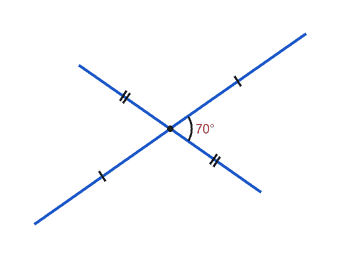
The thread forms
- 41 mark
Question 4
Competency: Application
A plot of land is in the shape of a parallelogram. One of its angles is 30° less than twice the angle next to it.
The largest angle of the plot is
- 51 mark
Question 5
Competency: Evaluation
Assertion (A): Every rhombus is a regular polygon.
Reason (R): All the sides of a rhombus are equal.
- 61 mark
Question 6
Competency: Analysis
A rectangular gate ABCD is strengthened by two iron strips along its diagonals AC and BD. The strips cross at O and ∠AOB = 124°.

The angle that the strip AC makes with the side AB is
- 72 marks
Question 7
Competency: Application
A cyclist rides once round a five-sided park, keeping along its boundary. At four of the corners she turns through 60°, 75°, 80° and 70°.
Through what angle does she turn at the fifth corner? What is the interior angle of the park at that corner?
- 82 marks
Question 8
Competency: Evaluation
Ravi says, "If a regular polygon has more sides, each of its exterior angles is bigger."
Test his statement with a regular polygon of 6 sides and one of 9 sides. Is he right? Write the correct statement for exterior angles and for interior angles.
- 92 marks
Question 9
Competency: Application
A road sign is in the shape of a rhombus. Each side is 40 cm long and one of its angles is 60°.
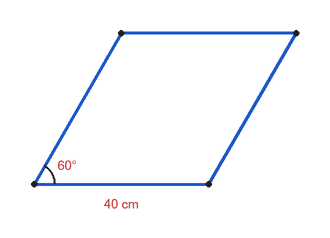
Find the length of the shorter diagonal of the sign. Give reasons.
- 102 marks
Question 10
Competency: Analysis
The figure shows an ironing table from the side. Its legs AC and BD are joined by a pin at O so that AO = OC and BO = OD. AB is the table-top, and the feet D and C rest on the floor.

(a) Explain why the table-top AB stays parallel to the floor, whatever the height of the table.
(b) The two legs are equal in length. What special quadrilateral is ABCD? Give a reason.
- 113 marks
Question 11
Competency: Application & Analysis
A table-top is a regular octagon ABCDEFGH. A carpenter joins the alternate corners A, C, E and G with thin strips of wood.
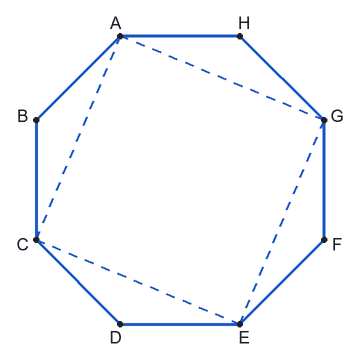
(a) Find each interior angle of the octagon.
(b) Find ∠BCA.
(c) Show that ∠ACE = 90°. What does this suggest about the figure ACEG?
- 123 marks
Question 12
Competency: Creativity
You have to make three different four-sided frames. For each frame you tie two straight sticks together as its diagonals and stretch a thread round the four ends. You may cut the sticks to any lengths.
Plan how you will choose and tie the sticks to get :
(a) a rectangle that is not a square,
(b) a rhombus that is not a square,
(c) a square.
For each frame, state the lengths of the two sticks, where they are tied and the angle between them.
- 133 marks
Question 13
Competency: Analysis & Evaluation
Two students make statements about quadrilaterals.
Asha: "If one angle of a parallelogram is a right angle, then it must be a rectangle."
Bina: "If all four sides of a quadrilateral are equal, then it must be a square."
Decide whether each statement is true. Prove the true one and give an example to show that the other is false.
- 145 marks
Question 14
Competency: Application & Analysis
Case study — Making paper kites
Imran makes a paper kite ABCD on two thin bamboo sticks AC and BD. Each stick is 60 cm long. He ties them at their mid-points O, at right angles, and pastes paper over the frame.
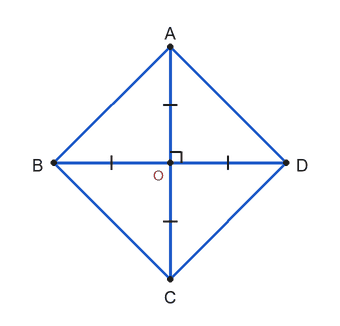
(a) What special kind of quadrilateral is the frame ABCD of this paper kite? Give reasons.
(b) Find the angle between the stick AC and the edge AB. Find the length of the edge AB, correct to one decimal place. (Take .)
(c) Imran makes a second paper kite in the same way, with sticks of 80 cm and 60 cm tied at their mid-points at right angles. Name the shape of its frame. Find the length of coloured tape needed to go once round its border.
- 154 marks
Question 15
Competency: Understanding & Analysis
Case study — Sorting frames by their diagonals
A workshop makes four-sided frames. Each frame has two straight braces along its diagonals. An inspector records the following.
Frame Brace 1 Brace 2 Do the braces bisect each other? Angle between the braces W 50 cm 50 cm Yes 90° X 60 cm 40 cm Yes 90° Y 52 cm 52 cm Yes 70° Z 48 cm 36 cm Yes 65° (a) Name the most special kind of quadrilateral that each frame must be. Give a reason for each.
(b) In frame Y, find the angles that a brace makes with the two sides at one corner.
(c) The workshop wants to turn frame Z into a rectangle by replacing only one brace. Which brace should be replaced, and by what length? Must the angle between the braces be changed?
- 161 mark
Question 16
Competency: Application
A student draws a polygon in her notebook. From one corner she draws straight lines inside the polygon to every other corner she can reach. These lines cut the polygon into 9 triangles.
What is the sum of the interior angles of her polygon?
- 171 mark
Question 17
Competency: Analysis
A giant wheel at a fair has straight arms of equal length from its hub, equally spaced round the hub. The angle between any two neighbouring arms at the hub is . The outer ends of neighbouring arms are joined by straight rods, and the rods form a regular polygon.
What is each interior angle of this polygon?
- 181 mark
Question 18
Competency: Application & Analysis
The figure shows the cross-section ABCD of a canal. The top AB is parallel to the bottom DC, and AB is longer than DC. The sloping sides AD and BC are equal, and .
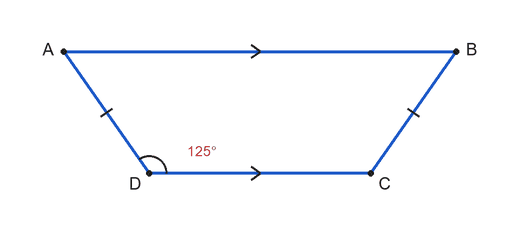
What is the measure of ?
- 191 mark
Question 19
Competency: Application
A rhombus-shaped floor tile has each side 13 cm long. A mason measures one diagonal of the tile and finds it is 10 cm.
What is the length of the other diagonal?
- 201 mark
Question 20
Competency: Analysis & Evaluation
Assertion (A): A regular polygon can have each interior angle equal to .
Reason (R): Each interior angle of every regular polygon is an obtuse angle.
- 211 mark
Question 21
Competency: Analysis
A student prepares a table of the sum of the interior angles of some polygons. One of the four entries is wrong.
Polygon Number of sides Sum of interior angles Pentagon 5 Hexagon 6 Octagon 8 Decagon 10 Which entry is wrong, and what should the sum be?
- 221 mark
Question 22
Competency: Understanding
The wooden frame ABCD of a window is known to be a parallelogram. The supervisor wants to prove that it is a rhombus by making one more check.
Which single check is enough?
- 231 mark
Question 23
Competency: Evaluation
Assertion (A): The sum of the exterior angles of a regular decagon is greater than the sum of the exterior angles of a regular triangle.
Reason (R): The exterior angle of a regular polygon becomes smaller when the number of sides increases.
- 241 mark
Question 24
Competency: Analysis
A signboard maker changes a design from a regular hexagon to a regular dodecagon (12 sides).
By how many degrees does each interior angle of the design increase?
- 251 mark
Question 25
Competency: Understanding
A folding clothes-drying frame has the shape of a parallelogram ABCD, with hinges at the four corners. The rods AB, BC, CD and DA keep the same lengths. When the frame is pushed, changes from to and the frame is still a parallelogram.
Which of the following does not change?
- 262 marks
Question 26
Competency: Application
A park is in the shape of a parallelogram ABCD. A fence is extended from A through B to a point E, so that A, B and E lie on a straight line, and .
Find all four angles of the park.
- 272 marks
Question 27
Competency: Application
A square garden ABCD has a straight path along its diagonal AC. A second straight path goes from A to a point P on the side BC, and .
Find and .
- 282 marks
Question 28
Competency: Analysis & Evaluation
A carpenter makes a four-sided frame ABCD in which AB is parallel to DC and the other two sides, AD and BC, are equal. He says, "One pair of opposite sides is parallel and the other pair is equal, so my frame must be a parallelogram."
Is he right? Give a reason. State one extra condition on the sides AB and DC that would make the frame sure to be a parallelogram.
- 292 marks
Question 29
Competency: Analysis
A designer compares two regular polygon table-tops. Table A has 15 sides. In table B each interior angle is .
Find the number of sides of table B. Which table-top has the larger interior angle, and by how many degrees?
- 302 marks
Question 30
Competency: Application
A plot of land is in the shape of a trapezium ABCD with AB parallel to DC. Its angles satisfy and .
Find the four angles of the plot.
- 312 marks
Question 31
Competency: Analysis
Two quadrilateral tiles are cut from a sheet. The angles of tile PQRS, taken in order at P, Q, R, S, are , , , . The angles of tile WXYZ, taken in order at W, X, Y, Z, are , , , .
Which tile is a parallelogram? Give a reason. For the other tile, name one pair of parallel sides.
- 323 marks
Question 32
Competency: Analysis
A rectangular playground ABCD has two straight paths along its diagonals AC and BD, which cross at O. Each path is 18 m long, and the side AB is 9 m long.
Find:
(i)
(ii)
(iii) the length of BC, and the perimeter of the playground (take )
- 333 marks
Question 33
Competency: Application & Analysis
A sheet-metal worker has a rectangular sheet ABCD with cm and cm. He marks a point P on AB and a point R on CD so that . He then cuts along DP and BR and keeps the four-sided piece PBRD.
(i) Show that PBRD is a parallelogram.
(ii) Find the perimeter of PBRD when cm.
(iii) Find the length AP for which PBRD is a rhombus.
- 343 marks
Question 34
Competency: Analysis
A tile maker can set her cutting machine only to whole numbers of degrees. She wants to make regular polygon tiles with 3 to 12 sides, in which each exterior angle is a whole number of degrees.
Which numbers of sides are possible? Of the possible tiles, which one has the largest interior angle, and what is it?
- 353 marks
Question 35
Competency: Evaluation
Three students find the number of sides of a regular polygon in which each interior angle is .
Ria: "I divide 360 by 165. The answer is not a whole number, so no such polygon exists."
Sam: "The angle sum is , and it is also . Solving gives ."
Tara: "Each exterior angle is . Dividing 360 by 15 gives ."
Decide whose working is correct, and explain the error in the wrong working. Then check the answer by finding the sum of the interior angles in two ways.
- 363 marks
Question 36
Competency: Application
A plot of land is in the shape of a parallelogram. Its perimeter is 76 m, and one side is 6 m longer than the side next to it. The ratio of two adjacent angles of the plot is . The owner fences the whole plot at ₹ 45 per metre.
Find:
(i) the lengths of the sides
(ii) the angles of the plot
(iii) the cost of the fencing
- 375 marks
Question 37
Competency: Analysis & Evaluation
Case study — Rangoli designs
Kavya draws rangoli outlines on a turntable. After she draws each side she turns the turntable by a fixed angle and then draws the next side. Each design is a closed regular polygon, so the turning angle is the exterior angle of the polygon. Her notebook records (Hypothetical data):
Design Turning angle P Q R S (a) Find the number of sides of the designs P, Q and R.
(b) Find each interior angle of design S, and the sum of the interior angles of design S.
(c) Kavya's friend says that a turning angle of will also give a closed regular polygon. Is he right? Explain.
- 384 marks
Question 38
Competency: Analysis
Case study — A pentagonal courtyard
A courtyard ABCDE is in the shape of a regular pentagon. Two straight paths AC and AD are laid from the corner A.
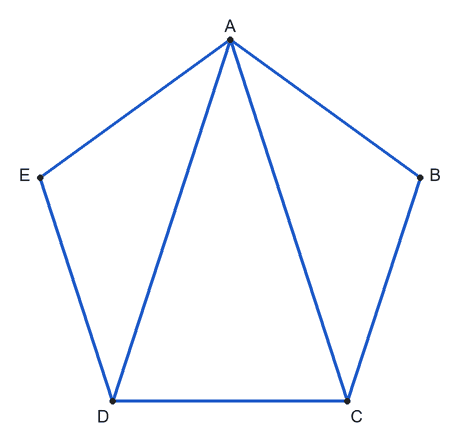
(a) Find and then .
(b) Find .
(c) Show that BC is parallel to AD, and name the special quadrilateral ABCD.
- 395 marks
Question 39
Competency: Understanding & Evaluation
Case study — Land survey
A surveyor measures three four-sided plots ABCD. She records the angles in the order A, B, C, D and the sides in the order AB, BC, CD, DA (Hypothetical data):
Plot Angles A, B, C, D Sides AB, BC, CD, DA 1 , , , not measured 2 , , , 30 m, 20 m, 30 m, 20 m 3 , , , 25 m, 25 m, 25 m, 25 m (a) Which plots are parallelograms? Give a reason for each.
(b) Give the most exact name for plot 2 and for plot 3.
(c) The owner of plot 2 plans a straight path along the diagonal AC. He says, "The path will cut the corner angle at A into two equal angles of each." Is he right? Which of and is larger? Give a reason.
- 404 marks
Question 40
Competency: Creativity
Case study — Frames from a wire
A craftsman has a wire 40 cm long. For each frame below he uses the whole wire and joins the ends. Design the frames.
(a) A square frame. State the length of each side.
(b) A rhombus frame that is not a square. Choose one of its angles, and state the length of each side and all four angles.
(c) A parallelogram frame that is not a rhombus. Choose the lengths of two adjacent sides and one angle, and state all four angles and the lengths of all four sides.