
Question 393 marksEasy
Prove that the bisectors of opposite angles of a parallelogram are parallel.
Confirming your payment
Sign up now and get 250 free tokens.
Rectilinear Figures · Question 39 of 57
Prove that the bisectors of opposite angles of a parallelogram are parallel.
Solution:
Concept: In a parallelogram, opposite sides are equal and parallel, opposite angles are equal, adjacent angles add up to (co-interior angles), and the diagonals bisect each other. Two lines are parallel when a pair of corresponding angles is equal.
Step 1 — Set up.
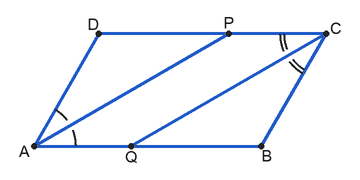
Let ABCD be a parallelogram, AP the bisector of ∠A (P on DC) and CQ the bisector of ∠C (Q on AB).
Step 2 — Equal half-angles.
Opposite angles of a parallelogram are equal, so their halves are equal.
Since ∠A = ∠C, ∠PAB = ∠QCD.
Step 3 — Alternate angles.
DC ∥ AB with QC as a transversal, so ∠QCD = ∠CQB (alternate angles).
Hence ∠PAB = ∠CQB.
Step 4 — Corresponding angles.
∠PAB and ∠CQB are corresponding angles for the lines AP and QC with the transversal AB. They are equal, so AP ∥ QC.
Watch out: Use the bisectors of OPPOSITE angles (A and C); the bisectors of adjacent angles meet at 90°.
Therefore, AP ∥ QC: the bisectors of opposite angles of a parallelogram are parallel. Hence proved.