
Question 133 marksMedium
AB, BC and CD are the three consecutive sides of a regular polygon. If ∠BAC = 15°; find,
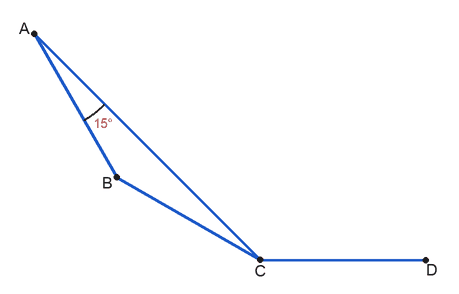
(i) each interior angle of the polygon.
(ii) each exterior angle of the polygon.
(iii) number of sides of the polygon.
Confirming your payment
Sign up now and get 250 free tokens.
Rectilinear Figures · Question 13 of 57
AB, BC and CD are the three consecutive sides of a regular polygon. If ∠BAC = 15°; find,
(i) each interior angle of the polygon.
(ii) each exterior angle of the polygon.
(iii) number of sides of the polygon.
Solution:
Concept: At each vertex, the interior angle and the exterior angle make a straight line, so they add up to . In a regular polygon all exterior angles are equal and add up to , so each exterior angle is and .
Given: AB, BC, CD consecutive sides of a regular polygon, ∠BAC = 15°.
Step 1 — Interior angle ABC.
The sides of a regular polygon are equal, so AB = BC; triangle ABC is isosceles, and its base angle ∠BCA equals ∠BAC, which is 15°. ∠ABC is an interior angle of the polygon.
Step 2 — Exterior angle.
The interior and exterior angles at a vertex add up to 180°.
Step 3 — Number of sides.
We divide 360° by one exterior angle.
Watch out: ∠BAC is not an exterior angle; it is a base angle of the isosceles triangle ABC.
Therefore, (i) each interior angle = 150°, (ii) each exterior angle = 30°, (iii) the polygon has 12 sides.