
Question 553 marksMedium
In the following figure, ABCD is a rhombus and DCFE is a square.
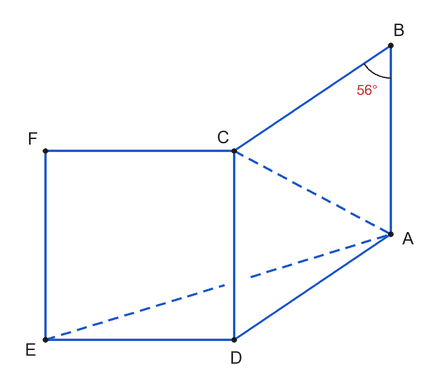
If ∠ABC = 56°, find :
(i) ∠DAE
(ii) ∠FEA
(iii) ∠EAC
(iv) ∠AEC
Confirming your payment
Sign up now and get 250 free tokens.
Rectilinear Figures · Question 55 of 57
In the following figure, ABCD is a rhombus and DCFE is a square.
If ∠ABC = 56°, find :
(i) ∠DAE
(ii) ∠FEA
(iii) ∠EAC
(iv) ∠AEC
Solution:
Concept: All sides of a rhombus are equal and a diagonal bisects its angles; a diagonal of a square makes with the sides. In a triangle, the sides opposite equal angles are equal, and the angles opposite equal sides are equal.
Given: ABCD a rhombus with ∠ABC = 56°, DCFE a square.
Step 1 — Known angles.
Opposite angles of the rhombus are equal, so ∠ADC = ∠ABC, which is 56°. Adjacent angles add up to 180°.
∠CDE = 90°, because DCFE is a square. Also, AD = DC (rhombus) and DC = DE (square), so AD = DE.
Step 2 — Part (i).
∠ADE is made of ∠ADC and ∠CDE. Triangle ADE is isosceles (AD = DE), so its angles at A and E are equal.
Step 3 — Part (ii).
∠DEA = ∠DAE, so ∠DEA is also 17°; ∠FEA is the rest of the right angle FED.
Step 4 — Part (iii).
The diagonal AC of the rhombus bisects ∠DAB.
Step 5 — Part (iv).
The diagonal EC of the square makes 45° with ED, so ∠DEC = 45°.
Watch out: AD and DE are both equal to DC, so triangle ADE is isosceles; that is the key step.
Therefore, (i) ∠DAE = 17°, (ii) ∠FEA = 73°, (iii) ∠EAC = 45°, (iv) ∠AEC = 28°.