
Opening your dashboard
Class 9 Maths Chapter 12: Mid-Point Theorem and Its Converse Solutions
45 textbook questions with step-by-step answers, free to read, for ICSE 2026-27.
Get talked through Ch 12, not just shown the answer
Reading a finished solution is not the same as being able to do it. The AI tutor takes one question at a time and works it with you, in your own words, until you can.
- Ask it out loud, in your own words
- It gives you the next step, not the answer
- Stuck on part (ii)? Start there
45 questions with solutions
1–3 marks · Mixed difficulty
- 11 mark
Question 1
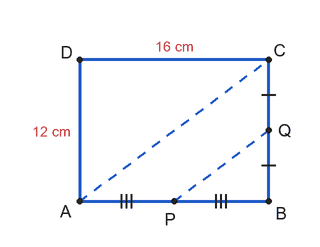
In the given figure, ABCD is a rectangle. As per the given information, the length of PQ is :
 Solve with AI
Answer
(A) 12 cm
(B) 14 cm
(C) 20 cm
- Correct
(D) 10 cm
Answer: (D) 10 cm
Concept: Mid-point theorem: the segment joining the mid-points of two sides of a triangle is parallel to the third side and equal to half of it.
Step 1 — Read the figure.
ABCD is a rectangle, so AB and DC are both 16 cm, and AD and BC are both 12 cm. The ticks mark P as the mid-point of AB and Q as the mid-point of BC.
Step 2 — Find the diagonal AC.
∠B = 90°, so in the right triangle ABC Pythagoras' theorem gives AC.
Step 3 — Use the mid-point theorem in ΔABC.
P and Q are the mid-points of AB and BC, so PQ is half of the third side AC.
Watch out: The joining segment is half of the THIRD side, the side it is parallel to, not of either side it joins.
Why the other options are wrong:
- (A): 12 cm is the side AD (= BC), not PQ.
- (B): 14 cm is the average of 16 cm and 12 cm; PQ is half the diagonal, not the average of the sides.
- (C): 20 cm is the whole diagonal AC; PQ is only half of it.
Therefore, PQ = 10 cm, option (D).
- 21 mark
Question 2
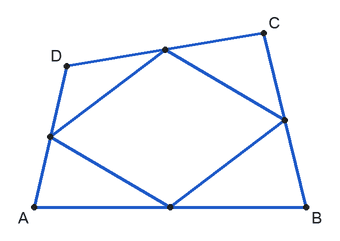
The quadrilateral obtained by joining the mid-points (in order) of the sides of quadrilateral ABCD is :
 Solve with AI
Answer
(A) rectangle
(B) rhombus
- Correct
(C) parallelogram
(D) square
Answer: (C) parallelogram
Concept: Mid-point theorem: the segment joining the mid-points of two sides of a triangle is parallel to the third side and equal to half of it. A quadrilateral is a parallelogram when both pairs of opposite sides are parallel, or when one pair of opposite sides is equal and parallel, or when its diagonals bisect each other.
Step 1 — Name the mid-points.
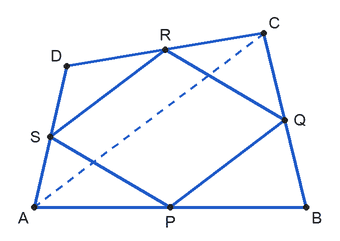
Let P, Q, R, S be the mid-points of AB, BC, CD, DA, and join the diagonal AC.
Step 2 — Use the mid-point theorem twice.
In ΔABC, P and Q are mid-points, so PQ ∥ AC and PQ is half of AC.
In ΔADC, S and R are mid-points, so SR ∥ AC and SR is half of AC.
Step 3 — Conclude.
So PQ and SR are equal and parallel. One pair of opposite sides equal and parallel makes PQRS a parallelogram, whatever the shape of ABCD.
Watch out: Nothing is known about ABCD, so only the result that holds for EVERY quadrilateral can be the answer.
Why the other options are wrong:
- (A): PQRS is a rectangle only when the diagonals of ABCD are perpendicular, which is not given.
- (B): PQRS is a rhombus only when the diagonals of ABCD are equal, which is not given.
- (D): PQRS is a square only when the diagonals of ABCD are both equal and perpendicular, which is not given.
Therefore, the quadrilateral is a parallelogram, option (C).
- 31 mark
Question 3
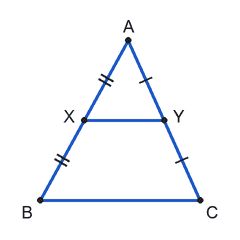
If BC = 12 cm, AB = 14·8 cm, AC = 12·8 cm, the perimeter of quadrilateral BCYX is :
 Solve with AI
Answer
- Correct
(A) 31·8 cm
(B) 15·9 cm
(C) 29·8 cm
(D) 32·8 cm
Answer: (A) 31·8 cm
Concept: Mid-point theorem: the segment joining the mid-points of two sides of a triangle is parallel to the third side and equal to half of it.
Step 1 — Read the figure.
The ticks mark X as the mid-point of AB and Y as the mid-point of AC.
Step 2 — Find XY.
X and Y are mid-points of two sides of ΔABC, so XY is half of the third side BC.
Step 3 — Find BX and CY.
Each is half of a whole side.
Step 4 — Add the four sides of BCYX.
The perimeter is BC + CY + YX + XB.
Watch out: BX and CY are HALVES of AB and AC; using the whole sides gives a wrong perimeter.
Why the other options are wrong:
- (B): 15·9 cm is half of the correct perimeter 31·8 cm.
- (C): 29·8 cm is 2 cm short; it would need XY = 4 cm, but XY is half of BC, which is 6 cm.
- (D): 32·8 cm is 1 cm too much; it would need XY = 7 cm, but XY is 6 cm.
Therefore, the perimeter of BCYX is 31·8 cm, option (A).
- 41 mark
Question 4
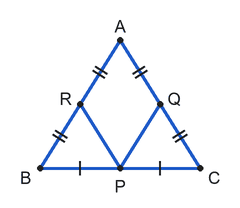
In the given figure, AB = AC, P, Q and R are mid-points of sides BC, CA and AB respectively, then ΔPQR is :
 Solve with AI
Answer
(A) scalene
- Correct
(B) isosceles
(C) equilateral
(D) obtuse angled
Answer: (B) isosceles
Concept: Mid-point theorem: the segment joining the mid-points of two sides of a triangle is parallel to the third side and equal to half of it.
Step 1 — Use the mid-point theorem for two sides of ΔPQR.
P and Q are the mid-points of BC and CA, so PQ is half of the third side AB.
P and R are the mid-points of BC and AB, so PR is half of the third side AC.
Step 2 — Compare PQ and PR.
AB = AC, so their halves are equal: PQ = PR. A triangle with two equal sides is isosceles.
Watch out: The joining segment is half of the THIRD side, the side it is parallel to, not of either side it joins.
Why the other options are wrong:
- (A): Step 2 shows two sides of ΔPQR are equal, so it is not scalene.
- (C): The third side QR is half of BC, and BC need not equal AB, so the three sides need not all be equal.
- (D): ΔPQR has the same angles as ΔABC (its sides are parallel to those of ΔABC), so it is obtuse only if ΔABC is, which is not given.
Therefore, ΔPQR is isosceles, option (B).
- 51 mark
Question 5
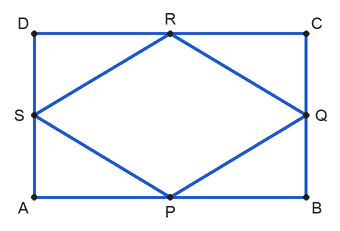
P, Q, R and S are the mid-points of sides AB, BC, CD and DA respectively of rectangle ABCD, then quadrilateral PQRS is :
 Solve with AI
Answer
(A) rectangle
- Correct
(B) rhombus
(C) square
(D) parallelogram
Answer: (B) rhombus
Concept: Mid-point theorem: the segment joining the mid-points of two sides of a triangle is parallel to the third side and equal to half of it. The diagonals of a rectangle are equal.
Step 1 — Each side of PQRS is half a diagonal.
Join AC and BD.

By the mid-point theorem in the four triangles ABC, ADC, ABD and BCD:
PQ and SR are each half of AC.
PS and QR are each half of BD.
Step 2 — Use the rectangle.
The diagonals of a rectangle are equal, AC = BD, so all four sides of PQRS are equal. A quadrilateral with four equal sides is a rhombus.
Watch out: The sides of PQRS are parallel to the diagonals of ABCD, so its angles are right angles only if the diagonals of ABCD are perpendicular.
Why the other options are wrong:
- (A): PQRS has right angles only if AC ⊥ BD, and the diagonals of a rectangle are perpendicular only when it is a square.
- (C): A square needs right angles as well, and those need AC ⊥ BD, which a general rectangle does not have.
- (D): PQRS is a parallelogram too, but every rhombus is a parallelogram; 'rhombus' is the exact description, so (B) is the best answer.
Therefore, PQRS is a rhombus, option (B).
- 63 marks
Question 6
In triangle ABC, M is mid-point of AB and a straight line through M and parallel to BC cuts AC at N.
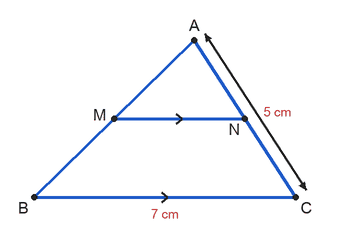
Find the lengths of AN and MN, if BC = 7 cm and AC = 5 cm.
Solve with AIWritten solution
Solution:
Concept: Converse of the mid-point theorem: a line drawn through the mid-point of one side of a triangle, parallel to a second side, bisects the third side. Mid-point theorem: the segment joining the mid-points of two sides of a triangle is parallel to the third side and equal to half of it.
Given: M is the mid-point of AB, MN ∥ BC with N on AC, BC = 7 cm and AC = 5 cm.
Step 1 — Find where the line meets AC.
M is the mid-point of AB and MN ∥ BC. By the converse of the mid-point theorem, N is the mid-point of AC.
Step 2 — Find AN.
AN is half of AC.
Step 3 — Find MN.
M and N are now both mid-points, so MN is half of the third side BC.
Watch out: First show N is a mid-point (converse); only then use MN = ½ BC.
Therefore, AN = 2·5 cm and MN = 3·5 cm.
- 73 marks
Question 7
Prove that the figure obtained by joining the mid-points of the adjacent sides of a rectangle is a rhombus.
 Solve with AI
Written solution
Solution:
Concept: Mid-point theorem: the segment joining the mid-points of two sides of a triangle is parallel to the third side and equal to half of it. The diagonals of a rectangle are equal.
Given: ABCD is a rectangle; P, Q, R, S are the mid-points of AB, BC, CD, DA.
Step 1 — Set up.
Let ABCD be a rectangle and P, Q, R, S the mid-points of AB, BC, CD, DA. Join the diagonals AC and BD.
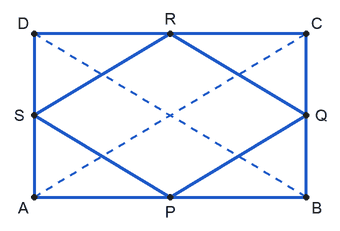
Step 2 — Sides PQ and SR.
In ΔABC, P and Q are mid-points, so PQ is half of AC.
In ΔADC, S and R are mid-points, so SR is half of AC.
Step 3 — Sides PS and QR.
In ΔABD, P and S are mid-points, so PS is half of BD.
In ΔBCD, Q and R are mid-points, so QR is half of BD.
Step 4 — Use the equal diagonals.
The diagonals of a rectangle are equal, AC = BD, so their halves are equal and PQ, QR, RS and SP are all equal. A quadrilateral with four equal sides is a rhombus.
Watch out: The joining segment is half of the THIRD side, the side it is parallel to, not of either side it joins.
Therefore, PQRS has four equal sides, so it is a rhombus. Hence proved.
- 83 marks
Question 8
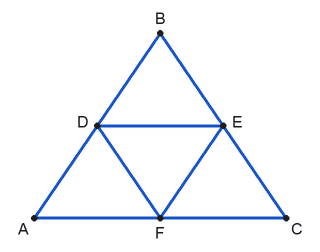
D, E and F are the mid-points of the sides AB, BC and CA of an isosceles Δ ABC in which AB = BC. Prove that Δ DEF is also isosceles.
 Solve with AI
Written solution
Solution:
Concept: Mid-point theorem: the segment joining the mid-points of two sides of a triangle is parallel to the third side and equal to half of it.
Given: D, E, F are the mid-points of AB, BC, CA, and AB = BC.
Step 1 — Side DF.
D and F are the mid-points of AB and CA, so DF is half of the third side BC.
Step 2 — Side EF.
E and F are the mid-points of BC and CA, so EF is half of the third side AB.
Step 3 — Compare.
AB = BC, so their halves are equal: DF = EF. Two sides of ΔDEF are equal, so it is isosceles.
Watch out: The joining segment is half of the THIRD side, the side it is parallel to, not of either side it joins.
Therefore, DF = EF, so ΔDEF is isosceles. Hence proved.
- 93 marks
Question 9
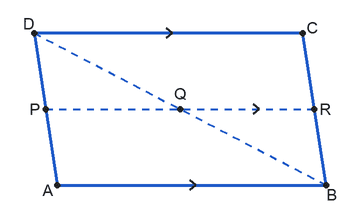
The following figure shows a trapezium ABCD in which AB // DC. P is the mid-point of AD and PR // AB. Prove that :
 Solve with AI
Written solution
Solution:
Concept: Converse of the mid-point theorem: a line drawn through the mid-point of one side of a triangle, parallel to a second side, bisects the third side. Mid-point theorem: the segment joining the mid-points of two sides of a triangle is parallel to the third side and equal to half of it.
Given: ABCD is a trapezium with AB ∥ DC, P is the mid-point of AD and PR ∥ AB.
Step 1 — Split PR at the diagonal.
Let the diagonal DB cut PR at Q, so PR = PQ + QR.
Step 2 — ΔDAB.
P is the mid-point of AD and PQ ∥ AB. By the converse of the mid-point theorem, Q is the mid-point of DB. P and Q are now both mid-points, so PQ is half of AB.
Step 3 — ΔBDC.
PR ∥ AB and AB ∥ DC, so QR ∥ DC. Q is the mid-point of DB, so by the converse R is the mid-point of BC, and by the mid-point theorem QR is half of DC.
Step 4 — Add the two parts.
Put the two halves together.
Watch out: Use a different triangle for each part of PR: ΔDAB for PQ, ΔBDC for QR.
Therefore, . Hence proved.
- 103 marks
Question 10
The figure, given below, shows a trapezium ABCD. M and N are the mid-points of the non-parallel sides AD and BC respectively. Find :
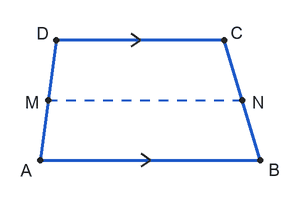
(i) MN, if AB = 11 cm and DC = 8 cm.
(ii) AB, if DC = 20 cm and MN = 27 cm.
(iii) DC, if MN = 15 cm and AB = 23 cm.
Solve with AIWritten solution
Solution:
Concept: In a trapezium, the segment joining the mid-points of the two non-parallel sides is parallel to the parallel sides and equal to half their sum.
Given: ABCD is a trapezium with AB ∥ DC; M and N are the mid-points of AD and BC.
Step 1 — The rule.
From the result of Q5, MN is half the sum of the parallel sides.
Step 2 — Part (i).
Put AB = 11 cm and DC = 8 cm.
Step 3 — Part (ii).
Put MN = 27 cm and DC = 20 cm, and solve for AB (written x).
Step 4 — Part (iii).
Put MN = 15 cm and AB = 23 cm, and solve for DC (written x).
Watch out: Multiply both sides by 2 first; that clears the ½ before you subtract.
Therefore, (i) MN = 9·5 cm, (ii) AB = 34 cm and (iii) DC = 7 cm.
- 113 marks
Question 11
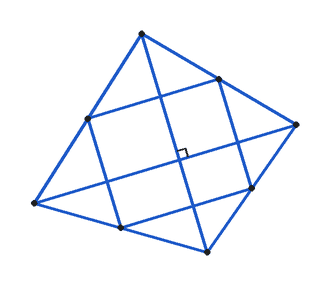
The diagonals of a quadrilateral intersect at right angles. Prove that the figure obtained by joining the mid-points of the adjacent sides of the quadrilateral is a rectangle.
 Solve with AI
Written solution
Solution:
Concept: Mid-point theorem: the segment joining the mid-points of two sides of a triangle is parallel to the third side and equal to half of it. A quadrilateral is a parallelogram when both pairs of opposite sides are parallel, or when one pair of opposite sides is equal and parallel, or when its diagonals bisect each other. A parallelogram with one right angle is a rectangle.
Given: The diagonals of ABCD meet at right angles; P, Q, R, S are the mid-points of its sides.
Step 1 — Set up.
Let ABCD have diagonals AC ⊥ BD, and let P, Q, R, S be the mid-points of AB, BC, CD, DA.

Step 2 — PQRS is a parallelogram.
In ΔABC, PQ ∥ AC and PQ is half of AC. In ΔADC, SR ∥ AC and SR is half of AC. So PQ and SR are equal and parallel, and PQRS is a parallelogram.
Step 3 — One angle of PQRS.
In ΔABD, P and S are mid-points, so PS ∥ BD. Now PQ ∥ AC, PS ∥ BD and AC ⊥ BD, so PQ ⊥ PS: ∠SPQ = 90°.
Step 4 — Conclude.
A parallelogram with one right angle is a rectangle.
Watch out: The right angle of PQRS comes from the sides being PARALLEL to the perpendicular diagonals.
Therefore, PQRS is a rectangle. Hence proved.
- 123 marks
Question 12
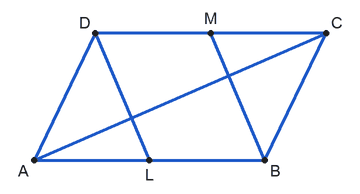
L and M are the mid-points of sides AB and DC respectively of parallelogram ABCD. Prove that segments DL and BM trisect diagonal AC.
 Solve with AI
Written solution
Solution:
Concept: Converse of the mid-point theorem: a line drawn through the mid-point of one side of a triangle, parallel to a second side, bisects the third side. A quadrilateral is a parallelogram when both pairs of opposite sides are parallel, or when one pair of opposite sides is equal and parallel, or when its diagonals bisect each other.
Given: ABCD is a parallelogram; L and M are the mid-points of AB and DC.
Step 1 — DLBM is a parallelogram.
DM is half of DC and LB is half of AB. AB = DC (parallelogram), so DM = LB. Also DM ∥ LB (they lie on DC and AB). One pair of opposite sides equal and parallel makes DLBM a parallelogram, so DL ∥ MB.
Step 2 — Name the points on AC.
Let DL meet AC at X and BM meet AC at Y.

Step 3 — ΔDCX.
M is the mid-point of DC and MY ∥ DX (as MB ∥ DL). By the converse of the mid-point theorem, Y is the mid-point of CX, so CY = YX.
Step 4 — ΔABY.
L is the mid-point of AB and LX ∥ BY (as DL ∥ BM). By the converse, X is the mid-point of AY, so AX = XY.
Step 5 — Conclude.
AX equals XY, and XY equals YC, so the three parts of AC are equal.
Watch out: The parallel lines DL and BM come from the parallelogram DLBM, so prove that first.
Therefore, AX, XY and YC are equal, so DL and BM trisect the diagonal AC. Hence proved.
- 133 marks
Question 13
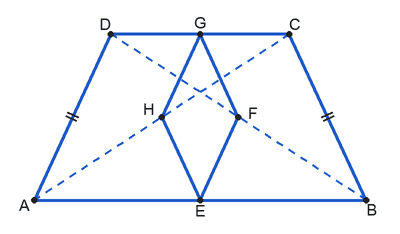
ABCD is a quadrilateral in which AD = BC. E, F, G and H are the mid-points of AB, BD, CD and AC respectively. Prove that EFGH is a rhombus.
 Solve with AI
Written solution
Solution:
Concept: Mid-point theorem: the segment joining the mid-points of two sides of a triangle is parallel to the third side and equal to half of it.
Given: ABCD is a quadrilateral with AD = BC; E, F, G, H are the mid-points of AB, BD, CD, AC.
Step 1 — EF and HG.
In ΔABD, E and F are the mid-points of AB and BD, so EF is half of AD.
In ΔACD, H and G are the mid-points of AC and CD, so HG is half of AD.
Step 2 — FG and EH.
In ΔBCD, F and G are the mid-points of BD and CD, so FG is half of BC.
In ΔABC, E and H are the mid-points of AB and AC, so EH is half of BC.
Step 3 — Use AD = BC.
AD = BC, so all four halves are equal: EF, FG, GH and HE are equal. A quadrilateral with four equal sides is a rhombus.
Watch out: F and H are mid-points of the DIAGONALS BD and AC, so pick the triangle that has the right two points on its sides.
Therefore, EFGH is a rhombus. Hence proved.
- 143 marks
Question 14
A parallelogram ABCD has P the mid-point of DC and Q a point of AC such that . PQ produced meets BC at R.
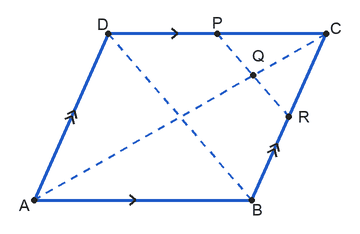
Prove that :
(i) R is the mid-point of BC,
(ii) .
Solve with AIWritten solution
Solution:
Concept: Mid-point theorem: the segment joining the mid-points of two sides of a triangle is parallel to the third side and equal to half of it. Converse of the mid-point theorem: a line drawn through the mid-point of one side of a triangle, parallel to a second side, bisects the third side. The diagonals of a parallelogram bisect each other.
Given: ABCD is a parallelogram, P the mid-point of DC, Q on AC with , and PQ produced meets BC at R.
Step 1 — Locate Q.
Let the diagonals meet at O.
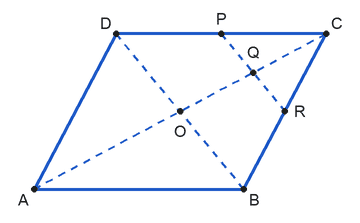
The diagonals of a parallelogram bisect each other, so OC is half of AC. CQ is a quarter of AC, which is half of OC, so Q is the mid-point of OC.
Step 2 — Part (i): PR ∥ DB.
In ΔCDO, P and Q are the mid-points of CD and CO, so PQ ∥ DO, that is PR ∥ DB.
Step 3 — Part (i): R is a mid-point.
In ΔCDB, P is the mid-point of CD and PR ∥ DB. By the converse of the mid-point theorem, R is the mid-point of BC.
Step 4 — Part (ii).
In ΔCDB, P and R are now both mid-points, so PR is half of the third side DB.
Watch out: ¼ of AC is HALF of OC; that is what makes Q a mid-point.
Therefore, (i) R is the mid-point of BC and (ii) . Hence proved.
- 153 marks
Question 15
D, E and F are the mid-points of the sides AB, BC and CA respectively of Δ ABC. AE meets DF at O. P and Q are the mid-points of OB and OC respectively.
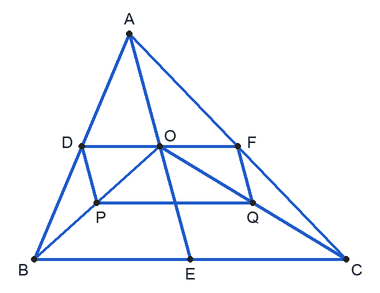
Prove that DPQF is a parallelogram.
Solve with AIWritten solution
Solution:
Concept: Mid-point theorem: the segment joining the mid-points of two sides of a triangle is parallel to the third side and equal to half of it. A quadrilateral is a parallelogram when both pairs of opposite sides are parallel, or when one pair of opposite sides is equal and parallel, or when its diagonals bisect each other.
Given: D, E, F are the mid-points of AB, BC, CA; AE meets DF at O; P, Q are the mid-points of OB and OC.
Step 1 — DF.
In ΔABC, D and F are the mid-points of AB and AC, so DF ∥ BC and DF is half of BC.
Step 2 — PQ.
In ΔOBC, P and Q are the mid-points of OB and OC, so PQ ∥ BC and PQ is half of BC.
Step 3 — Conclude.
So DF ∥ PQ and DF = PQ. One pair of opposite sides equal and parallel makes DPQF a parallelogram.
Watch out: Both DF and PQ are compared with the SAME side BC; that is what makes them equal.
Therefore, DPQF is a parallelogram. Hence proved.
- 163 marks
Question 16
In triangle ABC, P is the mid-point of side BC. A line through P and parallel to CA meets AB at point Q; and a line through Q and parallel to BC meets median AP at point R.
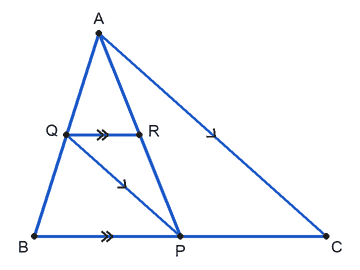
Prove that : (i) AP = 2AR (ii) BC = 4QR
Solve with AIWritten solution
Solution:
Concept: Converse of the mid-point theorem: a line drawn through the mid-point of one side of a triangle, parallel to a second side, bisects the third side. Mid-point theorem: the segment joining the mid-points of two sides of a triangle is parallel to the third side and equal to half of it.
Given: P is the mid-point of BC, PQ ∥ CA meets AB at Q, and QR ∥ BC meets the median AP at R.
Step 1 — Q is the mid-point of AB.
In ΔABC, P is the mid-point of BC and PQ ∥ CA. By the converse of the mid-point theorem, Q is the mid-point of AB.
Step 2 — Part (i).
In ΔABP, Q is the mid-point of AB and QR ∥ BP (QR ∥ BC). By the converse, R is the mid-point of AP, so AP is twice AR.
Step 3 — Part (ii).
In ΔABP, Q and R are both mid-points, so QR is half of BP. BP is half of BC, so QR is a quarter of BC.
Watch out: Use ΔABC for Q and then the smaller ΔABP for R.
Therefore, (i) AP = 2AR and (ii) BC = 4QR. Hence proved.
- 173 marks
Question 17
In trapezium ABCD, AB is parallel to DC; P and Q are the mid-points of AD and BC respectively. BP produced meets CD produced at point E.
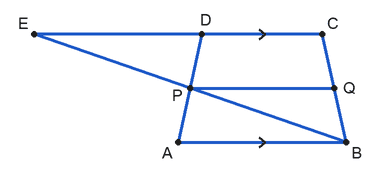
Prove that :
(i) point P bisects BE,
(ii) PQ is parallel to AB.
Solve with AIWritten solution
Solution:
Concept: Mid-point theorem: the segment joining the mid-points of two sides of a triangle is parallel to the third side and equal to half of it. A.S.A.: two angles and the side between them equal in two triangles make them congruent.
Given: ABCD is a trapezium with AB ∥ DC; P, Q are the mid-points of AD, BC; BP produced meets CD produced at E.
Step 1 — Part (i): compare ΔAPB and ΔDPE.
AP = DP (P is the mid-point of AD)
∠APB = ∠DPE (vertically opposite angles)
∠PAB = ∠PDE (alternate angles, AB ∥ DE with AD as transversal)
So ΔAPB ≅ ΔDPE by A.S.A., and by C.P.C.T.C. BP = PE: P bisects BE.
Step 2 — Part (ii).
In ΔBEC, P and Q are the mid-points of BE and BC, so PQ ∥ EC. EC lies along DC, and DC ∥ AB, so PQ ∥ AB.
Watch out: Part (ii) needs P to be the mid-point of BE, which is exactly what part (i) proves.
Therefore, (i) P bisects BE and (ii) PQ ∥ AB. Hence proved.
- 183 marks
Question 18
In a triangle ABC, AD is a median and E is mid-point of median AD. A line through B and E meets AC at point F.
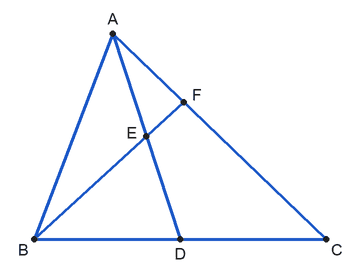
Prove that : AC = 3AF
Hint : Draw DG parallel to BF, which meets AC at point G.
Solve with AIWritten solution
Solution:
Concept: Converse of the mid-point theorem: a line drawn through the mid-point of one side of a triangle, parallel to a second side, bisects the third side.
Given: AD is a median, E is the mid-point of AD, and BE produced meets AC at F.
Step 1 — Draw DG.
Draw DG ∥ BF meeting AC at G.
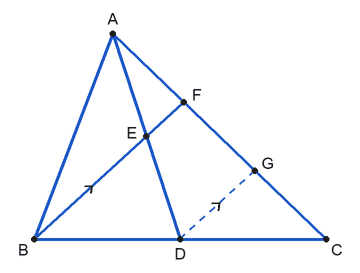
Step 2 — ΔBCF.
D is the mid-point of BC and DG ∥ BF. By the converse of the mid-point theorem, G is the mid-point of CF, so FG = GC.
Step 3 — ΔADG.
E is the mid-point of AD and EF ∥ DG. By the converse, F is the mid-point of AG, so AF = FG.
Step 4 — Add the three parts.
AF, FG and GC are all equal.
Watch out: The extra line DG is drawn PARALLEL to BF, so each triangle has a mid-point and a parallel line.
Therefore, AC = 3AF. Hence proved.
- 193 marks
Question 19
D and F are mid-points of sides AB and AC of a triangle ABC. A line through F and parallel to AB meets BC at point E.
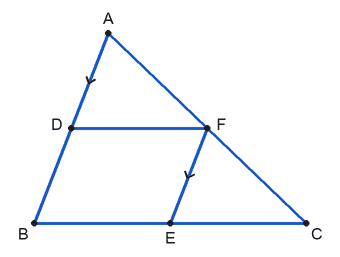
(i) Prove that BDFE is a parallelogram.
(ii) Find AB, if EF = 4·8 cm.
Solve with AIWritten solution
Solution:
Concept: Mid-point theorem: the segment joining the mid-points of two sides of a triangle is parallel to the third side and equal to half of it. A quadrilateral is a parallelogram when both pairs of opposite sides are parallel, or when one pair of opposite sides is equal and parallel, or when its diagonals bisect each other.
Given: D, F are the mid-points of AB, AC, and FE ∥ AB meets BC at E.
Step 1 — Part (i): DF ∥ BE.
In ΔABC, D and F are the mid-points of AB and AC, so DF ∥ BC, that is DF ∥ BE.
Step 2 — Part (i): FE ∥ BD.
FE ∥ AB is given, that is FE ∥ BD. Both pairs of opposite sides of BDFE are parallel, so it is a parallelogram.
Step 3 — Part (ii).
Opposite sides of a parallelogram are equal, so BD equals EF, which is 4.8 cm. D is the mid-point of AB, so AB is twice BD.
Watch out: EF equals BD, which is HALF of AB; double it to get AB.
Therefore, (i) BDFE is a parallelogram and (ii) AB = 9·6 cm.
- 203 marks
Question 20
In triangle ABC, AD is the median and DE, drawn parallel to side BA, meets AC at point E.
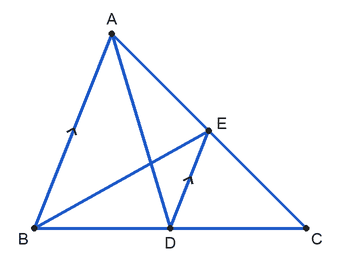
Show that BE is also a median.
Solve with AIWritten solution
Solution:
Concept: Converse of the mid-point theorem: a line drawn through the mid-point of one side of a triangle, parallel to a second side, bisects the third side.
Given: AD is a median of ΔABC and DE ∥ BA meets AC at E.
Step 1 — D is a mid-point.
AD is a median, so D is the mid-point of BC.
Step 2 — Use the converse.
In ΔABC, DE passes through the mid-point D of BC and DE ∥ BA. By the converse of the mid-point theorem, E is the mid-point of AC.
Step 3 — Conclude.
BE joins the vertex B to the mid-point E of the opposite side AC, so BE is a median.
Watch out: The mid-point theorem needs BOTH points to be mid-points; with only one, use the converse (and a parallel line).
Therefore, BE is also a median. Hence shown.
- 211 mark
Question 21
In the given figure, and D is mid-point of CE. If AE = 12·6 cm, then BD is :
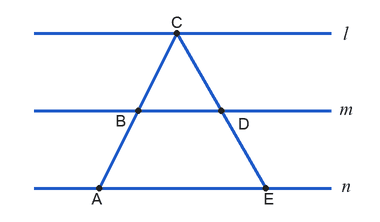 Solve with AI
Answer
(A) 12·6 cm
(B) 25·2 cm
- Correct
(C) 6·3 cm
(D) 18·9 cm
Answer: (C) 6·3 cm
Concept: Converse of the mid-point theorem: a line drawn through the mid-point of one side of a triangle, parallel to a second side, bisects the third side. Mid-point theorem: the segment joining the mid-points of two sides of a triangle is parallel to the third side and equal to half of it.
Step 1 — B is the mid-point of CA.
In ΔCAE, D is the mid-point of CE and BD lies on m, which is parallel to n, so BD ∥ AE. By the converse of the mid-point theorem, B is the mid-point of CA.
Step 2 — Find BD.
B and D are both mid-points, so BD is half of the third side AE.
Watch out: The joining segment is half of the THIRD side, the side it is parallel to, not of either side it joins.
Why the other options are wrong:
- (A): 12·6 cm is AE itself, not BD.
- (B): 25·2 cm doubles AE instead of halving it.
- (D): 18·9 cm is one and a half times AE.
Therefore, BD = 6·3 cm, option (C).
- 221 mark
Question 22
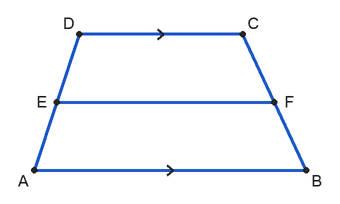
In a trapezium ABCD, AB//DC, E is mid-point of AD and F is mid-point of BC, then :
 Solve with AI
Answer
(A)
- Correct
(B) 2EF = AB + DC
(C) EF = AB + DC
(D)
Answer: (B) 2EF = AB + DC
Concept: In a trapezium, the segment joining the mid-points of the two non-parallel sides is parallel to the parallel sides and equal to half their sum.
Step 1 — The trapezium result.
E and F are the mid-points of the non-parallel sides AD and BC, so EF is half the sum of the parallel sides.
Step 2 — Clear the half.
Multiply both sides by 2.
Watch out: The ½ moves to the other side as a factor 2; it does not stay on both sides.
Why the other options are wrong:
- (A): This keeps the ½ on the right after doubling the left, so it is half of the true value.
- (C): This drops the ½ altogether, making EF twice its true length.
- (D): This multiplies the parallel sides instead of adding them.
Therefore, 2EF = AB + DC, option (B).
- 231 mark
Question 23
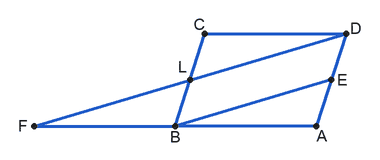
The given figure shows a parallelogram ABCD in which E is mid-point of AD and DL//EB. Then, BF is equal to :
 Solve with AI
Answer
(A) AD
(B) BE
(C) AE
- Correct
(D) AB
Answer: (D) AB
Concept: Converse of the mid-point theorem: a line drawn through the mid-point of one side of a triangle, parallel to a second side, bisects the third side.
Step 1 — Look at ΔAFD.
AB is produced to F, so A, B, F lie on one line and ΔAFD has sides AF, FD and DA. E is the mid-point of AD, and EB ∥ DF (given DL ∥ EB, and L lies on DF).
Step 2 — Use the converse.
A line through the mid-point E of AD, parallel to DF, bisects the third side AF. So B is the mid-point of AF.
Step 3 — Conclude.
B is the mid-point of AF, so BF = AB.
Watch out: The triangle to use is ΔAFD, with AF along AB produced; ABCD itself is only used for the position of the points.
Why the other options are wrong:
- (A): BF = AB, and the adjacent sides AB and AD of a parallelogram need not be equal.
- (B): By the mid-point theorem in ΔAFD, BE is half of DF; nothing makes it equal to BF.
- (C): AE is half of AD, while BF equals AB; they are equal only in a special parallelogram.
Therefore, BF = AB, option (D).
- 241 mark
Question 24
In the given figure AD and BE are medians, then ED is equal to :
 Solve with AI
Answer
(A) 2AB
- Correct
(B)
(C)
(D)
Answer: (B)
Concept: Mid-point theorem: the segment joining the mid-points of two sides of a triangle is parallel to the third side and equal to half of it.
Step 1 — Read the medians.
AD is a median, so D is the mid-point of BC. BE is a median, so E is the mid-point of CA.
Step 2 — Use the mid-point theorem in ΔABC.
E and D are the mid-points of CA and CB, so ED is half of the third side AB.
Watch out: The joining segment is half of the THIRD side, the side it is parallel to, not of either side it joins.
Why the other options are wrong:
- (A): 2AB doubles AB instead of halving it.
- (C): ¼AB halves AB twice; the theorem halves it only once.
- (D): ⅛AB halves AB three times; the theorem halves it only once.
Therefore, ED = ½AB, option (B).
- 251 mark
Question 25
In the quadrilateral ABCD, if AB//CD, E is mid-point of side AD and F is mid-point of BC. If AB = 20 cm and EF = 16 cm, the length of side DC is :
 Solve with AI
Answer
(A) 18 cm
- Correct
(B) 12 cm
(C) 24 cm
(D) 32 cm
Answer: (B) 12 cm
Concept: In a trapezium, the segment joining the mid-points of the two non-parallel sides is parallel to the parallel sides and equal to half their sum.
Step 1 — The trapezium result.
E and F are the mid-points of the non-parallel sides AD and BC, so EF is half the sum of AB and DC.
Step 2 — Solve for DC.
Put EF = 16 cm and AB = 20 cm, and write x for DC.
Watch out: Double EF first: AB + DC = 32 cm, then subtract AB.
Why the other options are wrong:
- (A): 18 cm is the average of 20 and 16, which is not how EF is related to the parallel sides.
- (C): With DC = 24 cm, EF would be half of 44 cm, which is 22 cm, not 16 cm.
- (D): 32 cm is 2EF, which is the SUM AB + DC, not DC alone.
Therefore, DC = 12 cm, option (B).
- 263 marks
Question 26
Use the following figure to find :
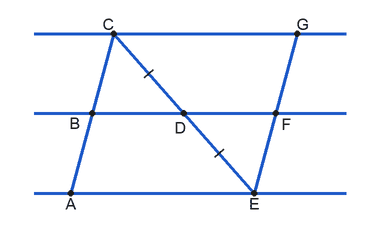
(i) BC, if AB = 7·2 cm.
(ii) GE, if FE = 4 cm.
(iii) AE, if BD = 4·1 cm.
(iv) DF, if CG = 11 cm.
Solve with AIWritten solution
Solution:
Concept: Intercept theorem: if three or more parallel lines make equal intercepts on one transversal, they make equal intercepts on every other transversal. Mid-point theorem: the segment joining the mid-points of two sides of a triangle is parallel to the third side and equal to half of it.
Given: Three parallel lines with CD = DE (marked).
Step 1 — Equal intercepts on every transversal.
The three lines are parallel and make equal intercepts CD = DE on the transversal CE. By the intercept theorem they make equal intercepts on CA and on GE too: CB = BA and GF = FE.
Step 2 — Part (i).
BC = AB, so BC = 7.2 cm.
Step 3 — Part (ii).
GF and FE are equal (each 4 cm), so GE is twice FE.
Step 4 — Part (iii).
In ΔCAE, B and D are the mid-points of CA and CE, so BD is half of AE, and AE is twice BD.
Step 5 — Part (iv).
In ΔECG, D and F are the mid-points of EC and EG, so DF is half of CG.
Watch out: Parts (iii) and (iv) use different triangles: ΔCAE for BD and ΔECG for DF.
Therefore, (i) BC = 7·2 cm, (ii) GE = 8 cm, (iii) AE = 8·2 cm and (iv) DF = 5·5 cm.
- 273 marks
Question 27
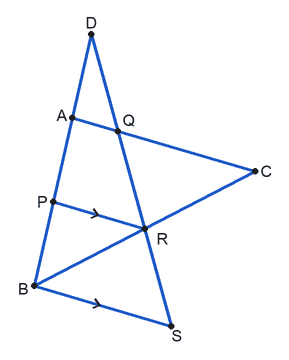
In the figure, given below, 2AD = AB, P is mid-point of AB, Q is mid-point of DR and PR // BS. Prove that :
(i) AQ // BS,
(ii) DS = 3 RS.
 Solve with AI
Written solution
Solution:
Concept: Mid-point theorem: the segment joining the mid-points of two sides of a triangle is parallel to the third side and equal to half of it. Intercept theorem: if three or more parallel lines make equal intercepts on one transversal, they make equal intercepts on every other transversal.
Given: 2AD = AB, P is the mid-point of AB, Q is the mid-point of DR and PR ∥ BS.
Step 1 — Equal parts of DB.
2AD = AB, so AD is half of AB. P is the mid-point of AB, so AP is also half of AB. Hence DA, AP and PB are all equal.
Step 2 — Part (i).
In ΔDPR, A is the mid-point of DP (DA = AP) and Q is the mid-point of DR. By the mid-point theorem AQ ∥ PR. PR ∥ BS, so AQ ∥ BS.
Step 3 — Part (ii): equal intercepts on DS.
The parallel lines AQ, PR and BS make equal intercepts AP = PB on the transversal DB.
By the intercept theorem they make equal intercepts on DS:
QR = RS.
Also DQ = QR, because Q is the mid-point of DR.
Step 4 — Part (ii): add the parts.
DQ, QR and RS are all equal.
Watch out: The equality of DA and AP needs both 2AD = AB AND P being the mid-point; check both before using A as a mid-point.
Therefore, (i) AQ ∥ BS and (ii) DS = 3RS. Hence proved.
- 283 marks
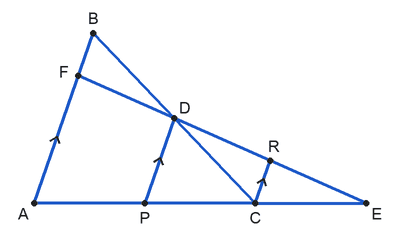
Question 28
The side AC of a triangle ABC is produced to point E so that . D is the mid-point of BC and ED produced meets AB at F. Lines through D and C are drawn parallel to AB which meet AC at point P and EF at point R respectively.
Prove that :
(i) 3DF = EF
(ii) 4CR = AB.
Solve with AIWritten solution
Solution:
Concept: Converse of the mid-point theorem: a line drawn through the mid-point of one side of a triangle, parallel to a second side, bisects the third side. Mid-point theorem: the segment joining the mid-points of two sides of a triangle is parallel to the third side and equal to half of it.
Given: AC is produced to E with ; D is the mid-point of BC; ED produced meets AB at F; DP ∥ AB meets AC at P and CR ∥ AB meets EF at R.
Step 1 — P is the mid-point of AC.
In ΔABC, D is the mid-point of BC and DP ∥ AB. By the converse of the mid-point theorem, P is the mid-point of AC, and then by the mid-point theorem DP is half of AB.
Step 2 — C is the mid-point of EP.
CP is half of AC, and CE is also half of AC (given), so CP = CE: C is the mid-point of EP.
Step 3 — R is the mid-point of ED.
In ΔEDP, C is the mid-point of EP and CR ∥ DP (both are parallel to AB). By the converse, R is the mid-point of ED, so ER = RD, and by the mid-point theorem CR is half of DP.
Step 4 — Part (i): compare ΔDCR and ΔDBF.
CD = BD (D is the mid-point of BC)
∠CDR = ∠BDF (vertically opposite angles)
∠DCR = ∠DBF (alternate angles, CR ∥ AB with BC as transversal)
So ΔDCR ≅ ΔDBF by A.S.A., and by C.P.C.T.C. DR = DF.
Step 5 — Part (i): add the parts of EF.
ER = RD and RD = DF, so the three parts of EF are equal.
Step 6 — Part (ii).
CR is half of DP, and DP is half of AB.
Watch out: CE is half of AC, not half of AE; that is why C turns out to be the mid-point of EP.
Therefore, (i) 3DF = EF and (ii) 4CR = AB. Hence proved.
- 293 marks
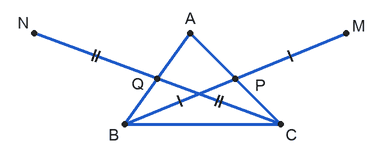
Question 29
In triangle ABC, the medians BP and CQ are produced upto points M and N respectively such that BP = PM and CQ = QN.
Prove that :
(i) M, A and N are collinear.
(ii) A is the mid-point of MN.
Solve with AIWritten solution
Solution:
Concept: A quadrilateral is a parallelogram when both pairs of opposite sides are parallel, or when one pair of opposite sides is equal and parallel, or when its diagonals bisect each other. Through a point there is only one line parallel to a given line.
Given: BP and CQ are medians of ΔABC, produced to M and N with BP = PM and CQ = QN.
Step 1 — Part (i): ABCM is a parallelogram.
P is the mid-point of AC (BP is a median) and of BM (BP = PM). So the diagonals AC and BM of ABCM bisect each other, and ABCM is a parallelogram: AM ∥ BC and AM = BC.
Step 2 — Part (i): ANBC is a parallelogram.
Q is the mid-point of AB (CQ is a median) and of NC (CQ = QN). So the diagonals AB and NC of ANBC bisect each other, and ANBC is a parallelogram: AN ∥ BC and AN = BC.
Step 3 — Part (i): collinear.
AM and AN are both parallel to BC and both pass through A. Only one line through A is parallel to BC, so M, A and N lie on it.
Step 4 — Part (ii).
AM = BC and AN = BC, so AM = AN, and A lies on MN between M and N. So A is the mid-point of MN.
Watch out: A median goes to the MID-POINT of a side; that is the second bisection each diagonal needs.
Therefore, (i) M, A and N are collinear and (ii) A is the mid-point of MN. Hence proved.
- 303 marks
Question 30
In triangle ABC, angle B is obtuse. D and E are mid-points of sides AB and BC respectively and F is a point on side AC such that EF is parallel to AB.

Show that BEFD is a parallelogram.
Solve with AIWritten solution
Solution:
Concept: Converse of the mid-point theorem: a line drawn through the mid-point of one side of a triangle, parallel to a second side, bisects the third side. Mid-point theorem: the segment joining the mid-points of two sides of a triangle is parallel to the third side and equal to half of it. A quadrilateral is a parallelogram when both pairs of opposite sides are parallel, or when one pair of opposite sides is equal and parallel, or when its diagonals bisect each other.
Given: ∠B is obtuse; D, E are the mid-points of AB, BC; F on AC with EF ∥ AB.
Step 1 — F is the mid-point of AC.
In ΔABC, E is the mid-point of BC and EF ∥ AB. By the converse of the mid-point theorem, F is the mid-point of AC.
Step 2 — DF ∥ BE.
D and F are the mid-points of AB and AC, so DF ∥ BC (mid-point theorem), that is DF ∥ BE.
Step 3 — Conclude.
EF ∥ AB, that is EF ∥ BD. Both pairs of opposite sides of BEFD are parallel, so it is a parallelogram.
Watch out: That ∠B is obtuse does not change the proof; it only fixes the shape of the figure.
Therefore, BEFD is a parallelogram. Hence shown.
- 313 marks
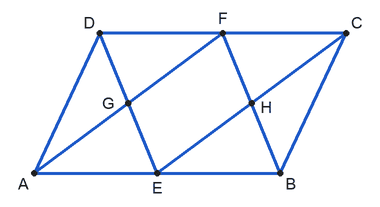
Question 31
In parallelogram ABCD, E and F are mid-points of the sides AB and CD respectively. The line segments AF and BF meet the line segments ED and EC at points G and H respectively.
Prove that:
(i) triangles HEB and FHC are congruent;
(ii) GEHF is a parallelogram.
Solve with AIWritten solution
Solution:
Concept: A quadrilateral is a parallelogram when both pairs of opposite sides are parallel, or when one pair of opposite sides is equal and parallel, or when its diagonals bisect each other. S.A.S.: two sides and the included angle equal in two triangles make them congruent.
Given: ABCD is a parallelogram, E and F are the mid-points of AB and CD, AF meets ED at G, and BF meets EC at H.
Step 1 — EBCF is a parallelogram.
EB is half of AB and FC is half of DC, and AB = DC, so EB = FC. Also EB ∥ FC (they lie on AB and DC). So EBCF is a parallelogram, and its diagonals EC and BF bisect each other at H: EH = HC and BH = HF.
Step 2 — Part (i): compare ΔHEB and ΔHCF.
EH = CH (Step 1)
∠EHB = ∠CHF (vertically opposite angles)
HB = HF (Step 1)
So ΔHEB ≅ ΔHCF by S.A.S. These are the triangles printed as HEB and FHC.
Step 3 — Part (ii): GF ∥ EH.
AE = FC (halves of the equal sides AB, DC) and AE ∥ FC, so AECF is a parallelogram and AF ∥ EC, that is GF ∥ EH.
Step 4 — Part (ii): GE ∥ FH.
DF = EB and DF ∥ EB, so DEBF is a parallelogram and DE ∥ BF, that is GE ∥ FH.
Step 5 — Part (ii): conclude.
Both pairs of opposite sides of GEHF are parallel, so GEHF is a parallelogram.
Watch out: Match H with H: the vertex order that fits is ΔHEB ≅ ΔHCF.
Note: As printed, "HEB and FHC" lists the vertices in a different order; the matching order is ΔHEB ≅ ΔHCF, which is the same pair of triangles.
Therefore, (i) the triangles HEB and FHC (in matching order ΔHEB ≅ ΔHCF) are congruent and (ii) GEHF is a parallelogram. Hence proved.
- 323 marks
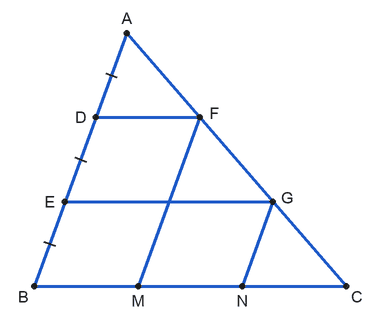
Question 32
In triangle ABC, D and E are points on side AB such that AD = DE = EB. Through D and E, lines are drawn parallel to BC which meet side AC at points F and G respectively. Through F and G, lines are drawn parallel to AB which meet side BC at points M and N respectively.
Prove that : BM = MN = NC.
Solve with AIWritten solution
Solution:
Concept: Intercept theorem: if three or more parallel lines make equal intercepts on one transversal, they make equal intercepts on every other transversal.
Given: D, E on AB with AD, DE, EB equal; DF ∥ EG ∥ BC; FM ∥ GN ∥ AB with M, N on BC.
Step 1 — Equal parts of AC.
Draw a line through A parallel to BC.
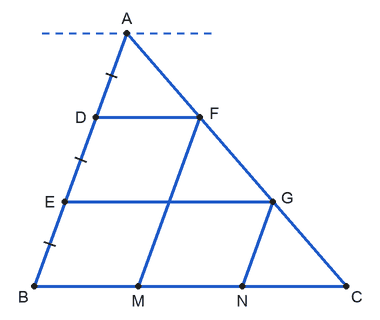
The four parallel lines (through A, D, E and B, all parallel to BC) make the three equal intercepts AD, DE and EB on AB. By the intercept theorem they make equal intercepts on AC, so AF, FG and GC are equal.
Step 2 — Equal parts of BC.
Now take the lines parallel to AB: AB itself, FM, GN and the line through C parallel to AB. They make the three equal intercepts AF, FG and GC on AC. By the intercept theorem they make equal intercepts on BC, so BM, MN and NC are equal.
Watch out: The intercept theorem needs the lines to be parallel to EACH OTHER; add the line through A (or through C) so each family is complete.
Therefore, BM, MN and NC are equal. Hence proved.
- 333 marks
Question 33
In triangle ABC; M is mid-point of AB, N is mid-point of AC and D is any point in base BC.

Use Intercept Theorem to show that MN bisects AD.
Solve with AIWritten solution
Solution:
Concept: Mid-point theorem: the segment joining the mid-points of two sides of a triangle is parallel to the third side and equal to half of it. Intercept theorem: if three or more parallel lines make equal intercepts on one transversal, they make equal intercepts on every other transversal.
Given: M, N are the mid-points of AB, AC, and D is any point on BC.
Step 1 — MN ∥ BC.
M and N are the mid-points of AB and AC, so MN ∥ BC by the mid-point theorem.
Step 2 — Three parallel lines.
Draw the line l through A parallel to BC. Then l, MN and BC are three parallel lines.
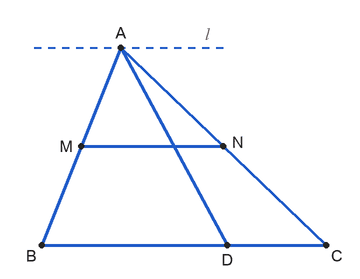
Step 3 — Use the intercept theorem.
These lines make equal intercepts AM = MB on the transversal AB. So they make equal intercepts on the transversal AD as well: MN cuts AD at its mid-point.
Watch out: D can be ANY point of BC; the intercept theorem works for every transversal, so no special position is needed.
Therefore, MN bisects AD. Hence shown.
- 343 marks
Question 34
If the quadrilateral formed by joining the mid-points of the adjacent sides of quadrilateral ABCD is a rectangle, show that the diagonals AC and BD intersect at right angle.
 Solve with AI
Written solution
Solution:
Concept: Mid-point theorem: the segment joining the mid-points of two sides of a triangle is parallel to the third side and equal to half of it. Lines parallel to two perpendicular lines are themselves perpendicular.
Given: The mid-points of the sides of ABCD form a rectangle.
Step 1 — Set up.
Let P, Q, R, S be the mid-points of AB, BC, CD, DA, and let PQRS be a rectangle.
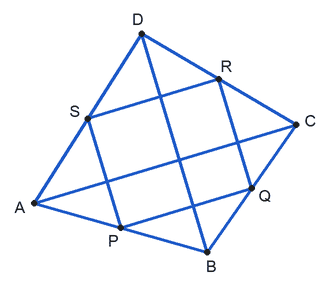
Step 2 — The sides are parallel to the diagonals.
In ΔABC, P and Q are mid-points, so PQ ∥ AC.
In ΔBCD, Q and R are mid-points, so QR ∥ BD.
Step 3 — Use the right angle.
PQRS is a rectangle, so PQ ⊥ QR. AC is parallel to PQ and BD is parallel to QR, so AC ⊥ BD.
Watch out: Use the angle at Q (between PQ and QR), whose two sides are parallel to the two diagonals.
Therefore, the diagonals AC and BD intersect at right angles. Hence shown.
- 353 marks
Question 35
In triangle ABC, D and E are mid-points of the sides AB and AC respectively. Through E, a straight line is drawn parallel to AB to meet BC at F. Prove that BDEF is a parallelogram. If AB = 8 cm and BC = 9 cm; find the perimeter of the parallelogram BDEF.
 Solve with AI
Written solution
Solution:
Concept: Mid-point theorem: the segment joining the mid-points of two sides of a triangle is parallel to the third side and equal to half of it. A quadrilateral is a parallelogram when both pairs of opposite sides are parallel, or when one pair of opposite sides is equal and parallel, or when its diagonals bisect each other.
Given: D, E are the mid-points of AB, AC; EF ∥ AB meets BC at F; AB = 8 cm, BC = 9 cm.
Step 1 — Prove BDEF is a parallelogram.
D and E are the mid-points of AB and AC, so DE ∥ BC (mid-point theorem), that is DE ∥ BF. EF ∥ AB is given, that is EF ∥ BD. Both pairs of opposite sides are parallel, so BDEF is a parallelogram.
Step 2 — Find two adjacent sides.
BD is half of AB, and DE is half of BC (mid-point theorem).
Step 3 — Find the perimeter.
Opposite sides of a parallelogram are equal, so the perimeter is twice BD + DE.
Watch out: The sides of BDEF are HALVES of AB and BC, not the whole sides.
Therefore, BDEF is a parallelogram and its perimeter is 17 cm.
- 363 marks
Question 36
P, Q and R are mid-points of sides AB, BC and CD respectively of a rhombus ABCD. Show that PQ is perpendicular to QR.
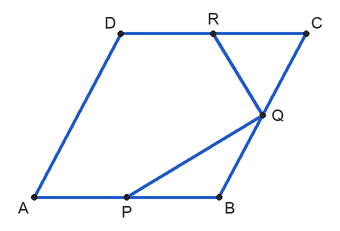 Solve with AI
Written solution
Solution:
Concept: Mid-point theorem: the segment joining the mid-points of two sides of a triangle is parallel to the third side and equal to half of it. The diagonals of a rhombus are perpendicular to each other.
Given: P, Q, R are the mid-points of AB, BC, CD of rhombus ABCD.
Step 1 — PQ ∥ AC.
In ΔABC, P and Q are the mid-points of AB and BC, so PQ ∥ AC (mid-point theorem).
Step 2 — QR ∥ BD.
In ΔBCD, Q and R are the mid-points of BC and CD, so QR ∥ BD.
Step 3 — Use the rhombus.
The diagonals of a rhombus cut at right angles, AC ⊥ BD. PQ and QR are parallel to these two diagonals, so PQ ⊥ QR.
Watch out: It is the DIAGONALS of a rhombus that are perpendicular, not its sides.
Therefore, PQ is perpendicular to QR. Hence shown.
- 373 marks
Question 37
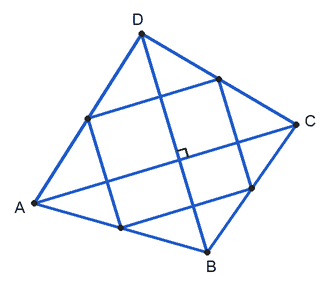
The diagonals of a quadrilateral ABCD are perpendicular to each other. Prove that the quadrilateral obtained by joining the mid-points of its adjacent sides is a rectangle.
 Solve with AI
Written solution
Solution:
Concept: Mid-point theorem: the segment joining the mid-points of two sides of a triangle is parallel to the third side and equal to half of it. A quadrilateral is a parallelogram when both pairs of opposite sides are parallel, or when one pair of opposite sides is equal and parallel, or when its diagonals bisect each other. A parallelogram with one right angle is a rectangle.
Given: The diagonals of ABCD are perpendicular; P, Q, R, S are the mid-points of its sides.
Step 1 — Set up.
Let P, Q, R, S be the mid-points of AB, BC, CD, DA of ABCD, whose diagonals AC and BD are perpendicular.

Step 2 — PQRS is a parallelogram.
In ΔABC, PQ ∥ AC and PQ is half of AC. In ΔADC, SR ∥ AC and SR is half of AC. So PQ and SR are equal and parallel, and PQRS is a parallelogram.
Step 3 — One right angle.
In ΔABD, PS ∥ BD. PQ ∥ AC, PS ∥ BD and AC ⊥ BD, so PQ ⊥ PS: ∠SPQ = 90°.
Step 4 — Conclude.
A parallelogram with one right angle is a rectangle.
Watch out: First show PQRS is a parallelogram; one right angle alone does not make a quadrilateral a rectangle.
Therefore, PQRS is a rectangle. Hence proved.
- 383 marks
Question 38
In Δ ABC, E is mid-point of the median AD and BE produced meets side AC at point Q.

Show that BE : EQ = 3 : 1.
Solve with AIWritten solution
Solution:
Concept: Converse of the mid-point theorem: a line drawn through the mid-point of one side of a triangle, parallel to a second side, bisects the third side. Mid-point theorem: the segment joining the mid-points of two sides of a triangle is parallel to the third side and equal to half of it.
Given: E is the mid-point of the median AD, and BE produced meets AC at Q.
Step 1 — Draw DG.
Draw DG ∥ BQ meeting AC at G.

Step 2 — ΔBCQ.
D is the mid-point of BC and DG ∥ BQ. By the converse of the mid-point theorem, G is the mid-point of CQ, and by the mid-point theorem DG is half of BQ.
Step 3 — ΔADG.
E is the mid-point of AD and EQ ∥ DG. By the converse, Q is the mid-point of AG, and EQ is half of DG.
Step 4 — Find BE.
BE is what is left of BQ after EQ.
Step 5 — Form the ratio.
Divide BE by EQ; BQ cancels.
Watch out: Both lengths must be written in terms of the SAME segment BQ before comparing them.
Therefore, BE : EQ = 3 : 1. Hence shown.
- 393 marks
Question 39
In the given figure, M is mid-point of AB and DE, whereas N is mid-point of BC and DF. Show that : EF = AC.
 Solve with AI
Written solution
Solution:
Concept: Mid-point theorem: the segment joining the mid-points of two sides of a triangle is parallel to the third side and equal to half of it.
Given: M is the mid-point of AB and of DE; N is the mid-point of BC and of DF.
Step 1 — ΔDEF.
M is the mid-point of DE and N is the mid-point of DF, so MN is half of EF (mid-point theorem).
Step 2 — ΔBAC.
M is the mid-point of BA and N is the mid-point of BC, so MN is half of AC.
Step 3 — Compare.
MN is half of EF and also half of AC. So half of EF equals half of AC, and EF = AC.
Watch out: The same segment MN sits in two different triangles; that link is the whole proof.
Therefore, EF = AC. Hence shown.
- 403 marks
Question 40
In triangle ABC; D and E are mid-points of the sides AB and AC respectively. Through E, a straight line is drawn parallel to AB to meet BC at F. Prove that BDEF is a parallelogram. If AB = 16 cm, AC = 12 cm and BC = 18 cm, find the perimeter of the parallelogram BDEF.
 Solve with AI
Written solution
Solution:
Concept: Mid-point theorem: the segment joining the mid-points of two sides of a triangle is parallel to the third side and equal to half of it. A quadrilateral is a parallelogram when both pairs of opposite sides are parallel, or when one pair of opposite sides is equal and parallel, or when its diagonals bisect each other.
Given: D, E are the mid-points of AB, AC; EF ∥ AB meets BC at F; AB = 16 cm, AC = 12 cm, BC = 18 cm.
Step 1 — Prove BDEF is a parallelogram.
D and E are the mid-points of AB and AC, so DE ∥ BC (mid-point theorem), that is DE ∥ BF. EF ∥ AB is given, that is EF ∥ BD. Both pairs of opposite sides are parallel, so BDEF is a parallelogram.
Step 2 — Find two adjacent sides.
BD is half of AB, and DE is half of BC.
Step 3 — Find the perimeter.
Opposite sides of a parallelogram are equal, so the perimeter is twice BD + DE. AC = 12 cm is not needed.
Watch out: AC is extra data here; the sides of BDEF are halves of AB and BC only.
Therefore, BDEF is a parallelogram and its perimeter is 34 cm.
- 413 marks
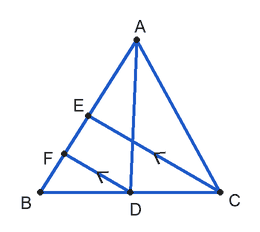
Question 41
In the given figure, AD and CE are medians and DF//CE. Prove that : .
 Solve with AI
Written solution
Solution:
Concept: Converse of the mid-point theorem: a line drawn through the mid-point of one side of a triangle, parallel to a second side, bisects the third side.
Given: AD and CE are medians of ΔABC and DF ∥ CE.
Step 1 — F is the mid-point of BE.
In ΔBCE, D is the mid-point of BC (AD is a median) and DF ∥ CE. By the converse of the mid-point theorem, F is the mid-point of BE.
Step 2 — Find FB.
E is the mid-point of AB (CE is a median), so BE is half of AB, and FB is half of BE.
Watch out: The mid-point theorem needs BOTH points to be mid-points; with only one, use the converse (and a parallel line).
Therefore, . Hence proved.
- 423 marks
Question 42
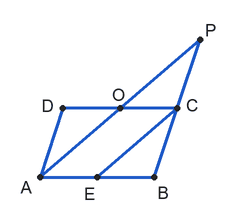
In parallelogram ABCD, E is the mid-point of AB and AP is parallel to EC which meets DC at point O and BC produced at P. Prove that :
(i) BP = 2AD
(ii) O is mid-point of AP.
Solve with AIWritten solution
Solution:
Concept: Converse of the mid-point theorem: a line drawn through the mid-point of one side of a triangle, parallel to a second side, bisects the third side. A.S.A.: two angles and the side between them equal in two triangles make them congruent.
Given: ABCD is a parallelogram, E is the mid-point of AB, and AP ∥ EC meets DC at O and BC produced at P.
Step 1 — Part (i): C is the mid-point of BP.
In ΔABP, E is the mid-point of AB and EC ∥ AP. By the converse of the mid-point theorem, C is the mid-point of BP.
Step 2 — Part (i): BP = 2AD.
BP is twice BC, and BC = AD (opposite sides of a parallelogram), so BP = 2AD.
Step 3 — Part (ii): compare ΔADO and ΔPCO.
AD = CP (AD equals BC, and BC equals CP by part (i))
∠DAO = ∠CPO (alternate angles, AD ∥ BP with AP as transversal)
∠ADO = ∠PCO (alternate angles, AD ∥ BP with DC as transversal)
So ΔADO ≅ ΔPCO by A.S.A., and by C.P.C.T.C. AO = PO.
Watch out: CP equals AD only after part (i) has shown that C is the mid-point of BP.
Therefore, (i) BP = 2AD and (ii) O is the mid-point of AP. Hence proved.
- 433 marks
Question 43
In a trapezium ABCD, sides AB and DC are parallel to each other. E is mid-point of AD and F is mid-point of BC.

Prove that : AB + DC = 2EF
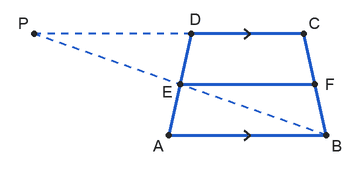
Hint : Join BE and produce to meet CD produced at point P. Δ PDE ≅ Δ BAE by ASA which gives BE = EP and AB = PD. Now apply mid-point theorem for Δ BPC.
Solve with AIWritten solution
Solution:
Concept: Mid-point theorem: the segment joining the mid-points of two sides of a triangle is parallel to the third side and equal to half of it. A.S.A.: two angles and the side between them equal in two triangles make them congruent.
Given: ABCD is a trapezium with AB ∥ DC; E and F are the mid-points of AD and BC.
Step 1 — Draw the extra line.
Join BE and produce it to meet CD produced at P.
Step 2 — Compare ΔPDE and ΔBAE.
DE = AE (E is the mid-point of AD)
∠PED = ∠BEA (vertically opposite angles)
∠PDE = ∠BAE (alternate angles, AB ∥ DP with AD as transversal)
So ΔPDE ≅ ΔBAE by A.S.A., and by C.P.C.T.C. BE = EP and PD = AB.
Step 3 — Use the mid-point theorem in ΔBPC.
E is the mid-point of BP (Step 2) and F is the mid-point of BC, so EF is half of PC.
Step 4 — Express PC.
P, D and C lie on one line, so PC is PD + DC, and PD = AB. Doubling EF gives the result.
Watch out: PD equals AB (from the congruence), so PC is the SUM of the parallel sides.
Therefore, AB + DC = 2EF. Hence proved.
- 443 marks
Question 44
In Δ ABC, AD is the median and DE is parallel to BA, where E is a point in AC.

Prove that BE is also a median.
Solve with AIWritten solution
Solution:
Concept: Converse of the mid-point theorem: a line drawn through the mid-point of one side of a triangle, parallel to a second side, bisects the third side.
Given: AD is a median of ΔABC and DE ∥ BA with E on AC.
Step 1 — D is a mid-point.
AD is a median, so D is the mid-point of BC.
Step 2 — Use the converse.
In ΔABC, DE passes through the mid-point D of BC and DE ∥ BA. By the converse of the mid-point theorem, E is the mid-point of AC.
Step 3 — Conclude.
BE joins the vertex B to the mid-point E of the opposite side AC, so BE is a median.
Watch out: The mid-point theorem needs BOTH points to be mid-points; with only one, use the converse (and a parallel line).
Therefore, BE is also a median. Hence proved.
- 453 marks
Question 45
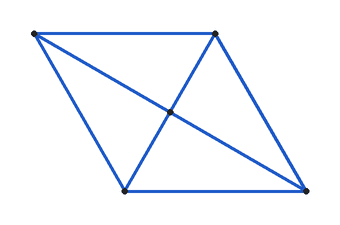
Adjacent sides of a parallelogram are equal and one of diagonals is equal to any one of the sides of this parallelogram. Show that its diagonals are in the ratio .
 Solve with AI
Written solution
Solution:
Concept: A parallelogram with equal adjacent sides is a rhombus, and the diagonals of a rhombus bisect each other at right angles.
Given: A parallelogram with equal adjacent sides, and one diagonal equal to a side.
Step 1 — The parallelogram is a rhombus.
Its adjacent sides are equal, so all four sides are equal: ABCD is a rhombus. Let each side be a, and let the diagonal AC also equal a.
Step 2 — Use the diagonals of a rhombus.
The diagonals of a rhombus bisect each other at right angles at O.
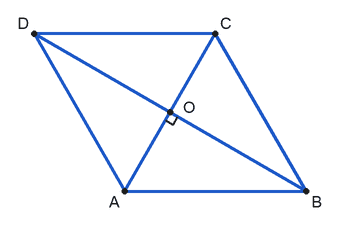
So AO is half of AC, which is a/2, and ∠AOB = 90°.
Step 3 — Find BO by Pythagoras in ΔAOB.
AB = a is the hypotenuse, so BO² = AB² − AO².
Step 4 — Find BD and the ratio.
BD is twice BO, so BD = √3 a.
Compare it with AC = a; the a cancels.
Watch out: The diagonal equal to a side is the SHORTER one; the other is √3 times as long.
Therefore, the diagonals are in the ratio . Hence shown.
What Class 9 Maths Ch 12 covers
The sections of the chapter, in the order the book takes them. Every question above comes from one of these.
- 01Mid-Point Theorem
- 02Converse of Mid-Point Theorem
- 03Equal Intercept Theorem
More ways to study this chapter
The same chapter asked three other ways. Practise it, revise it, and see what the board has set on Ch 12 before.
Class 9 Maths Ch 12 questions students ask
How many questions are there in Class 9 Maths Ch 12?
45 questions. Every one is solved step by step on this page.
Are these Class 9 Maths solutions free?
Yes. Every question and its full working is free to read, with no account needed.
Can I download the Class 9 Maths Ch 12 solutions as a PDF?
There is no PDF to download. Every solution is on this page instead, which means it is searchable, always the current syllabus, and readable on a phone. Use your browser's print option if you want it on paper.