
Question 333 marksMedium
In triangle ABC; M is mid-point of AB, N is mid-point of AC and D is any point in base BC.

Use Intercept Theorem to show that MN bisects AD.
Confirming your payment
Sign up now and get 250 free tokens.
Mid-Point Theorem and Its Converse · Question 33 of 45
In triangle ABC; M is mid-point of AB, N is mid-point of AC and D is any point in base BC.
Use Intercept Theorem to show that MN bisects AD.
Solution:
Concept: Mid-point theorem: the segment joining the mid-points of two sides of a triangle is parallel to the third side and equal to half of it. Intercept theorem: if three or more parallel lines make equal intercepts on one transversal, they make equal intercepts on every other transversal.
Given: M, N are the mid-points of AB, AC, and D is any point on BC.
Step 1 — MN ∥ BC.
M and N are the mid-points of AB and AC, so MN ∥ BC by the mid-point theorem.
Step 2 — Three parallel lines.
Draw the line l through A parallel to BC. Then l, MN and BC are three parallel lines.
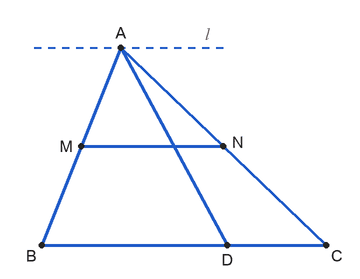
Step 3 — Use the intercept theorem.
These lines make equal intercepts AM = MB on the transversal AB. So they make equal intercepts on the transversal AD as well: MN cuts AD at its mid-point.
Watch out: D can be ANY point of BC; the intercept theorem works for every transversal, so no special position is needed.
Therefore, MN bisects AD. Hence shown.