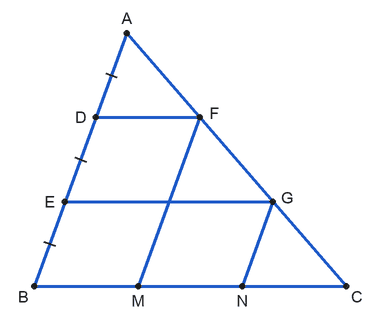
Solution:
Concept: Intercept theorem: if three or more parallel lines make equal intercepts on one transversal, they make equal intercepts on every other transversal.
Given: D, E on AB with AD, DE, EB equal; DF ∥ EG ∥ BC; FM ∥ GN ∥ AB with M, N on BC.
Step 1 — Equal parts of AC.
Draw a line through A parallel to BC.
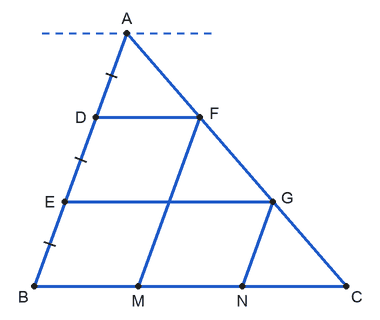
The four parallel lines (through A, D, E and B, all parallel to BC) make the three equal intercepts AD, DE and EB on AB. By the intercept theorem they make equal intercepts on AC, so AF, FG and GC are equal.
Step 2 — Equal parts of BC.
Now take the lines parallel to AB: AB itself, FM, GN and the line through C parallel to AB. They make the three equal intercepts AF, FG and GC on AC. By the intercept theorem they make equal intercepts on BC, so BM, MN and NC are equal.
Watch out: The intercept theorem needs the lines to be parallel to EACH OTHER; add the line through A (or through C) so each family is complete.
Therefore, BM, MN and NC are equal. Hence proved.