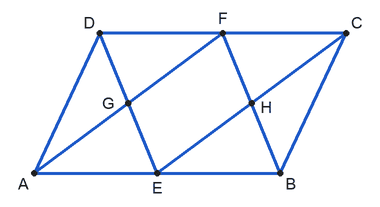
Solution:
Concept: A quadrilateral is a parallelogram when both pairs of opposite sides are parallel, or when one pair of opposite sides is equal and parallel, or when its diagonals bisect each other. S.A.S.: two sides and the included angle equal in two triangles make them congruent.
Given: ABCD is a parallelogram, E and F are the mid-points of AB and CD, AF meets ED at G, and BF meets EC at H.
Step 1 — EBCF is a parallelogram.
EB is half of AB and FC is half of DC, and AB = DC, so EB = FC. Also EB ∥ FC (they lie on AB and DC). So EBCF is a parallelogram, and its diagonals EC and BF bisect each other at H: EH = HC and BH = HF.
Step 2 — Part (i): compare ΔHEB and ΔHCF.
EH = CH (Step 1)
∠EHB = ∠CHF (vertically opposite angles)
HB = HF (Step 1)
So ΔHEB ≅ ΔHCF by S.A.S. These are the triangles printed as HEB and FHC.
Step 3 — Part (ii): GF ∥ EH.
AE = FC (halves of the equal sides AB, DC) and AE ∥ FC, so AECF is a parallelogram and AF ∥ EC, that is GF ∥ EH.
Step 4 — Part (ii): GE ∥ FH.
DF = EB and DF ∥ EB, so DEBF is a parallelogram and DE ∥ BF, that is GE ∥ FH.
Step 5 — Part (ii): conclude.
Both pairs of opposite sides of GEHF are parallel, so GEHF is a parallelogram.
Watch out: Match H with H: the vertex order that fits is ΔHEB ≅ ΔHCF.
Note: As printed, "HEB and FHC" lists the vertices in a different order; the matching order is ΔHEB ≅ ΔHCF, which is the same pair of triangles.
Therefore, (i) the triangles HEB and FHC (in matching order ΔHEB ≅ ΔHCF) are congruent and (ii) GEHF is a parallelogram. Hence proved.