Solution:
Concept: Mid-point theorem: the segment joining the mid-points of two sides of a triangle is parallel to the third side and equal to half of it. A.S.A.: two angles and the side between them equal in two triangles make them congruent.
Given: ABCD is a trapezium with AB ∥ DC; E and F are the mid-points of AD and BC.
Step 1 — Draw the extra line.
Join BE and produce it to meet CD produced at P.
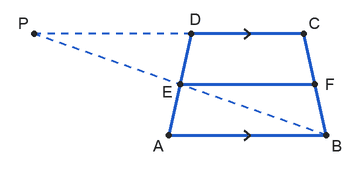
Step 2 — Compare ΔPDE and ΔBAE.
DE = AE (E is the mid-point of AD)
∠PED = ∠BEA (vertically opposite angles)
∠PDE = ∠BAE (alternate angles, AB ∥ DP with AD as transversal)
So ΔPDE ≅ ΔBAE by A.S.A., and by C.P.C.T.C. BE = EP and PD = AB.
Step 3 — Use the mid-point theorem in ΔBPC.
E is the mid-point of BP (Step 2) and F is the mid-point of BC, so EF is half of PC.
Step 4 — Express PC.
P, D and C lie on one line, so PC is PD + DC, and PD = AB. Doubling EF gives the result.
2EF=PC=PD+DC=AB+DC
Watch out: PD equals AB (from the congruence), so PC is the SUM of the parallel sides.
Therefore, AB + DC = 2EF. Hence proved.

