
Question 193 marksEasy
D and F are mid-points of sides AB and AC of a triangle ABC. A line through F and parallel to AB meets BC at point E.
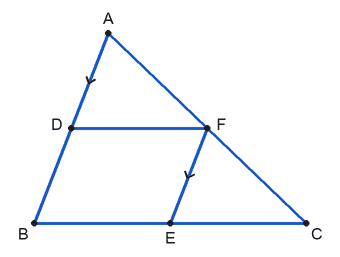
(i) Prove that BDFE is a parallelogram.
(ii) Find AB, if EF = 4·8 cm.
Confirming your payment
Sign up now and get 250 free tokens.
Mid-Point Theorem and Its Converse · Question 19 of 45
D and F are mid-points of sides AB and AC of a triangle ABC. A line through F and parallel to AB meets BC at point E.
(i) Prove that BDFE is a parallelogram.
(ii) Find AB, if EF = 4·8 cm.
Solution:
Concept: Mid-point theorem: the segment joining the mid-points of two sides of a triangle is parallel to the third side and equal to half of it. A quadrilateral is a parallelogram when both pairs of opposite sides are parallel, or when one pair of opposite sides is equal and parallel, or when its diagonals bisect each other.
Given: D, F are the mid-points of AB, AC, and FE ∥ AB meets BC at E.
Step 1 — Part (i): DF ∥ BE.
In ΔABC, D and F are the mid-points of AB and AC, so DF ∥ BC, that is DF ∥ BE.
Step 2 — Part (i): FE ∥ BD.
FE ∥ AB is given, that is FE ∥ BD. Both pairs of opposite sides of BDFE are parallel, so it is a parallelogram.
Step 3 — Part (ii).
Opposite sides of a parallelogram are equal, so BD equals EF, which is 4.8 cm. D is the mid-point of AB, so AB is twice BD.
Watch out: EF equals BD, which is HALF of AB; double it to get AB.
Therefore, (i) BDFE is a parallelogram and (ii) AB = 9·6 cm.