
Question 143 marksMedium
A parallelogram ABCD has P the mid-point of DC and Q a point of AC such that . PQ produced meets BC at R.
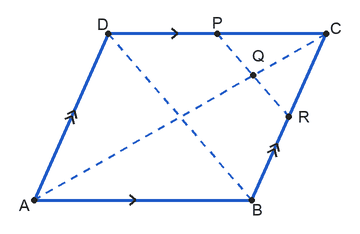
Prove that :
(i) R is the mid-point of BC,
(ii) .
Confirming your payment
Sign up now and get 250 free tokens.
Mid-Point Theorem and Its Converse · Question 14 of 45
A parallelogram ABCD has P the mid-point of DC and Q a point of AC such that . PQ produced meets BC at R.
Prove that :
(i) R is the mid-point of BC,
(ii) .
Solution:
Concept: Mid-point theorem: the segment joining the mid-points of two sides of a triangle is parallel to the third side and equal to half of it. Converse of the mid-point theorem: a line drawn through the mid-point of one side of a triangle, parallel to a second side, bisects the third side. The diagonals of a parallelogram bisect each other.
Given: ABCD is a parallelogram, P the mid-point of DC, Q on AC with , and PQ produced meets BC at R.
Step 1 — Locate Q.
Let the diagonals meet at O.
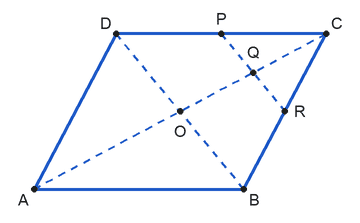
The diagonals of a parallelogram bisect each other, so OC is half of AC. CQ is a quarter of AC, which is half of OC, so Q is the mid-point of OC.
Step 2 — Part (i): PR ∥ DB.
In ΔCDO, P and Q are the mid-points of CD and CO, so PQ ∥ DO, that is PR ∥ DB.
Step 3 — Part (i): R is a mid-point.
In ΔCDB, P is the mid-point of CD and PR ∥ DB. By the converse of the mid-point theorem, R is the mid-point of BC.
Step 4 — Part (ii).
In ΔCDB, P and R are now both mid-points, so PR is half of the third side DB.
Watch out: ¼ of AC is HALF of OC; that is what makes Q a mid-point.
Therefore, (i) R is the mid-point of BC and (ii) . Hence proved.