
Opening your dashboard
Class 9 Maths Chapter 12 Mid-Point Theorem and Its Converse: Competency-Based Questions (CBQ)
40 questions on Chapter 12, each worked through on its own page with the AI tutor. Class 9 Maths, ICSE 2026-27.
40 questions
1–5 marks · Mixed difficulty
- 11 mark
Question 1
Competency: Application
The front of a hut is a triangular frame. Its base is 7.2 m long. A horizontal wooden beam joins the mid-points of the two sloping sides.
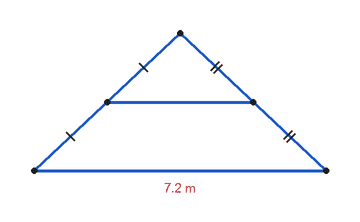
The length of the beam is
- 21 mark
Question 2
Competency: Application
A triangular plot ABC has AB = 10 m, AC = 14 m and BC = 16 m. A peg D is fixed at the mid-point of AB. A wire is stretched from D parallel to AC and it meets BC at E.
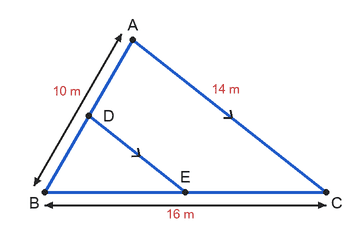
The length of fencing needed to enclose the small plot BDE is
- 31 mark
Question 3
Competency: Application
Three straight parallel roads are crossed by a lane. The lane is cut by the roads into two parts of 250 m each. A second street also crosses the three roads, and its length between the two outer roads is 640 m.
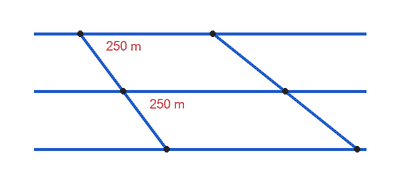
The part of the second street between the first road and the middle road is
- 41 mark
Question 4
Competency: Analysis
A field is in the shape of a kite. Its diagonals are 30 m and 16 m long and they cross at right angles. The mid-points of the four sides are joined in order to mark a flower bed.
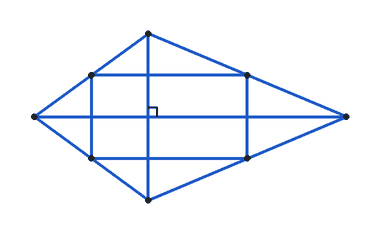
The flower bed is
- 51 mark
Question 5
Competency: Evaluation
Assertion (A): In ΔABC, D is a point on AB and E is a point on AC such that DE is half of BC. Then D and E must be the mid-points of AB and AC.
Reason (R): The line segment joining the mid-points of any two sides of a triangle is half of the third side.
- 61 mark
Question 6
Competency: Application
A park is in the shape of a right-angled triangle. Its longest side is 26 m. A lamp post stands at the mid-point of the longest side.
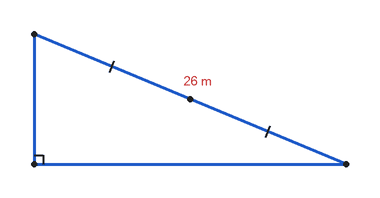
How far is the lamp post from the corner where the right angle is?
- 72 marks
Question 7
Competency: Application
Two trees B and C stand on opposite sides of a pond, so the distance BC cannot be measured directly. Meena stands at a point A from which she can walk straight to B and to C. She fixes pegs at D and E, the mid-points of AB and AC. She measures DE = 23.5 m.
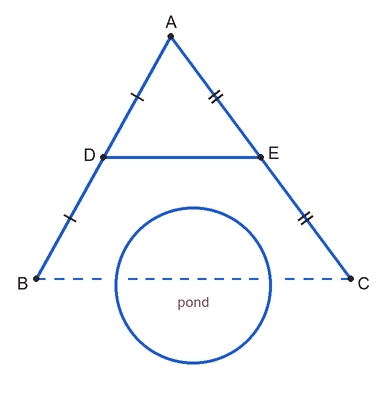
Find the distance BC between the trees. Name the result you use. What else does this result tell you about DE and BC?
- 82 marks
Question 8
Competency: Analysis
A wall unit has three parallel shelves: top, middle and bottom. A slanting rod crosses all three. The shelves cut it into two parts of 30 cm each. A second slanting rod also crosses the three shelves, and its part between the top and the middle shelf is 36 cm.
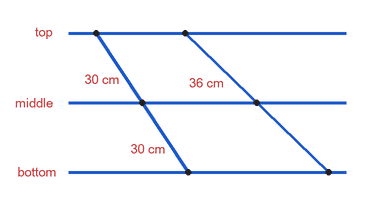
(a) Find the length of the second rod between the top and the bottom shelf.
(b) The top shelf is 50 cm above the bottom shelf. How far below the top shelf is the middle shelf? Give a reason.
- 92 marks
Question 9
Competency: Evaluation
The end wall of a shed is a triangle ABC with its base BC = 4.2 m on the ground. A mason cannot climb up to measure the sloping edge AC. He marks D, the mid-point of the edge AB. Then he fixes a string through D, parallel to BC, to meet AC at E.
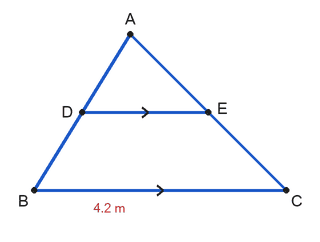
He says, "E is the mid-point of AC, and the string DE is 2.1 m long." Is he right on both counts? Justify.
- 102 marks
Question 10
Competency: Application
The mid-points of the three sides of a triangular plot are joined by ropes. The ropes form a small triangle with sides 4.5 m, 6 m and 7 m.

Find the sides of the plot and the length of wire needed to fence it once all round.
- 113 marks
Question 11
Competency: Analysis
A triangular park ABC has AB = 60 m and AC = 44 m. D, E and F are the mid-points of BC, CA and AB. Straight paths FD and DE are laid, and the part AFDE is kept as a lawn.
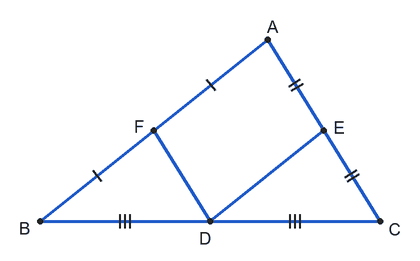
(a) Show that the lawn AFDE is a parallelogram.
(b) Find the length of the border of the lawn.
(c) Show that, for a park of this kind with any measurements, the border of the lawn AFDE is equal to AB + AC.
- 123 marks
Question 12
Competency: Creativity
Frame a word problem from daily life that is solved by the mid-point theorem and has the answer 45 m.
Your problem must describe a triangle, say clearly which points are mid-points, and ask for one length. Then write its solution.
- 133 marks
Question 13
Competency: Analysis & Evaluation
A plot ABCD has four straight sides, with AB = 80 m and DC = 50 m. AB is not parallel to DC. E is the mid-point of AD. A water pipe is laid from E, parallel to DC, to meet the diagonal AC at G. From G it turns and runs parallel to AB to meet BC at F.
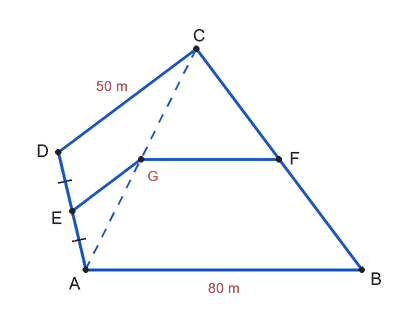
(a) Explain why G is the mid-point of AC.
(b) Find the total length of the pipe, EG + GF.
(c) The plumber says, "A straight pipe from E to F would need the same length." Is he right? Justify.
- 144 marks
Question 14
Competency: Application & Analysis
Case study — A roof truss
A steel roof truss is a triangle ABC with AB = AC = 6 m and BC = 9.6 m. To make it stronger, four rods are welded inside it, as shown. D and E are the mid-points of AB and AC. F and G are the mid-points of AD and AE. M is the mid-point of BC. The rods are DE, FG, DM and EM.
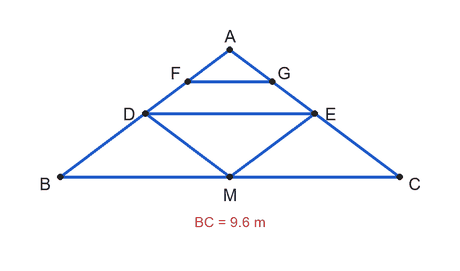
(a) Find the length of the rod DE. Give a reason.
(b) Find the length of the rod FG. Show that FG is parallel to BC.
(c) Find the lengths of the rods DM and EM. If steel rod costs ₹ 180 per metre, find the cost of the four rods.
- 155 marks
Question 15
Competency: Application & Analysis
Case study — Posts under a ramp
A straight ramp AB, 7.8 m long, rises from the ground at A to a platform at B. C is the point on the level ground directly below B, with AC = 7.2 m and BC = 3 m. Two vertical posts PR and QS hold up the ramp. Their feet P and Q divide AC into three equal parts of 2.4 m each.
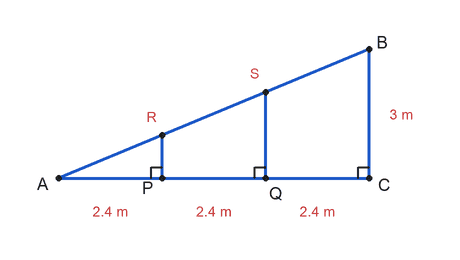
(a) The posts PR and QS and the edge BC are all vertical. Explain why R and S divide the ramp into three equal parts, and find the length of each part.
(b) Through R and S, imagine lines drawn parallel to the ground to meet BC. Use them to find the heights of the two posts.
(c) Suppose only one post is used, fixed at the mid-point of AC. Find its height, naming the results you use.
- 161 mark
Question 16
Competency: Application
A fence stands on level ground. It has 7 vertical pickets, equally spaced along the ground. The tops of the pickets lie on one straight sloping line. The first picket is 0.6 m tall and the seventh is 1.8 m tall. (Hypothetical data.)
The height of the fourth picket is :
- 171 mark
Question 17
Competency: Application & Analysis
A triangular flag ABC has a straight band DE stitched across it, where D and E are the mid-points of the sides AB and AC. The band makes with the side AB, and with the lower part EC of the side AC.
The angle of the flag at A is :
- 181 mark
Question 18
Competency: Analysis
In a triangular park ABC, only the side BC has been measured, and BC = 48 m. Lamps stand at D, E and F, the mid-points of AB, CA and BC. Straight wires are to be run between some of the lamps and from the corner A. (Hypothetical data.)
Without measuring anything else, the length of which wire can be found?
- 191 mark
Question 19
Competency: Evaluation
In the plan of a triangular plot ABC, D is the mid-point of AB and E is a point on AC. A surveyor ties a string from D to E and wants to be sure that E is the mid-point of AC.
Which ONE extra fact about the string DE is enough to be sure ?
- 201 mark
Question 20
Competency: Analysis & Evaluation
Assertion (A) : In triangle ABC, if D and E are the mid-points of AB and AC, then the quadrilateral BDEC is a trapezium.
Reason (R) : In triangle ABC, if D and E are the mid-points of AB and AC, then DE is half of BC.
- 211 mark
Question 21
Competency: Analysis
ABCD is a parallelogram with AB = 14 cm and BC = 10 cm. Its diagonals meet at O. P, Q, R and S are the mid-points of OA, OB, OC and OD, and the quadrilateral PQRS is drawn as shown.
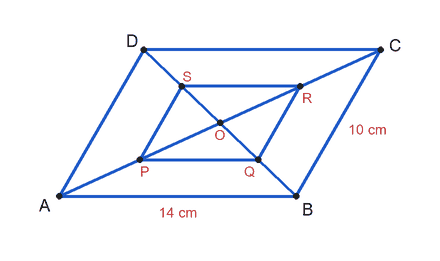
The perimeter of PQRS is :
- 221 mark
Question 22
Competency: Analysis
In triangle ABC, AB = 10 cm and AC = 14 cm. D and E are the mid-points of AB and AC.
The length of DE can be any value between :
- 231 mark
Question 23
Competency: Evaluation
Assertion (A) : Three parallel canals cut a straight road into parts of 40 m and 60 m. Then no other straight road crossing the same three canals can be cut by them into two equal parts.
Reason (R) : Whenever the canals divide one road into two equal parts, every other road that crosses them is also divided into two equal parts.
- 241 mark
Question 24
Competency: Analysis
In the figure, D, E and F are the mid-points of the sides AB, BC and CA of triangle ABC, and the segments DE, EF and FD are drawn.

Using only the points A, B, C, D, E, F as corners and the drawn lines as sides, the number of parallelograms in the figure is :
- 251 mark
Question 25
Competency: Analysis
Four students each drew a triangle ABC. Each student marked a point D on AB and a point E on AC, joined DE, and measured the four lengths below. Take the readings as exact. (Hypothetical data.)
Student AD (cm) DB (cm) AE (cm) EC (cm) 1 4.0 4.0 5.0 5.4 2 4.2 4.2 5.3 5.3 3 3.6 4.4 5.1 5.1 4 3.8 4.2 4.8 5.2 The mid-point theorem shows for certain that DE is half of BC in the drawing of :
- 262 marks
Question 26
Competency: Analysis
For a school rangoli, Meera draws a large triangle ABC on the floor. She marks D, E and F, the mid-points of AB, BC and CA, and draws DE, EF and FD. Then she outlines three parallelograms with ribbon: ADEF with 136 cm of red ribbon, BDFE with 160 cm of green ribbon and CEDF with 168 cm of yellow ribbon. (Hypothetical data.)
Find the three sides of the triangle ABC.
- 272 marks
Question 27
Competency: Evaluation
In a triangular plot ABC, AB = 18 m and AC = 24 m. D and E are the mid-points of AB and BC. Ishaan says, "DE is parallel to AB and DE = AB = 9 m."
Is Ishaan right? Give the correct statement about DE and find the length of DE.
- 282 marks
Question 28
Competency: Application
At night, a garden lamp L is fixed at the top of a vertical post OL that stands on level ground, with its foot at O. Riya is 1.5 m tall. She stands upright at M on the ground, 2 m from O. The tip of her shadow is at T, on the ground 4 m from O, on the same side as M. The light ray from L passes the top R of her head and reaches the ground at T, and this ray LT is 5 m long. (Hypothetical data.)
(a) Show that R is the mid-point of LT, and find the height of the lamp OL.
(b) Find RT, the distance from the top of Riya's head to the tip of her shadow.
- 292 marks
Question 29
Competency: Analysis
In triangle ABC, AB = 9 cm, BC = 12 cm and AC = 15 cm. D, E and F are the mid-points of AB, BC and CA.
(a) Find the three sides of triangle DEF.
(b) Show that triangle DEF is right-angled and find its area.
- 302 marks
Question 30
Competency: Analysis & Evaluation
The Equal Intercept Theorem starts with parallel lines: if three parallel lines make equal intercepts on one transversal, they make equal intercepts on every transversal. Asha asks about the converse: if three lines make equal intercepts on two different transversals, must the three lines be parallel?
Take a triangle OAC with B the mid-point of AC, and the three lines OA, OB and OC. Let D and F be the mid-points of OA and OC, and let DF meet OB at E. Show that DE = EF, and use this construction to answer Asha's question.
- 312 marks
Question 31
Competency: Application
In a drawing of a triangle ABC, D is the mid-point of AB, and the line through D parallel to BC meets AC at E. The lengths on the drawing are AE = cm, EC = cm and DE = cm.
Find , and then find the lengths of AC and BC.
- 323 marks
Question 32
Competency: Analysis & Evaluation
A triangular farm ABC has AB = 100 m, BC = 120 m and CA = 80 m. D, E and F are the mid-points of AB, BC and CA. The owner wants one straight fence from one mid-point to another, to cut off a corner of the farm. There are three plans: Plan 1 is the fence DF, Plan 2 is the fence DE and Plan 3 is the fence EF. Fencing costs ₹ 180 per metre. (Hypothetical data.)
(a) Without working out any fence length, explain which plan needs the shortest fence.
(b) Find the cost of the cheapest plan, and how much more the dearest plan costs.
(c) Which corner of the farm does the cheapest plan cut off? Find the three sides of the piece it cuts off.
- 333 marks
Question 33
Competency: Application & Analysis
An A-shaped signboard stand ABC stands on level ground, as shown. Its legs are AB = AC = 2.6 m and the distance between the feet is BC = 2.0 m. M is the mid-point of BC, and AM is vertical. A crossbar DE joins D and E, the mid-points of AB and AC, and meets AM at N.
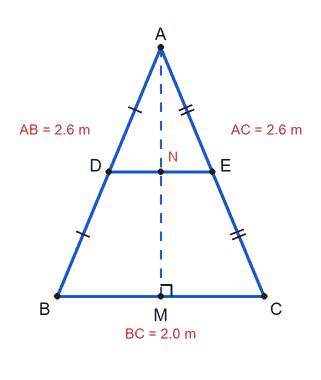
(a) Explain why the crossbar DE is horizontal.
(b) Find the height of AM, and then the height of the crossbar above the ground.
- 343 marks
Question 34
Competency: Analysis
A farmer's field ABCD is a trapezium with AB parallel to DC, AB = 40 m, DC = 70 m, AD = 36 m and BC = 45 m. Two straight fences PQ and RS are put up parallel to AB, with P and R on AD and Q and S on BC, so that AP = PR = RD = 12 m. (Hypothetical data.)
(a) Explain why the fences cut BC into three equal parts, and find the length of each part.
(b) Use the result for the segment joining the mid-points of the non-parallel sides of a trapezium to write two equations connecting the fence lengths PQ and RS.
(c) Solve the equations to find PQ and RS.
- 353 marks
Question 35
Competency: Understanding & Analysis
A triangular sheet of paper ABC has AB = 13 cm, BC = 14 cm and CA = 15 cm. P is the point on BC such that AP is perpendicular to BC, and AP = 12 cm. The sheet is folded so that the corner A falls exactly on P. When a point is folded onto another point, the fold line is the perpendicular bisector of the segment joining the two points. The fold line meets AB at D and AC at E.
(a) Explain why the fold line DE is parallel to BC.
(b) Show that D and E are the mid-points of AB and AC.
(c) Find the length of the fold DE and its height above BC.
- 363 marks
Question 36
Competency: Application & Analysis
An old triangular floor tile ABC has been lost, but three marks D, E and F are left on the floor where the mid-points of its sides BC, CA and AB were. The marks form a triangle with DE = 30 cm, EF = 40 cm and FD = 25 cm. To redraw the tile, a mason draws a line through D parallel to EF, a line through E parallel to FD and a line through F parallel to DE. (Hypothetical data.)
(a) The line through D meets the line through F at B and the line through E at C. Show that BDEF and CDFE are parallelograms.
(b) Hence show that D is the mid-point of BC.
(c) Find the length of BC, and explain why no other triangle can have D, E and F as the mid-points of its sides.
- 375 marks
Question 37
Competency: Analysis & Evaluation
Case study: Class 9 students checked the mid-point theorem on paper. Each group drew a triangle ABC, marked D, the mid-point of AB, and E, the mid-point of AC, and measured BC and DE with a ruler, to the nearest 0.1 cm. (Hypothetical data.)
Group BC (cm) DE (cm) A 9.0 4.5 B 12.4 6.3 C 15.2 7.5 D 7.6 3.8 E 10.0 6.8 (a) By the mid-point theorem, what length should DE have in each of the groups A to D? Find how much each measured value differs from it.
(b) Group E's reading differs much more from the expected value. Find the expected DE for Group E and say what the group should check.
(c) Group F finds that DE is exactly half of BC, but a set square shows that DE is not parallel to BC. What can you conclude about D and E? Give a reason.
- 385 marks
Question 38
Competency: Analysis & Evaluation
Case study: A park ABC is a right-angled triangle with the right angle at B, AB = 15 m and BC = 20 m. A fountain is at F, the mid-point of the longest side AC. Lamp posts are at D, the mid-point of AB, and E, the mid-point of BC. The paths DF and FE are laid, as shown, and the dashed lines BF and DE show two cables that are planned.
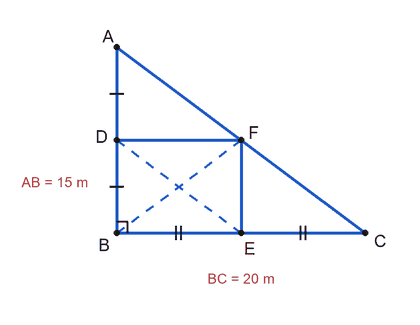
(a) Find the lengths AC, DF and FE.
(b) Show that BDFE is a rectangle and find its perimeter.
(c) Ravi says that the two cables BF and DE are of the same length. Is he right? Give two different reasons.
- 394 marks
Question 39
Competency: Creativity & Analysis
Case study: A craftsperson wants to make a triangular brass frame ABC, and to weld a smaller triangle DEF inside it, where D, E and F are the mid-points of the sides. The smaller triangle DEF must have a perimeter of 36 cm.
(a) Find the perimeter of the frame ABC.
(b) Design the frame: give the three side lengths of one triangle ABC, in whole centimetres and with no two sides equal, that meets the condition. Show that your triangle works.
(c) The craftsperson says, "No side of the frame can be 36 cm or longer." Is this correct? Give a reason.
- 405 marks
Question 40
Competency: Application & Analysis
Case study: A triangular quilt ABC has AB = 60 cm, CA = 80 cm and BC = 100 cm, with a right angle at A. D, E and F are the mid-points of BC, CA and AB. The segments DE, EF and FD are sewn, so the quilt is made of four pieces: AFE, BDF, CED and the middle piece DEF, as shown. Edging tape costs ₹ 4 per centimetre. (Hypothetical data.)
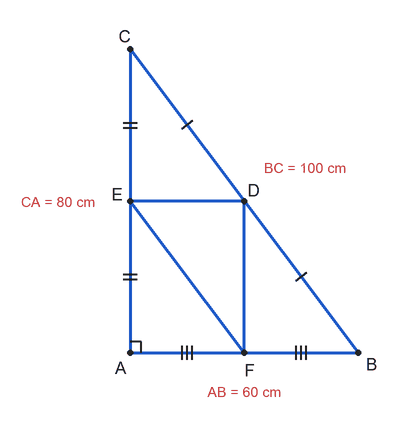
(a) Find the sides of each of the four pieces, and show that the four pieces are congruent.
(b) Make a table with one row for each piece, showing its three sides, its perimeter and the cost of edging all its sides.
(c) Suppose each piece is edged separately along all its sides. If instead the tape runs once along the outer border of the quilt and once along each sewn segment, how much money is saved?