
Question 155 marksHard
Competency: Application & Analysis
Case study — Posts under a ramp
A straight ramp AB, 7.8 m long, rises from the ground at A to a platform at B. C is the point on the level ground directly below B, with AC = 7.2 m and BC = 3 m. Two vertical posts PR and QS hold up the ramp. Their feet P and Q divide AC into three equal parts of 2.4 m each.
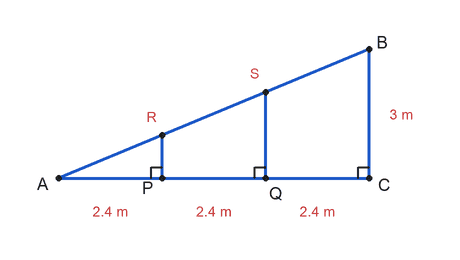
(a) The posts PR and QS and the edge BC are all vertical. Explain why R and S divide the ramp into three equal parts, and find the length of each part.
(b) Through R and S, imagine lines drawn parallel to the ground to meet BC. Use them to find the heights of the two posts.
(c) Suppose only one post is used, fixed at the mid-point of AC. Find its height, naming the results you use.