
Question 123 marksMedium
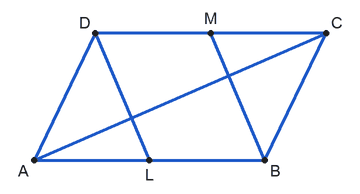
L and M are the mid-points of sides AB and DC respectively of parallelogram ABCD. Prove that segments DL and BM trisect diagonal AC.
Confirming your payment
Sign up now and get 250 free tokens.
Mid-Point Theorem and Its Converse · Question 12 of 45
L and M are the mid-points of sides AB and DC respectively of parallelogram ABCD. Prove that segments DL and BM trisect diagonal AC.
Solution:
Concept: Converse of the mid-point theorem: a line drawn through the mid-point of one side of a triangle, parallel to a second side, bisects the third side. A quadrilateral is a parallelogram when both pairs of opposite sides are parallel, or when one pair of opposite sides is equal and parallel, or when its diagonals bisect each other.
Given: ABCD is a parallelogram; L and M are the mid-points of AB and DC.
Step 1 — DLBM is a parallelogram.
DM is half of DC and LB is half of AB. AB = DC (parallelogram), so DM = LB. Also DM ∥ LB (they lie on DC and AB). One pair of opposite sides equal and parallel makes DLBM a parallelogram, so DL ∥ MB.
Step 2 — Name the points on AC.
Let DL meet AC at X and BM meet AC at Y.

Step 3 — ΔDCX.
M is the mid-point of DC and MY ∥ DX (as MB ∥ DL). By the converse of the mid-point theorem, Y is the mid-point of CX, so CY = YX.
Step 4 — ΔABY.
L is the mid-point of AB and LX ∥ BY (as DL ∥ BM). By the converse, X is the mid-point of AY, so AX = XY.
Step 5 — Conclude.
AX equals XY, and XY equals YC, so the three parts of AC are equal.
Watch out: The parallel lines DL and BM come from the parallelogram DLBM, so prove that first.
Therefore, AX, XY and YC are equal, so DL and BM trisect the diagonal AC. Hence proved.