
Question 73 marksEasy
Prove that the figure obtained by joining the mid-points of the adjacent sides of a rectangle is a rhombus.

Confirming your payment
Sign up now and get 250 free tokens.
Mid-Point Theorem and Its Converse · Question 7 of 45
Prove that the figure obtained by joining the mid-points of the adjacent sides of a rectangle is a rhombus.
Solution:
Concept: Mid-point theorem: the segment joining the mid-points of two sides of a triangle is parallel to the third side and equal to half of it. The diagonals of a rectangle are equal.
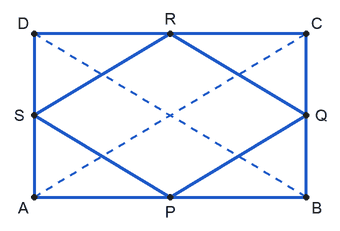
Given: ABCD is a rectangle; P, Q, R, S are the mid-points of AB, BC, CD, DA.
Step 1 — Set up.
Let ABCD be a rectangle and P, Q, R, S the mid-points of AB, BC, CD, DA. Join the diagonals AC and BD.
Step 2 — Sides PQ and SR.
In ΔABC, P and Q are mid-points, so PQ is half of AC.
In ΔADC, S and R are mid-points, so SR is half of AC.
Step 3 — Sides PS and QR.
In ΔABD, P and S are mid-points, so PS is half of BD.
In ΔBCD, Q and R are mid-points, so QR is half of BD.
Step 4 — Use the equal diagonals.
The diagonals of a rectangle are equal, AC = BD, so their halves are equal and PQ, QR, RS and SP are all equal. A quadrilateral with four equal sides is a rhombus.
Watch out: The joining segment is half of the THIRD side, the side it is parallel to, not of either side it joins.
Therefore, PQRS has four equal sides, so it is a rhombus. Hence proved.