
Opening your dashboard
Class 9 Maths Chapter 12 Mid-Point Theorem and Its Converse: Practice Questions
40 questions on Chapter 12, each worked through on its own page with the AI tutor. Class 9 Maths, ICSE 2026-27.
40 questions
1–5 marks · Mixed difficulty
- 11 mark
Question 1
Bloom's level: Remember
The line segment joining the mid-points of any two sides of a triangle is :
- 21 mark
Question 2
Bloom's level: Remember
A line is drawn through the mid-point of one side of a triangle, parallel to a second side. This line :
- 31 mark
Question 3
Bloom's level: Remember
Three parallel lines make equal intercepts on one transversal. The intercepts they make on any other transversal are :
- 41 mark
Question 4
Bloom's level: Understand
D and E are the mid-points of sides AB and AC of ΔABC.
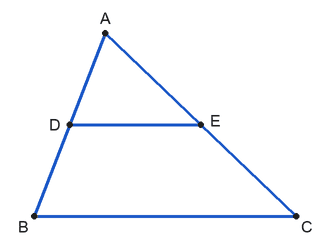
Which of the following is not necessarily true?
- 51 mark
Question 5
Bloom's level: Understand
In ΔPQR, M is the mid-point of PQ. A line through M parallel to QR meets PR at N.

Then :
- 61 mark
Question 6
Bloom's level: Apply
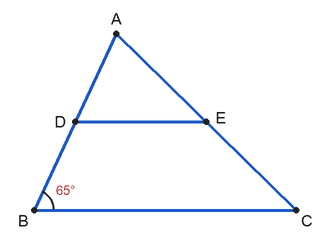
D and E are the mid-points of sides AB and AC of ΔABC. If ∠ABC = 65°, then ∠ADE is :
- 71 mark
Question 7
Bloom's level: Apply
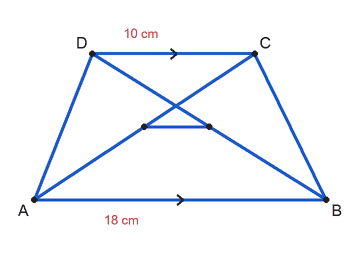
In trapezium ABCD, AB ∥ DC, AB = 18 cm and DC = 10 cm. The length of the segment joining the mid-points of the diagonals AC and BD is :
- 81 mark
Question 8
Bloom's level: Apply
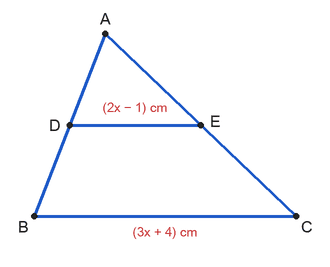
D and E are the mid-points of sides AB and AC of ΔABC. If DE = cm and BC = cm, then is :
- 91 mark
Question 9
Bloom's level: Analyse
D, E and F are the mid-points of sides BC, CA and AB of ΔABC. The segments DE, EF and FD divide ΔABC into four triangles.
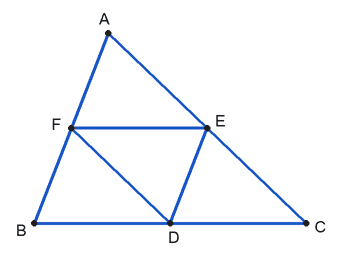
Which statement is true?
- 101 mark
Question 10
Bloom's level: Understand
Assertion (A) : In ΔABC, D and E are the mid-points of AB and AC. If BC = 10 cm, then DE = 5 cm.
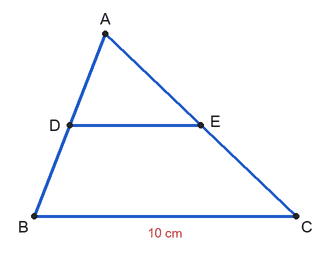
Reason (R) : The line segment joining the mid-points of any two sides of a triangle is parallel to the third side and equal to half of it.
- 111 mark
Question 11
Bloom's level: Analyse
Assertion (A) : In ΔABC, D is the mid-point of AB and the line through D parallel to BC meets AC at E. Then E is the mid-point of AC.
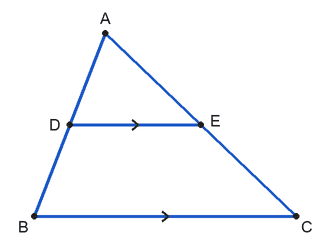
Reason (R) : The diagonals of a parallelogram bisect each other.
- 121 mark
Question 12
Bloom's level: Evaluate
Assertion (A) : Three parallel lines make intercepts of 2 cm and 3 cm on one transversal. Then they make equal intercepts on every other transversal.
Reason (R) : If three or more parallel lines make equal intercepts on one transversal, they make equal intercepts on every other transversal.
- 131 mark
Question 13
Bloom's level: Remember
State the Equal Intercept Theorem.
- 141 mark
Question 14
Bloom's level: Understand
State what is given and what is proved in (a) the Mid-Point Theorem and (b) its converse.
- 152 marks
Question 15
Bloom's level: Apply
In ΔABC, AB = 9 cm, BC = 11 cm and CA = 7 cm. D, E and F are the mid-points of AB, BC and CA respectively.

Find DE, EF and FD.
- 162 marks
Question 16
Bloom's level: Apply
Lines , and are parallel. A transversal cuts them at A, B and C with AB = BC. Another transversal cuts them at D, E and F, with DE = cm and EF = cm.
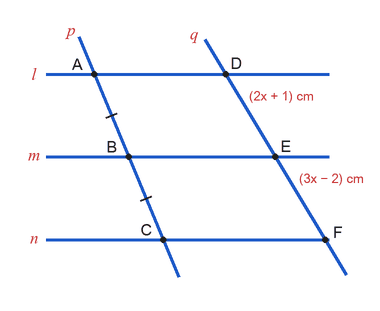
Find and DF.
- 172 marks
Question 17
Bloom's level: Understand
D and E are the mid-points of sides AB and AC of ΔABC.
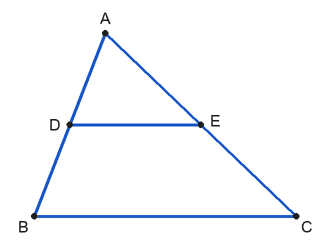
Explain why the quadrilateral DBCE is a trapezium and not a parallelogram.
- 182 marks
Question 18
Bloom's level: Understand
A ladder has parallel rungs that are equally spaced along each of its two side rails. A rope is stretched in a straight line from the bottom rung to the top rung, slanting across the ladder.
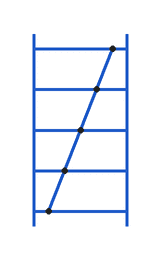
Explain why the rungs cut the rope into equal pieces.
- 192 marks
Question 19
Bloom's level: Apply
The diagonals of parallelogram ABCD meet at O. A line through O parallel to AB meets BC at P.

Prove that P is the mid-point of BC. If AB = 9 cm, find OP.
- 202 marks
Question 20
Bloom's level: Analyse
D, E and F are the mid-points of the sides BC, CA and AB of ΔABC.
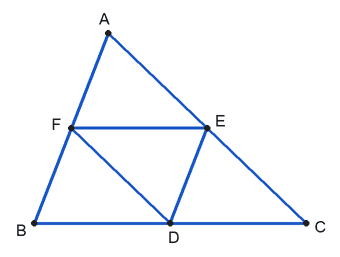
Prove that the perimeter of ΔDEF is half the perimeter of ΔABC.
- 212 marks
Question 21
Bloom's level: Evaluate
Rahul says, “In ΔABC, D is on AB and E is on AC with DE ∥ BC. So D and E must be the mid-points of AB and AC.” Is he right? Explain.
- 222 marks
Question 22
Bloom's level: Apply
A page has equally spaced parallel ruled lines. A straight stick is laid on the page so that its two ends lie on the 1st and the 5th ruled lines. The stick is 18 cm long.
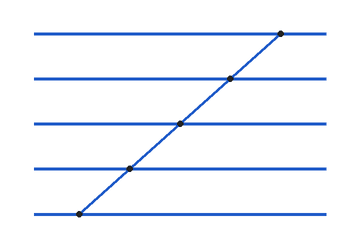
Find the length of the stick between two consecutive ruled lines, giving the theorem used.
- 234 marks
Question 23
Bloom's level: Analyse
In ΔABC, ∠ABC = 90° and M is the mid-point of the hypotenuse AC. N is the mid-point of BC.
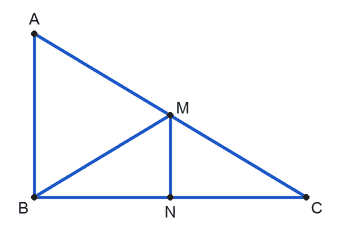
(a) Prove that MN ∥ AB and hence that MN ⊥ BC.
(b) Prove that ΔMNB ≅ ΔMNC.
(c) Hence prove that MB = ½ AC.
- 243 marks
Question 24
Bloom's level: Understand
D is the mid-point of side AB of ΔABC. A line through D parallel to BC meets AC at E, and a line through D parallel to AC meets BC at F. BC = 10 cm and AC = 8 cm.
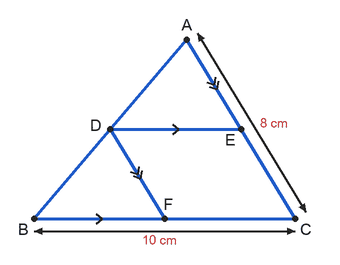
(a) Where do E and F lie? Give the reason.
(b) Find DE and DF.
(c) Name the quadrilateral DECF and find its perimeter.
- 254 marks
Question 25
Bloom's level: Apply
In the figure, ABCD is a quadrilateral whose diagonals are AC = 12 cm and BD = 9 cm. P, Q, R and S are the mid-points of AB, BC, CD and DA.

(a) Find PQ, QR, RS and SP.
(b) Prove that PQRS is a parallelogram.
(c) Show that the perimeter of PQRS is equal to AC + BD, and find it.
- 264 marks
Question 26
Bloom's level: Analyse
In the figure, , and are parallel lines. A transversal cuts them at A, B and C, with AB = BC. Another transversal cuts them at D, E and F. AF is joined and meets at G.
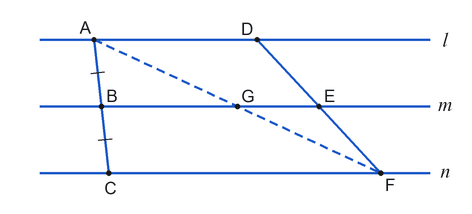
(a) Using ΔACF, prove that G is the mid-point of AF.
(b) Using ΔAFD, prove that DE = EF.
(c) If AD = 6 cm and CF = 10 cm, find BG, GE and BE.
- 275 marks
Question 27
Bloom's level: Apply
Case study: A triangular garden ABC has sides AB = 30 m, AC = 26 m and BC = 40 m. The gardener fixes stakes at D, the mid-point of AB, and E, the mid-point of AC, and puts up a straight fence DE. Later he adds a second fence from E to F, the mid-point of BC.
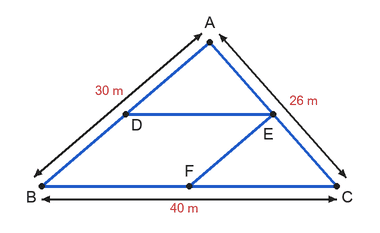
(a) Find the length of fence DE, and explain why it runs parallel to the side BC.
(b) Find the perimeter of the small triangular bed ADE.
(c) Find the total length of the fences DE and EF, and their cost at ₹150 per metre.
- 285 marks
Question 28
Bloom's level: Evaluate
Case study: Rohan wants to divide a 10 cm strip of paper into 5 equal parts without using a ruler. He uses a notebook page with equally spaced parallel lines and lays the strip slanting across the page so that one end is on line 1 and the other end on line 6. He marks the strip where it crosses each line.
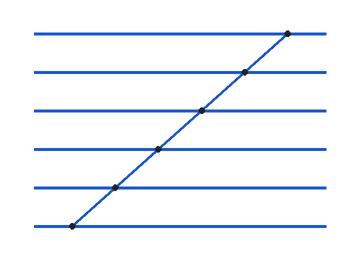
(a) Which theorem guarantees that his marks divide the strip into equal parts? Explain.
(b) How long is each part?
(c) His friend Meena lays the same strip with its ends on line 1 and line 5 and says, “Now it is also divided into 5 equal parts.” Evaluate her claim.
- 294 marks
Question 29
Bloom's level: Create
Without measuring fractions of a centimetre, design a construction to divide a line segment AB = 7 cm into three equal parts using only a ruler, compasses and set squares.
(a) Write the steps of your construction.
(b) Use the Equal Intercept Theorem to justify that the three parts are equal.
(c) What is the length of each part?
- 304 marks
Question 30
Bloom's level: Create
Start with a triangle T₁ whose sides are 12 cm, 16 cm and 20 cm. Join the mid-points of its sides to get triangle T₂; join the mid-points of the sides of T₂ to get T₃, and so on.
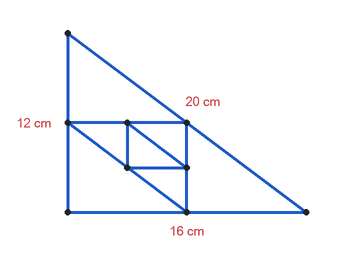
(a) Find the perimeters of T₁, T₂ and T₃.
(b) Write a general rule for the perimeter of each new triangle, and justify it with the Mid-Point Theorem.
(c) Plan how many times the mid-points must be joined (starting from T₁) until the perimeter first becomes less than 5 cm.
- 311 mark
Question 31
In , and are the mid-points of and . is a point on , and meets at .
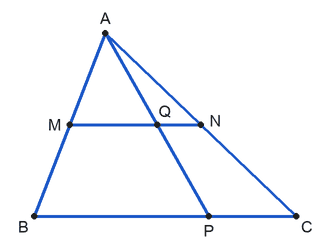
If cm, then is :
- 321 mark
Question 32
In trapezium , and . and are the mid-points of the non-parallel sides and , and cm.

The length of is :
- 331 mark
Question 33
Four parallel lines are cut by a transversal at , , , in that order, so that . Another transversal cuts the same lines at , , , in that order, and cm.
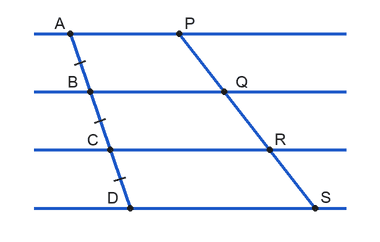
Then is :
- 342 marks
Question 34
, and are the mid-points of the sides , and of , in which and .

(i) Find .
(ii) Find and .
- 353 marks
Question 35
In , is the mid-point of . A line through parallel to meets at .
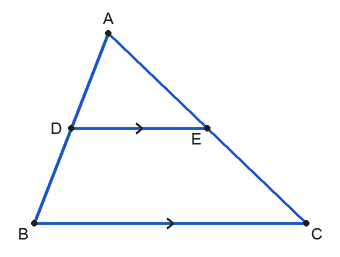
Prove that is the mid-point of .
Hint : through draw to meet produced at .
- 362 marks
Question 36
In trapezium , . is the mid-point of , and a line through parallel to meets at .
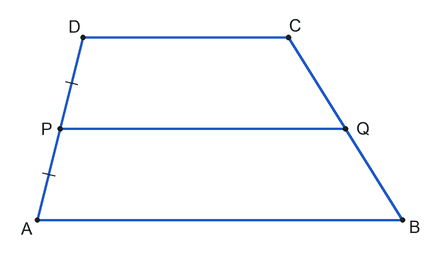
(i) Name three parallel lines and two transversals in this figure.
(ii) Prove that is the mid-point of .
- 372 marks
Question 37
In , is a median. and are the mid-points of and respectively.
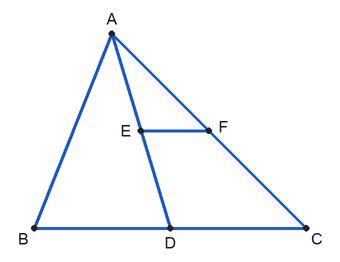
(i) Prove that .
(ii) Find , if cm.
- 384 marks
Question 38
In the figure, and are the mid-points of and of . is the mid-point of , and produced meets at .

(i) Prove that is the mid-point of .
(ii) Prove that and .
(iii) Hence prove that is the mid-point of .
- 394 marks
Question 39
In , . and are the mid-points of and respectively.
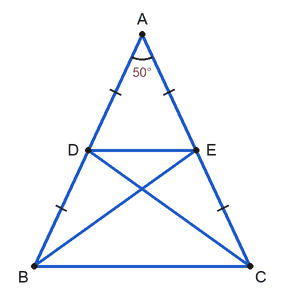
(i) Prove that and .
(ii) Prove that .
(iii) If , find .
- 404 marks
Question 40
In the figure, is a trapezium with , cm and cm. and are the mid-points of and , and cuts the diagonals and at and respectively.
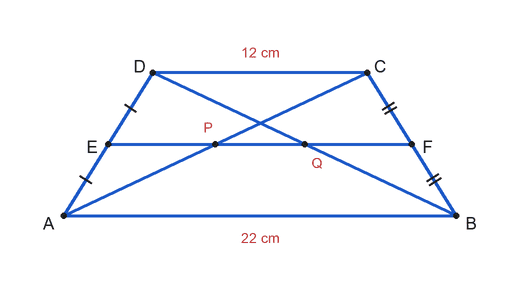
(i) Prove that is the mid-point of and is the mid-point of .
(ii) Find and .
(iii) Find .