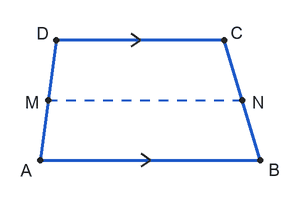
Solution:
Concept: In a trapezium, the segment joining the mid-points of the two non-parallel sides is parallel to the parallel sides and equal to half their sum.
Given: ABCD is a trapezium with AB ∥ DC; M and N are the mid-points of AD and BC.
Step 1 — The rule.
From the result of Q5, MN is half the sum of the parallel sides.
MN=21(AB+DC)
Step 2 — Part (i).
Put AB = 11 cm and DC = 8 cm.
MN=21(11+8)=219=9.5 cm
Step 3 — Part (ii).
Put MN = 27 cm and DC = 20 cm, and solve for AB (written x).
2754x=21(x+20)=x+20=34
Step 4 — Part (iii).
Put MN = 15 cm and AB = 23 cm, and solve for DC (written x).
1530x=21(23+x)=23+x=7
Watch out: Multiply both sides by 2 first; that clears the ½ before you subtract.
Therefore, (i) MN = 9·5 cm, (ii) AB = 34 cm and (iii) DC = 7 cm.